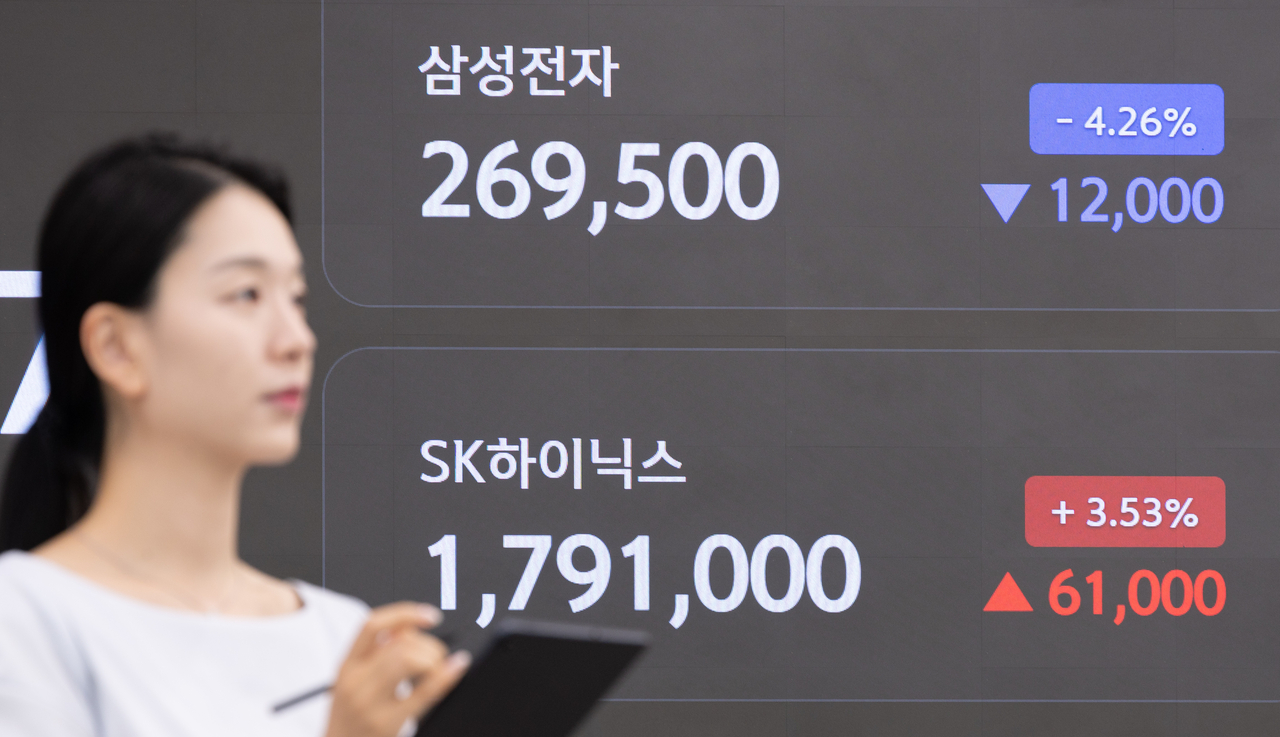
Samsung Electronics shares tumbled more than 6 percent in early trading Monday, even after the company unveiled a record shareholder return plan of up to 110 trillion won ($79 billion) on Friday.
According to Korea Exchange, Samsung Electronics was trading down 6.22 percent at 264,000 won as of 9:20 a.m. on the main Kospi market. The stock opened 3.55 percent lower at 271,500 won before extending its losses.
SK Hynix, by contrast, was up 0.92 percent at 1.75 million won at the same time. The chipmaker opened 2.60 percent higher at 1.77 million won and surged as high as 1.79 million won, a gain of 3.58 percent, before trimming its advance.
Samsung Electronics' board approved the shareholder return plan on Friday, setting a range of 90 trillion won to 110 trillion won — the largest such commitment by any domestic company in history and more than five times the previous annual maximum.
As an initial step, the company plans to pay out roughly 30 trillion won in cash dividends, including regular quarterly dividends for the third quarter of this year. Further details are to be finalized at a board meeting in late October.
Analysts say the sell-off reflects a gap between market expectations and the actual announcement. Many investors had anticipated an immediate, concrete decision from the board, and when the plan fell short of those hopes, sell-on-news pressure emerged, pushing the share price lower.
However, experts broadly expect the volatility to be short-lived. Hot Chips 2026, a major global semiconductor industry conference, opened overnight in the United States, and Nvidia is scheduled to report its earnings on Thursday — events that could quickly redirect market attention.
"Even if semiconductor share price volatility rises after Monday's market open, it is unlikely to last long — so it is appropriate to focus on responding to key external events," said Jung Yoon-hee, a researcher at Kiwoom Securities.
As of the same time, foreign and institutional investors were net sellers of 710.3 billion won and 284.4 billion won, respectively, on the Kospi, while retail investors were net buyers of 888.7 billion won.
In the Kospi's electrical and electronics sector, which includes both Samsung Electronics and SK Hynix, foreign and institutional investors posted net selling of 704.9 billion won and 268.9 billion won, respectively, while retail investors recorded net buying of 875.3 billion won.

yuni@heraldcorp.com