One officer falsified records in two missing-person cases
National Investigation chief apologizes to public
Case lays bare gaps in initial response to adult disappearances
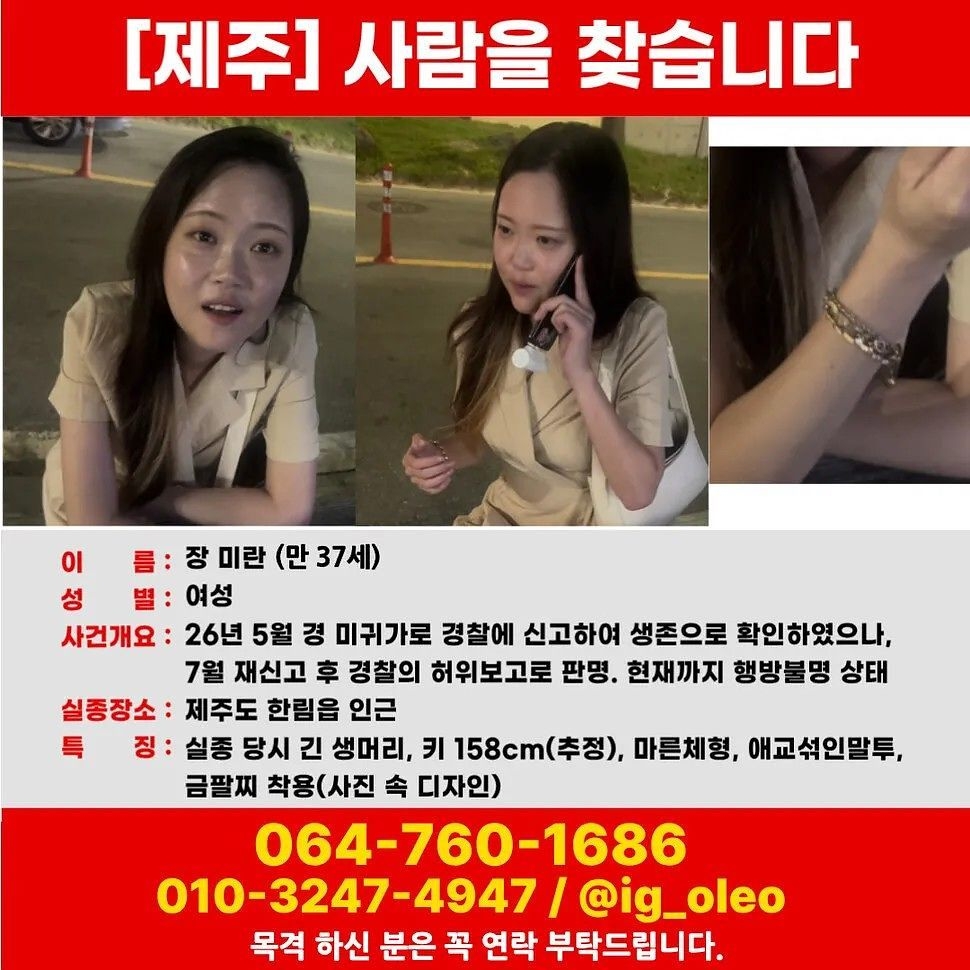
The fallout from the disappearance of Jang Mi-ran, 37, on Jeju Island continues to grow. A police officer has been found to have not only unilaterally closed Jang's case and deleted her records from the police missing-persons management system, but also to have falsified the case of a second missing person in the same manner. The incident — in which a single officer manipulated two separate cases — has reignited criticism of the police's lax initial response to adult disappearances. Distrust is mounting that police treat such cases too lightly, partly because nearly 99 percent of missing adults are eventually found safe.
According to police Monday, Officer A, a senior constable attached to the Jeju Western Police Station who handled Jang's case, closed it just two and a half hours after the first report was filed on May 15. Officer A falsely reported to superiors that contact had been made with Jang, and told her family she did not want her whereabouts disclosed. Jang's phone records, however, showed no evidence of any contact with Officer A. The officer was also found to have had Jang's case deleted from the police's electronic missing-persons management system.
Officer A is also suspected of fraudulently closing the case of a man in his 60s, identified only as B, in the same manner. B was found dead Saturday. His family had first reported him missing to police on July 2, and visited the police station again on July 27 and Aug. 6. Police launched no search, and B was ultimately found dead.
A single officer had effectively been able to mark two missing-persons cases as resolved on his own. Police placed Officer A under emergency arrest on charges of dereliction of duty and forgery and use of electronic public records, and said they would revise the system to prevent individual officers from closing missing-persons cases at their own discretion.
Hong Seok-gi, head of the Korean National Police Agency's National Investigation Headquarters, visited the Jeju Provincial Police Agency on Sunday and said he was "deeply sorry to the public," pledging to "make institutional improvements to ensure this never happens again." The agency said it would reform procedures to require supervisory approval before a missing-persons case can be closed. Currently, the officer in charge can close a case in the system unilaterally.
Hong also told officers at the scene that a nationwide audit was underway to check for other fraudulently closed missing-persons cases, and urged Jeju police to conduct a thorough review. "Each missing-persons case is directly tied to the life and safety of a member of the public," he said, "so investigations must proceed more accurately and swiftly."
Even as police belatedly launched a nationwide audit, calls are growing for urgent reform of the inadequate initial response to adult disappearances — a problem that, unlike with children, has long gone unaddressed. According to Korean National Police Agency statistics, an average of more than 1,400 missing adults were found dead each year between 2016 and last year. While more than 70,000 adult missing-persons reports are filed annually — most involving voluntary disappearances or runaways — critics have long said the system for identifying those in genuine danger remains inadequate. The pattern is widely attributed to the fact that the vast majority of missing adults are found safe, leading police to treat such cases as routine. In 2024, 71,703 of 71,854 missing adults were located; in 2023, 74,827 of 74,847 were found.
Unlike children, people with dementia, or those with mental disabilities, adults who go missing are generally presumed to have left voluntarily, meaning search protocols are not automatically activated. Bills aimed at closing this legal gap in the search for missing adults have been introduced in the National Assembly multiple times, but have repeatedly failed to pass.
Lee Yun-ho, a professor in the department of police administration at Dongguk University, said of the fraudulent case closures in Jeju that "even if this was the misconduct of an individual officer, the system currently in place is not capable of filtering it out." Lee added that "leaving a matter of life and death to the judgment of a single officer is an excessive grant of discretion," and called for "institutional safeguards to monitor and supervise the exercise of that discretion."
Lee Ung-hyeok, a professor in the department of police studies at Konkuk University, said police needed legal backing to respond swiftly even in adult missing-persons cases. "Police must be able to mount an initial response with the possibility of criminal involvement kept open," he said.
arin@heraldcorp.com
kido@heraldcorp.com