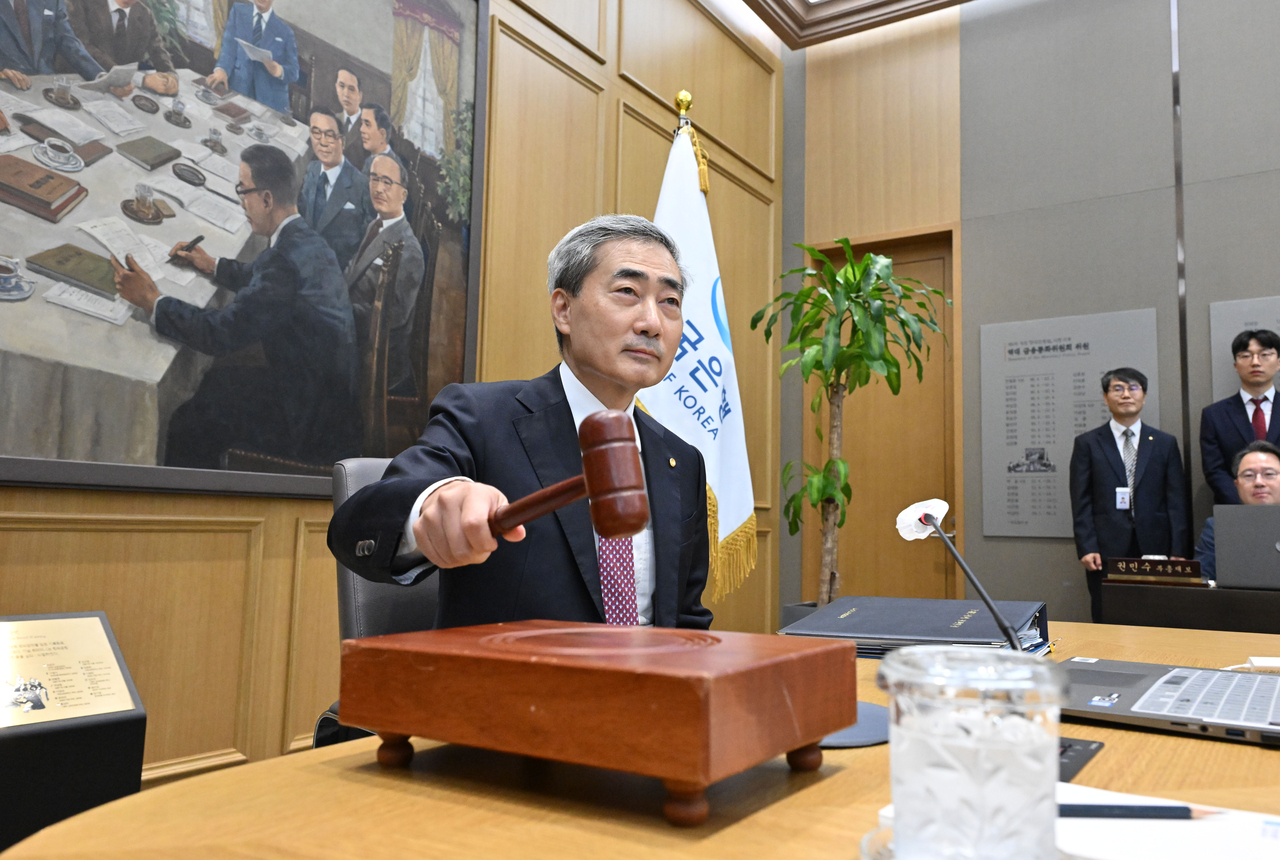
Market opinion is split between a rate hike and a hold ahead of the Bank of Korea's Monetary Policy Board decision Thursday, with indicators pointing in different directions — a contrast to the previous meeting, when all signals aligned in favor of a hike. Still, the case for raising rates is slightly stronger, given that inflation and growth, the two metrics Governor Shin Hyun-song has repeatedly flagged as key, have come in above expectations.
The Monetary Policy Board will hold its policy rate decision meeting Thursday to set the benchmark interest rate, according to the financial sector. At its last meeting, the board raised the rate from 2.5 percent to 2.75 percent — the first increase in roughly three and a half years since Jan. 13, 2023.
Elevated inflation and solid economic growth are lending weight to another hike. Consumer price inflation fell back to the 2 percent range last month for the first time in three months, but core inflation — which strips out volatile items — rose 2.6 percent, its fastest pace in two years and seven months. Shin has said on multiple public occasions that he places greater importance on core inflation, suggesting the board will give it more weight in Thursday's decision.
Second-quarter real GDP also grew 0.6 percent from the previous quarter, three times the BOK's own forecast of 0.2 percent. At that pace, annual growth of 3 percent or more this year appears increasingly likely. The revised growth forecast the BOK will release alongside Thursday's decision is another key variable; the bank had projected 2.6 percent growth for this year at its previous meeting and is expected to revise that figure up to the 3 percent range. A confirmed high-growth trajectory would strengthen the rationale for a preemptive hike to contain demand-side price pressures.
Notably, Shin had singled out July consumer prices and second-quarter GDP growth as the key indicators for assessing future monetary policy at the press briefing following the last policy meeting. By that benchmark, the grounds for a rate increase appear solid.
Financial stability conditions remain a concern as well. The average sale price of all housing types in Seoul — apartments, row houses and detached homes — rose 1.09 percent in July from the previous month, according to the Korea Real Estate Board. The monthly gain has accelerated for four consecutive months since April, when it stood at 0.55 percent, reaching its highest level this year. South Korea's household debt also surpassed 2,000 trillion won ($1.45 trillion) in the second quarter, a record high.
On the other side of the ledger, foreign exchange and equity market conditions, along with uncertainty over US monetary policy, are bolstering the case for a pause. The won-dollar exchange rate, which had been elevated in the 1,500-won range, has been trending lower since July. The weekly closing rate Wednesday stood at 1,397.7 won per dollar, falling into the 1,300-won range for the first time in about 11 months. That move weakens the argument for raising rates to defend the currency. Stock market volatility also remains high; a weaker equity market can dampen consumer sentiment and drag on economic growth. This month's Consumer Composite Sentiment Index broke a four-month rising streak, partly reflecting the impact of recent share price swings.
Uncertainty over US monetary policy is also growing. With American inflation easing and labor market data softening, market expectations for further US rate hikes have faded. Some analysts warn that if South Korea moves too quickly on its own while the US direction remains unclear, it could face a backlash down the road.
Opinion within the Monetary Policy Board itself appears divided. Even if the board votes to raise rates Thursday, a unanimous decision — as seen at the previous meeting — is not expected.
If the board does hike, markets will be watching closely for signals on the possibility of further increases before year-end. The dot plot to be released at Thursday's meeting and Shin's remarks at the subsequent press briefing will be the key gauges. The dot plot is a communication tool in which all seven board members, including the governor, each submit three projections for the rate six months out, producing 21 data points in total. The average value of the dot plot released at the May meeting was 2.89 percent, with a median of 3 percent. If those figures move higher, expectations for additional rate hikes will gain further traction.
kimstar@heraldcorp.com