A patient walks into a clinic perfectly fine on a Tuesday morning and is brought home cold by the afternoon. The family cannot make sense of it.
So they begin a fight that seems nearly impossible to win. They cash out savings accounts and sell their homes to fund the search for answers — to find out why their loved one died. But proving a medical institution's liability is extraordinarily difficult for patients and their families. The reason is a fundamental asymmetry of information.
In South Korea, medical disputes are handled primarily through two channels: mediation and arbitration via the Korea Medical Dispute Mediation and Arbitration Agency, which receives an average of about 2,100 cases a year, and civil litigation, which accounts for roughly 1,000 cases annually, according to research by the Korea Insurance Research Institute. More than 3,000 medical disputes play out every year — a David-versus-Goliath battle in each case.
The Herald Business has partnered with law firm O'Kims to analyze medical dispute rulings and examine how the weaker side can prevail. This series, "Medical Survival Game," is published twice a month, every other Tuesday, and is dedicated to helping patients and their families survive the fight. [Editor's note]
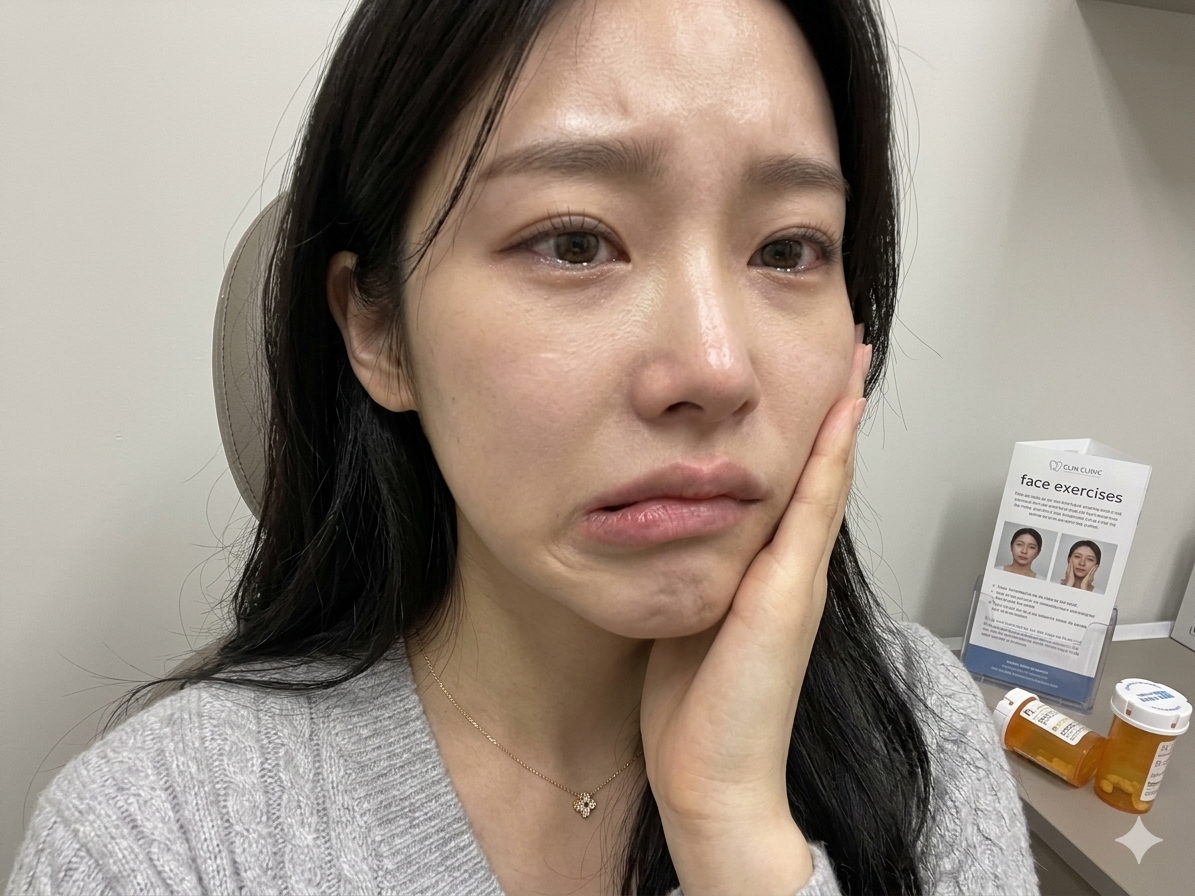
It started with teeth clenching. What began as Botox treatment for bruxism led to a second round of injections — and then to facial paralysis. Patient A sought relief from the courts after the worst possible outcome, but that avenue, too, proved fruitless.
In June 2015, dentist B administered a first round of Botox injections — 10 units targeting the temporalis and masseter muscles on both sides of A's face — to treat teeth-clenching symptoms.
Teeth clenching is medically recognized as a form of bruxism, an involuntary habit of pressing the upper and lower teeth tightly together. The force on the teeth and jaw joint can be up to three times greater than that produced during normal chewing, and in severe cases can lead to full-body pain. That was why A sought the first round of Botox.
But the treatment did not end there. After the first procedure, A's mouth began pulling to the left without warning. About two weeks later, A returned to the clinic, and dentist B injected 1.7 units of Botox into the lower left side of A's face — a second procedure.
The situation only worsened. About a month after the second injection, A went back to see dentist B. This time, A's left eye would not close fully, and the mouth had shifted to the right.
No longer trusting dentist B, A sought care at Hospital C. An MRI of the temporal region and a neuromuscular function test there revealed localized signal enhancement in the tubular segment of cranial nerves VII and VIII.
Cranial nerve VII, the facial nerve, controls the muscles of the face and governs saliva production. Cranial nerve VIII, the vestibulocochlear nerve, handles hearing and the sense of balance.
In plain terms, inflammation was found in the nerve pathway running from inside the ear through the jaw and face, and the neuromuscular test returned a diagnosis of incomplete left facial nerve dysfunction. For A, it was a devastating blow.
Facial paralysis after two Botox procedures
A filed suit against dentist B, raising two main claims: negligence in performing the procedures, citing the facial paralysis that followed the two Botox injections; and failure to disclose Botox side effects before either procedure, in violation of the duty to inform.
More specifically, A argued that the facial paralysis was caused by B's negligence and that B's failure to explain the risks of Botox had violated A's right to self-determination. On those grounds, A sought 21 million won ($15,200) in damages from dentist B.
Dentist B pushed back, arguing that the Botox had been administered at the appropriate dosage and that the facial paralysis resulted from inflammation unrelated to the injections.
B further said there was no causal link between either round of Botox and the paralysis. A drawn-out legal battle lasting nearly three years was about to begin.
Court rejects all claims, finding no negligence by B
![Court logo. [Yonhap]](https://wimg.heraldcorp.com/news/cms/2026/08/25/news-p.v1.20260823.63a80f03d41b4e7f87376e80d223429b_P1.jpg)
The Seoul Central District Court, presided over by Judge Nam Su-jin, dismissed all of A's claims — negligence in the procedures and failure to fulfill the duty to inform alike.
On the negligence claim, the court pointed to two key findings: that A's facial paralysis stemmed from inflammation of the facial nerve, and that the second Botox injection had not been administered to correct the leftward deviation of A's mouth.
Drawing on the evidence A submitted and the results of a medical records assessment requested from Association D, the court ruled that "dentist B administered Botox to A at the appropriate dosage, and A's facial paralysis appears to have been caused by inflammation of the facial nerve — it is difficult to find negligence in connection with the Botox procedure."
The court also addressed A's argument that the second injection was performed to correct the leftward mouth deviation caused by the first, which A said implied negligence in the first procedure. The court rejected this, saying that "even when Botox is injected at the correct dosage, the degree of relaxation on each side can differ, and performing a second procedure to restore balance cannot be considered negligence."
The court also declined to find a violation of the duty to inform. It drew a line, setting out the conditions under which a physician can be required to pay compensation for such a violation: the patient must have suffered an unexpected serious outcome; the physician must have failed to explain the nature of the illness, the treatment, the diagnostic method and the associated risks beforehand; the patient must have lost the opportunity to exercise the right to self-determination — that is, to choose whether to undergo the procedure and thereby avoid the serious outcome; and the patient must have suffered mental anguish as a result of that lost opportunity.
The court added that "the duty to inform does not apply to the entire course of medical care, but specifically to invasive procedures such as surgery, to medical acts that carry a probability of adverse outcomes, or to medical acts where serious consequences such as death are foreseeable — in other words, situations that require the patient's autonomous choice."
On that basis, the court said that "where the serious outcome suffered by the patient was not caused by the physician's invasive act, or where the patient's right to self-determination is not at issue, a failure to inform cannot give rise to liability for compensation — per a Supreme Court ruling dated May 27, 2010."
The court acknowledged that dentist B had failed to prove the duty to inform regarding Botox side effects had been fulfilled.
Nevertheless, it found no liability for compensation, on the grounds that no causal link had been established between the facial paralysis and either of the two Botox procedures.
The court said that "if an infection arises from a Botox injection, the nearby facial nerve could be affected," but noted that "the left-side facial paralysis appears to have originated from inflammation in the tubular segment of A's facial nerve and the anterior genu — a location that is not anatomically adjacent to the sites of either the first or second Botox injection."
The court also rejected A's arguments regarding the spread of botulinum toxin — a known Botox side effect that can paralyze surrounding muscles or migrate to areas distant from the injection site — as well as the claimed connection between the second injection and A's inability to close the left eye.
The court cited the finding that the facial paralysis was caused by inflammation of the facial nerve, and noted the roughly one-month gap between the second Botox injection and the onset of the eye-closure symptom.
Attorney Cho Jin-seok: 'Proving the link between procedure and inflammation is key'
![Attorney Cho Jin-seok of law firm O'Kims. [O'Kims]](https://wimg.heraldcorp.com/news/cms/2026/08/25/news-p.v1.20260823.75c18c6d84ed4b2eb1c40415bf99c51e_P1.jpg)
Cho Jin-seok, an attorney at law firm O'Kims, said the plaintiff should have mounted a more aggressive effort to establish a causal link between the two Botox procedures and the facial nerve inflammation.
Cho particularly noted that while the court had acknowledged a failure to fulfill the duty to inform, it had treated proof of causation between the medical act and the outcome as a prerequisite for any compensation claim.
"In medical litigation, a patient seeking damages must prove not only negligence in the course of the medical procedure but also a causal link between that negligence and the resulting harm," Cho said. "In this case, when the anatomical location of the procedure site relative to the lesion, the timing of symptom onset, and the nature of the lesion are considered together, the possibility of a cause other than the procedure could not be ruled out — which is why causation was not established."
On the duty-to-inform issue, Cho added that "liability for compensation arising from a failure to fulfill the duty to inform is premised on the serious outcome suffered by the patient having been caused by the physician's invasive act. In this case, because causation linking the facial paralysis to the procedure was not established, liability for compensation was denied."
Cho was reiterating the Supreme Court's position that even where a failure to fulfill the duty to inform is found, a compensation claim will be rejected if no causal link between the medical act and the outcome can be shown.
"This ruling is worth noting for similar medical disputes," Cho said, "because it shows that courts rigorously examine causation between a medical act and its outcome — not merely the fact that a negative result occurred — and that a breach of the duty to inform does not automatically translate into liability for compensation."
ko@heraldcorp.com