LPDDR6, DDR5 performance gaps narrowing fast
YMTC vows to be No. 1 in NAND by end of next year
China's memory push moves beyond volume to technology
CXMT built on stolen Samsung Electronics secrets, court testimony shows
Editor's note: Chip Chip Fab Fab is a series that explores the semiconductor industry driving the AI era — in depth and in plain language. The name links the "chip" at the heart of the AI revolution with the "fab" that makes it, and echoes the rhythmic chug of a train to capture the industry's relentless advance. Each installment unpacks complex technology clearly while tracing the stories and trends behind the headlines, following the present and future of the semiconductors powering the AI age.
![An LPDDR6 module made by China's CXMT. [Captured from CXMT website]](https://wimg.heraldcorp.com/news/cms/2026/08/28/news-p.v1.20260826.efffe84d14dd40008aaa1e67355ad0c0_P1.png)
Just two weeks ago, this column reported that China's Yangtze Memory Technologies Corp. (YMTC) had overtaken Kioxia, Micron and SanDisk in NAND shipment volume to claim third place globally. At the time, the prevailing industry view was that Chinese memory makers were compensating for lower performance with sheer volume. That view has shifted in just two weeks, as a string of reports highlights the rapidly improving technical capabilities of CXMT — the Chinese chipmaker producing both commodity DRAM and HBM.
About a month ago, this column exclusively reported that SK hynix plans to begin mass-producing LPDDR6 — its next-generation low-power mobile DRAM — in the second half of this year, with Xiaomi as its first customer for a flagship smartphone model.
However cheap Chinese memory chips may be, smartphone makers — even Chinese ones — have until now used Korean-made memory in flagship models costing up to 2 million won ($1,450) per unit. SK hynix had a firm grip on that Chinese market.
Last week, however, a report sent a jolt through the industry: Xiaomi plans to equip its latest flagship foldable smartphone with LPDDR6 chips made by CXMT.
Two things make this striking. First, CXMT is mass-producing the latest LPDDR6 in the same timeframe as Samsung Electronics and SK hynix. Second, CXMT has risen to the status of a multi-vendor alternative, putting it in direct competition with SK hynix.
CXMT's technology still falls short of SK hynix. Its data transfer speed ranges from a baseline of 10.7 Gbps to a maximum of 12.8 Gbps, while Samsung Electronics and SK hynix both achieve up to 14.4 Gbps — the top speed under JEDEC (Joint Electron Device Engineering Council) specifications.
Chinese media have been celebratory. The Beijing News declared that CXMT had made "a pivotal leap from technological catch-up to equal competition with global giants," calling it "the first case in which China has seized a preemptive global lead in the advanced low-power memory race."
Chinese outlets also noted that while CXMT is forming a direct competitive front with SK hynix, Samsung Electronics and Micron face mounting restrictions on their China business — creating growth opportunities for CXMT. They argued the development could begin to reshape the existing order in which overseas giants have dominated cutting-edge memory technology development.
The argument, in short, is that US sanctions on China appeared to be slowing Chinese technological progress but instead handed CXMT a platform to dominate the domestic market.
'Cheap Chinese chips' no longer applies
CXMT within 1% of SK hynix on DDR5 performance
![A DDR5 product made by CXMT. [Captured from CXMT website]](https://wimg.heraldcorp.com/news/cms/2026/08/28/news-p.v1.20260828.577008bbbcf341a0a74a1a968cb9111b_P1.png)
Thursday brought an even more unsettling report: in commodity DRAM, the performance gap between CXMT and SK hynix has narrowed to within 1 percent.
The findings come from Chinese tech outlet Digitimes, which tested a Lexar DDR5 module using CXMT DRAM against a Gloway DDR5 module using SK hynix DRAM, pushing transfer speeds to 8,000 MT/s.
Memory read speeds came in at 123.32 GB per second for the CXMT product and 124.68 GB per second for the SK hynix product — a negligible difference. On Geekbench 6, which measures overall performance, the two scored 24,576 and 24,790 respectively, a gap of just 0.86 percent.
SK hynix held the edge in detailed metrics, however. Its chip's latency — the time from a data request to actual processing — was 72.2 nanoseconds, faster than CXMT's 76.1 nanoseconds, and SK hynix also led on memory timing. The narrowing benchmark scores should not be read as evidence that the two chips are technologically equivalent.
What makes the result striking is the process node gap. The SK hynix DDR5 used in the test is based on the 1a (fourth-generation 10nm-class) process, while CXMT's DDR5 is believed to use the 1z (third-generation 10nm-class) process. In the progression 1x → 1y → 1z → 1a → 1b → 1c, CXMT is achieving near-comparable performance on a process one generation behind.
Reports have also emerged that CXMT's yield rate on its 17nm DDR5 has exceeded 90 percent. Chinese IT outlet Kuai Technology assessed this as "only 2 percentage points below Samsung's yield of 92 to 93 percent for the same generation, placing it at the world's highest level by technical indicators." Some products from Taiwanese PC makers Acer and Asus already use CXMT chips, and HP uses CXMT memory in products sold in China.
China forecast to supply half of domestic DRAM demand by 2028
CXMT building toward 600,000-wafer monthly capacity to rival Samsung Electronics
As CXMT's technology improves, its production capacity is expanding even faster. Goldman Sachs recently published a China semiconductor research report forecasting that CXMT will supply 50 percent of China's domestic DRAM demand by 2028 and meet 40 percent of HBM demand by the same year. The bank projected that CXMT's DRAM supply volume relative to Samsung Electronics and SK hynix would rise from 28 percent and 35 percent respectively in 2025 to 41 percent and 50 percent by 2028.
Goldman Sachs cautioned, however, that CXMT remains two to three generations behind Samsung Electronics and SK hynix, which are transitioning to 1c DRAM, and that equipment procurement constraints — including limited access to EUV tools — make it unlikely that gap will close quickly. The bank added that surging domestic DRAM demand in China means a significant share will continue to depend on global suppliers, leaving both Samsung Electronics and SK hynix with substantial opportunities in the Chinese market even as competition from CXMT intensifies.
But the landscape could shift at any time. CXMT is pursuing new factory construction in Hefei in Anhui Province and in Shanghai, and is planning an additional facility in the Yizhuang area in southeastern Beijing. Reuters has reported that if those capacity expansion plans are realized, CXMT's monthly production capacity would double to 600,000 wafers — not far behind Samsung Electronics, which can produce roughly 650,000 to 700,000 wafers per month.
Apple, meanwhile, has been signaling interest in CXMT and YMTC, citing memory prices it considers too high. The US Congress is pushing to block any such arrangement, but some observers suggest Apple could be permitted to proceed after Chinese President Xi Jinping visits the United States in September. There are also reports that CXMT's capacity may be fully booked through 2027, meaning CXMT itself could turn Apple away.
![NAND flash shipment market share in the second quarter of 2026. [Counterpoint Research]](https://wimg.heraldcorp.com/news/cms/2026/08/28/news-p.v1.20260814.25e0ddec63aa4c5d8b97a3934e95e263_P1.png)
YMTC, China's NAND flash maker, is projecting equal confidence. According to the Financial Times and other outlets, YMTC told investors during preparations for a large-scale initial public offering that it intends to overtake Samsung Electronics and SK hynix to claim the No. 1 market position by the end of next year.
According to market research firm Counterpoint Research, YMTC overtook Japan's Kioxia in NAND flash shipments in the second quarter of this year, recording a 14 percent market share to rank third globally — tripling its share in five years. Korean companies have recently been purchasing YMTC technology, a sign of how far YMTC has advanced in NAND.
618-step DRAM recipe leaked in full
With prosecutors' investigative powers curtailed, who protects Korea's chips?
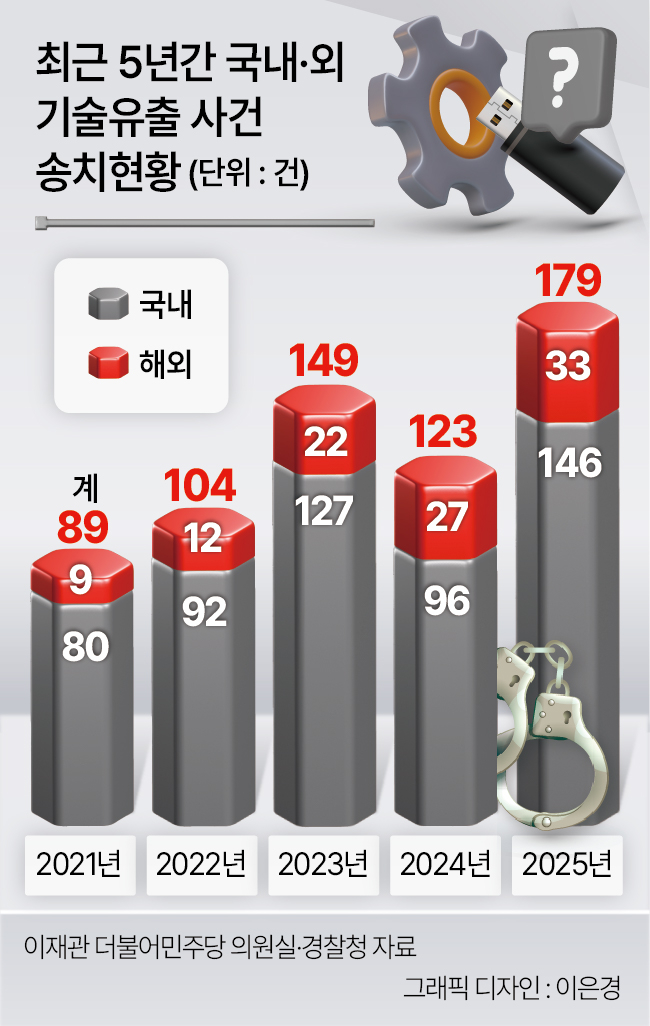
China's semiconductor ambitions are formidable — but can Korean companies fight back alone? A trial is currently underway in which a Samsung Electronics employee is accused of leaking the company's 18nm DRAM process technology to CXMT. A former Samsung Electronics employee surnamed Jeon, who worked at the company for 28 years and was a founding member of CXMT, gave startling courtroom testimony: CXMT's CEO and chief technology officer had intended from the outset to steal Samsung Electronics' information to develop DRAM.
What was taken was no ordinary document. The leaked material was a Process Recipe Plan — a 618-step manufacturing recipe required to produce DRAM. In exchange, Jeon reportedly received approximately 2.9 billion won over six years at CXMT, including contract incentives and stock options.
Jeon was indicted last year and received a first-instance sentence of just seven years in prison in April — a third of the 20-year term prosecutors had sought.
Concerns about gaps in technology theft investigations are deepening following the abolition of prosecutors' supplementary investigative authority. According to media reports, only two prosecutors are currently assigned to the defense industry and industrial technology crime unit at the Suwon District Prosecutors' Office, which has jurisdiction over the cluster of major advanced-technology companies including Samsung Electronics, SK hynix, Samsung Display and Hyundai Motor Company.
One of those two prosecutors handles defense industry cases exclusively, leaving effectively a single prosecutor responsible for industrial technology theft investigations.
As the technological challenge from China and other "red tech" players intensifies — and as the theft of talent and technology accelerates — the question of who will protect Korean companies grows more urgent.
go@heraldcorp.com