Korean Society for the Study of Obesity policy forum in Seoul
Same BMI, different risks: regional and low-income treatment gaps persist
Experts call for coverage starting with high-risk patients; government signals second national plan
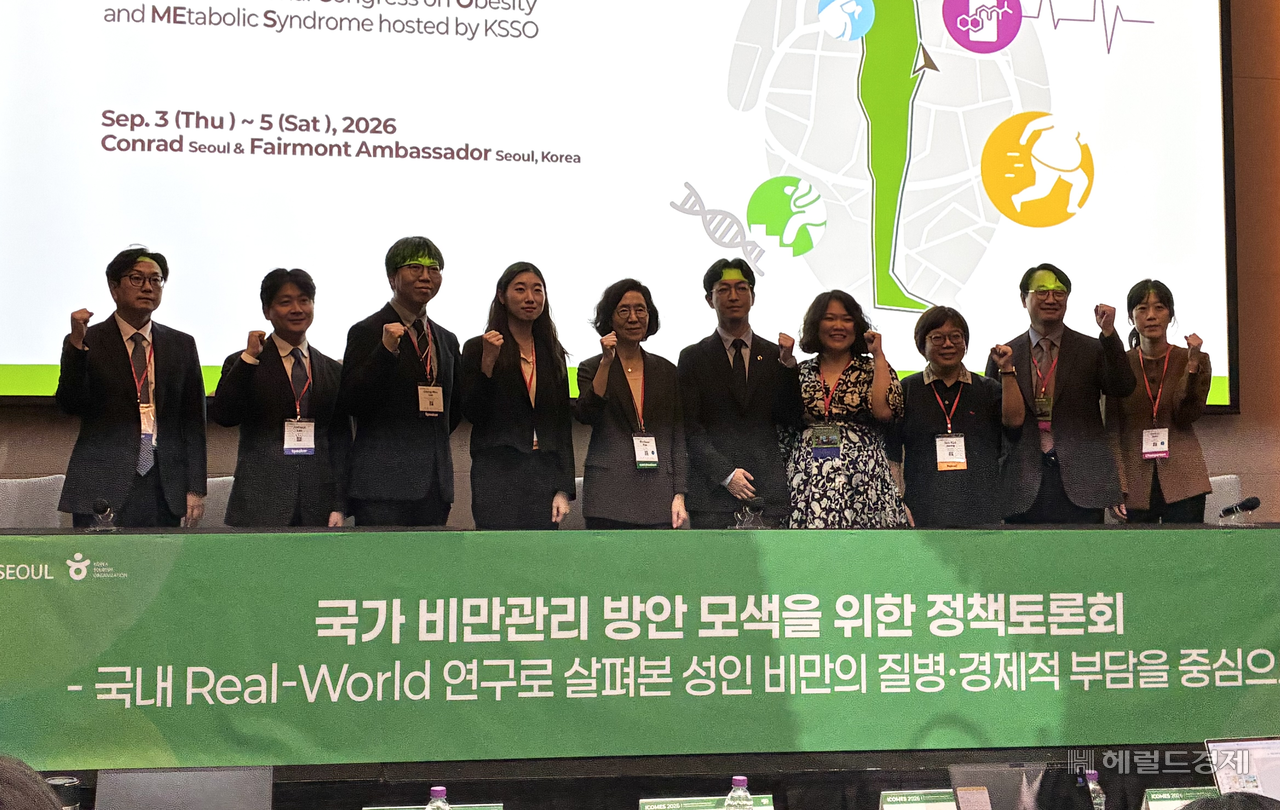
Treating obesity as a medical condition rather than a personal weight-management issue could ease the country's economic burden as well as improve public health, experts argued Thursday.
The Korean Society for the Study of Obesity held a policy forum at the Conrad Seoul hotel in Yeouido to discuss the disease burden of adult obesity and ways to improve access to treatment. Researchers presented analysis showing that the combined socioeconomic costs of obesity — including medical expenses, absenteeism, lost workplace productivity and premature death — exceed 23.4 trillion won ($16.8 billion) a year.
Same BMI, different risks: 'Risk-based treatment cuts social costs'
Even among patients with the same body mass index, actual health risks vary widely, researchers said. Lee Cheong-woo, a professor of family medicine at the Central Veterans Hospital, said an analysis of roughly 350,000 records from the National Health Insurance Service found that 20.8 percent of subjects had "clinical obesity" — excess body fat accompanied by measurable health abnormalities.
Particularly among patients in the BMI range of 25 to 29.9, commonly classified as stage-one obesity, the data showed a mix of clinical obesity cases with conditions such as hypertension and abnormal blood sugar alongside "preclinical obesity" cases with no clear disease yet. "Even within stage-one obesity, we see different phenotypes," Lee said. "BMI alone cannot adequately explain the actual disease burden."
Follow-up data from separate health screening records showed that the clinical obesity group faced about a 26 percent higher risk of future cardiovascular and cerebrovascular disease than those without obesity. Among younger patients, preclinical obesity — cases that had not yet progressed to disease — was relatively more common. "This suggests that early intervention in younger age groups can yield greater results," Lee said.
Yet the rate at which patients actually receive treatment remains low. A survey of 508 adult obesity patients in Korea found that about 80 percent had attempted weight loss, but only 8.5 percent said the results were "very effective." Even among stage-three obesity patients with a BMI of 35 or above, only about 30 percent had been prescribed anti-obesity medication in the past six months.
That treatment gap translates into an economic burden beyond individual health, researchers said. Kim Won-seok, a professor of family medicine at Uijeongbu Eulji University Hospital, said the socioeconomic cost of adult obesity — combining medical expenses, absenteeism, lost productivity and premature death — reaches 23.4 trillion won annually. "The rise in obesity among people in their 20s to 40s could significantly expand long-term losses in labor productivity," he said.
'Cover high-risk patients first' — government signals second national plan
Academics, patient advocates and youth groups called for expanding treatment access starting with the highest-risk patients rather than providing blanket support to all obesity patients. Lee Jun-hyeok, a professor of family medicine at Nowon Eulji University Hospital, proposed that priority coverage be considered for patients with severe obesity or complications, low-income individuals and those in areas with limited access to medical care.
Kim Yu-hyeon, head of the Gachi Health social cooperative, said obesity drugs are widely perceived as cosmetic products, leaving patients who genuinely need treatment behind. "We are not calling for immediate national health insurance coverage of GLP-1 drugs for all obese people," she said, "but we would like to at least begin a coverage discussion for specific groups based on health risk level."
Advocates also raised concerns about young obesity patients who fall outside existing management systems because they have not yet developed clear complications. Lee Do-gyeong, secretary-general of the Youth Foundation, said it is important to identify which young people are being missed by current systems and build structures that actually reach those who need support. "Young people whose health risks have already been confirmed are simply being told to manage on their own — that is a real limitation," he said.
The government said it plans to overhaul its obesity management policy. Jeong Hye-won, an official at the KDCA's chronic disease management division, acknowledged a gap in policy continuity after the first national obesity plan ended without a seamless transition to a second. "A pan-government second comprehensive obesity plan, led by the Ministry of Health and Welfare, is now being actively reviewed," she said.
A bill on the prevention and management of obesity disease, introduced by Democratic Party of Korea lawmaker Seo Mi-hwa in March, is currently pending in the National Assembly. Kim Min-seon, president of the Korean Society for the Study of Obesity, said the delays are frustrating. "Frankly, I'm burning up inside. The government says it will act, but implementation keeps getting pushed back," she said. "Everyone agrees that obesity with complications, or severe obesity, is a disease. If it's a disease, it must be treated — and if it must be treated, national health insurance has to cover it."
hong@heraldcorp.com
snsd@heraldcorp.com