Exhibition halls, artifacts viewable anytime, anywhere
Following National Museum of Korea, cultural heritage becomes digital asset

Naver is launching a "VR tour" service that lets users view Kansong Art Museum's exhibition spaces and key holdings in virtual reality.
Naver Labs and the Kansong Art and Culture Foundation said Friday that they are rolling out a VR tour service. The service allows visitors to explore Kansong Art Museum without any constraints of time or place. Kansong Art Museum, located in Seongbuk-gu, Seoul, is South Korea's first private art museum, known for its focus on collecting and researching artifacts to preserve the country's cultural heritage.
According to Naver, the VR tour is built on digital twins of the museum's exhibition space and the works featured in its "Munhwa Boguk" ("Safeguarding the Nation Through Culture") exhibition. Both digital twins were created by Naver Labs. Users can explore Bohwagak, the museum's exhibition hall, following a set route as if visiting in person, and select any artifact on display to view a detailed description.
Kansong Art Museum has traditionally been open to the public only during its regular spring and fall exhibition periods. Naver said the new VR tour service allows anyone to view the museum's collection without such time or place restrictions.
Naver also pointed to the ability to view artifacts that no longer exist as another advantage of the VR tour. A prime example is the Qing-era stone lion statue that once stood guard at the museum's main gate before it was donated to China in July. It has now been preserved as digital data. Other artifacts were difficult to access because they stood outdoors, including the octagonal stupa from Goesan and a stone octagonal monk's stupa. These can also be viewed through the VR tour.
Naver said the project marks a significant step toward permanently preserving cultural heritage in digital space through Naver Labs' spatial AI technology.
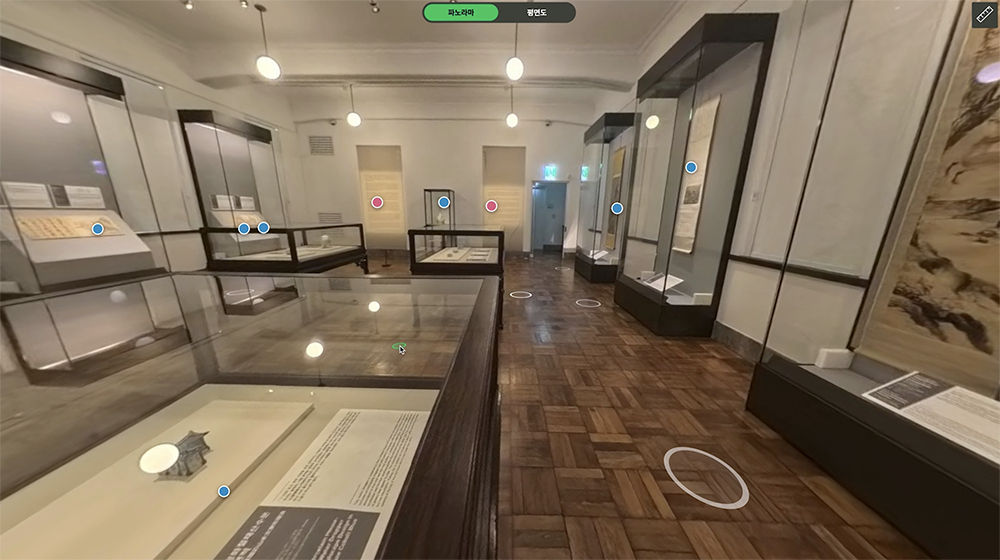
Naver Labs built digital twins of Kansong Art Museum's spaces and artifacts for the VR tour. The company used its vision technology, which can perform 3D mapping with only a smartphone camera and without specialized equipment such as high-precision scanners. This makes it possible to easily convert a wide range of spaces and objects into digital data.
This is not the first time Naver Labs has recreated a cultural space through virtual content. The company has operated an augmented reality navigation service at the National Museum of Korea since 2022. It has also introduced Flying View 3D on Naver Maps, a service that uses its Noble View Synthesis technology. The service lets users explore historic sites, such as Cheomseongdae in Gyeongju, in 360 degrees.
"Following the National Museum of Korea, we have now recreated Kansong Art Museum's cultural heritage in digital space, allowing anyone to enjoy it without any restrictions of time or place," said Lee Dong-hwan, leader of Naver Labs' Vision Group. "We will continue to advance our spatial AI technologies — including digital twins, positioning and 3D reconstruction — to create new cultural experiences."
chami@heraldcorp.com