Joint statement reaffirms commitment to North Korea's denuclearization, says 'path to dialogue remains open'
Ministers also back peaceful resolution of cross-strait issues, Taiwan's participation in international bodies
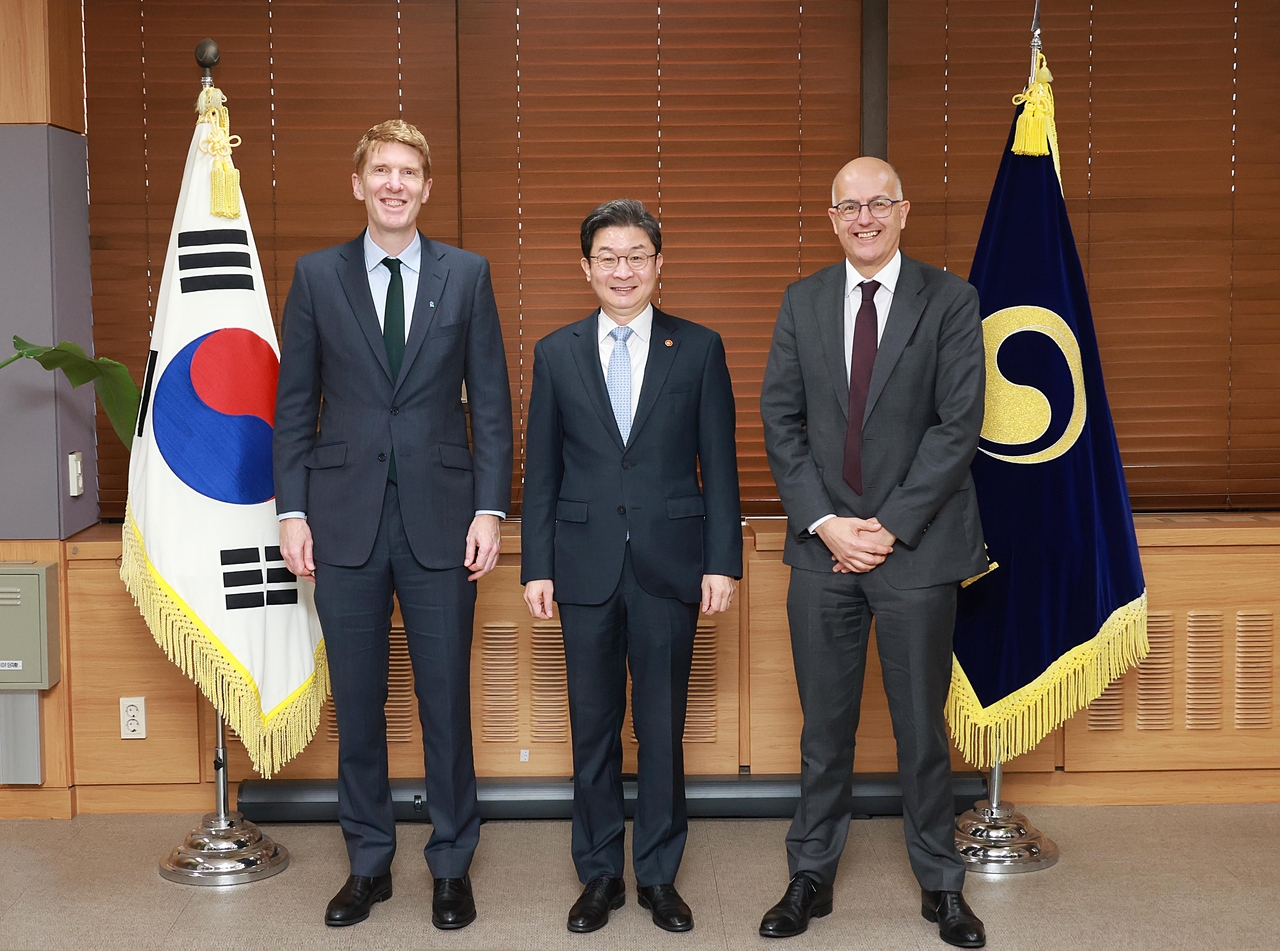
![Foreign Minister Cho Hyun, US Secretary of State Marco Rubio and Japanese Foreign Minister Toshimitsu Motegi pose for a photo before their trilateral meeting in New York on Monday (local time). [Yonhap]](https://wimg.heraldcorp.com/news/cms/2026/09/22/rcv.YNA.20260922.PYH2026092200090007201_P1.jpg)
The top diplomats of South Korea, the United States and Japan reaffirmed their commitment to North Korea's complete denuclearization Monday and called on Pyongyang to return to dialogue. They also underscored the importance of maintaining peace and stability in the Taiwan Strait and agreed to strengthen a trilateral supply chain early-warning system against "economic coercion."
Foreign Minister Cho Hyun met with US Secretary of State Marco Rubio and Japanese Foreign Minister Toshimitsu Motegi at the Lotte New York Palace hotel in New York on Monday (local time) for a trilateral foreign ministers' meeting, at which they adopted a joint statement.
In the statement, the three ministers said they "reaffirmed their unwavering commitment to the complete denuclearization of North Korea in accordance with UN Security Council resolutions and to prohibiting support for revenue generation for North Korea's nuclear and ballistic missile programs."
They added that they "reaffirmed that the path to dialogue remains open" and urged North Korea to return to talks, pledging to continue efforts to promote peace and stability on the Korean Peninsula.
The statement comes as US President Donald Trump has repeatedly expressed his intention to revive North Korea-US summit diplomacy. The three countries reaffirmed the principle of denuclearization while leaving open the possibility of resolving the issue through dialogue.
The ministers welcomed progress made through the UN Multilateral Sanctions Monitoring Team and in countering North Korean cyber threats. They also reiterated their commitment to working toward the immediate resolution of issues concerning abductees, prisoners of war and separated families.
The joint statement also addressed cooperation on Taiwan Strait issues and global supply chains.
The meeting, convened at US initiative three days before a US-China summit, drew analysis that South Korea and Japan joined Washington in sending a unified message on the Taiwan Strait and economic security — signaling a coordinated effort to check China.
The statement said the ministers "encouraged the peaceful resolution of cross-strait issues and opposed any unilateral attempts to change the status quo," adding that they "expressed support for Taiwan's meaningful participation in appropriate international organizations."
The ministers also emphasized the importance of freedom of navigation and overflight throughout the Indo-Pacific and beyond, adherence to international law as reflected in the UN Convention on the Law of the Sea, and strengthening maritime security.
The US reaffirmed its ironclad defense commitments to South Korea and Japan and its extended deterrence pledges.
The three ministers welcomed trilateral cooperation with the UN Office on Drugs and Crime to disrupt organized crime, including so-called "scam centers" in Southeast Asia, and agreed to continue cooperation under the Trilateral Maritime Security and Law Enforcement Cooperation Framework, as well as on Arctic affairs.
On global supply chains, the ministers said in the statement that they "firmly oppose economic coercion and non-market policies and practices that cause harmful overcapacity and market distortions, including arbitrary export restrictions that disrupt supply chains," and pledged to sustain free and transparent trade and secure critical supply chains.
To that end, they agreed to strengthen a third-country supply chain early-warning system and welcomed the launch of a new trilateral economic security consultative body.
The ministers also fleshed out cooperation on energy security and advanced technology.
They stressed the need to strengthen regional energy supply resilience by expanding oil reserves and deepening cooperation between energy producers and consumers.
They also expressed support for efforts to enhance energy security through regional cooperation.
The three countries agreed to advance an implementation plan under a trilateral memorandum of cooperation adopted July 7 to accelerate the deployment of small modular reactors in third countries.
South Korea, the US and Japan agreed to deepen practical cooperation in critical and emerging technology sectors, including AI, quantum technology, digital infrastructure and biotech.
They also welcomed expanded cooperation in semiconductors and expressed interest in strengthening collaboration between national research laboratories.
The trilateral foreign ministers' meeting was held on the sidelines of the high-level segment of the 81st UN General Assembly. It was the third such meeting in three months, following gatherings on the sidelines of the NATO summit in Turkey on July 7 and the ASEAN Regional Forum in the Philippines on July 22.
mokiya@heraldcorp.com