August transaction volume plunges 62.8% in three months
Record-high deals persist as buy-sell index stays buyer-dominant
Conditions differ from 2022's liquidity squeeze and rate surge
![Apartment complexes in the Gangnam and Seocho areas are seen from Namsan Park in Jung-gu, Seoul. [The Herald Business DB]](https://wimg.heraldcorp.com/news/cms/2026/09/22/news-p.v1.20260911.3b53e6580b1145aa9344fa6fe2ea0d0f_P1.jpg)
Seoul apartment transactions have dropped sharply, yet record-high deals continue to emerge across the city. With trading volume historically declining ahead of price corrections, analysts are watching whether the current transaction cliff signals a broader shift in home prices.
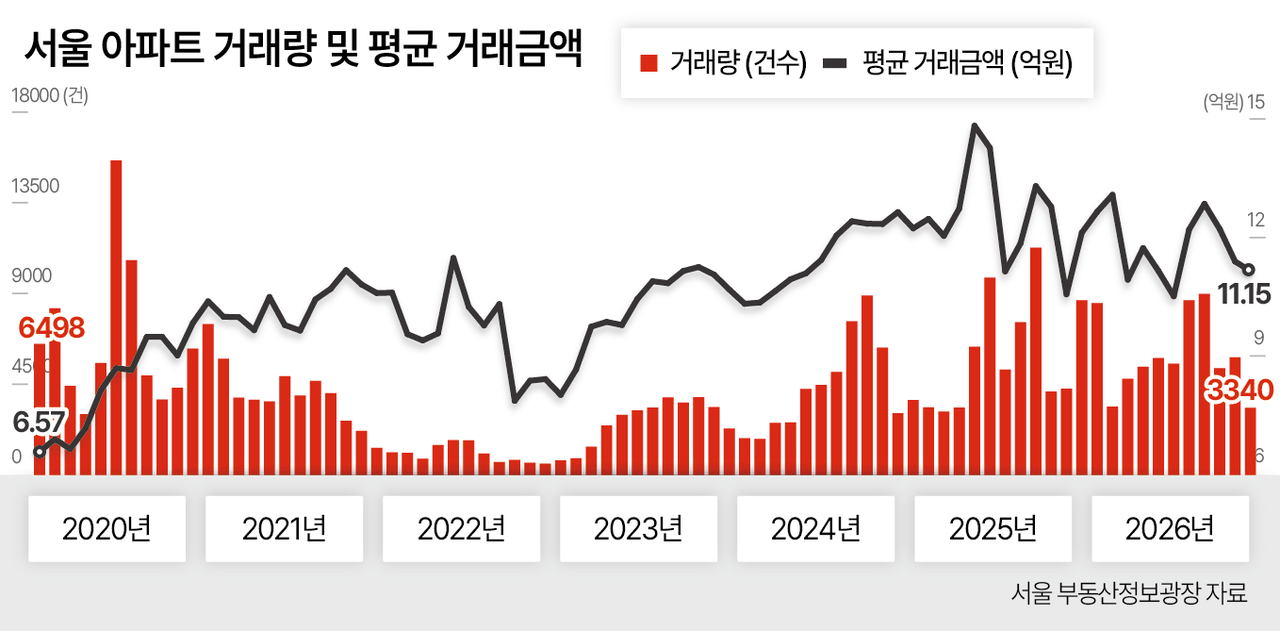
According to Seoul Real Estate Information Plaza, Seoul apartment sales in August totaled 3,340 transactions — down 42.8 percent from 5,841 the previous month and 21.9 percent below the 4,277 recorded in the same month last year.
Looking only at August figures since 2020, this year's tally is the second lowest on record, trailing only the 754 transactions logged in August 2022. Seoul apartment sales had climbed to 8,662 in April and 8,986 in May before sliding to 5,304 in June, recovering slightly to 5,841 in July, then plunging to 3,340 in August — a 62.8 percent drop from May in just three months.
The decline is drawing attention because transaction volume has historically fallen before prices do. Seoul apartment sales slipped from 4,058 in August 2021 to 2,688 in September, then continued falling to 2,194 in October, 1,342 in November and 1,130 in December. Although volume briefly rebounded in some months of 2022, the overall downward trend persisted, bottoming out at 558 transactions in October of that year.
Prices moved with a lag. Even after the transaction cliff had set in, the average Seoul apartment sale price remained elevated, peaking at 1.15 billion won ($829,000) in April 2022. It then fell to 785.51 million won by August of that year — a decline of about 362 million won, or 31.5 percent, in just four months.
So far, prices are telling a different story. Despite the sharp drop in transactions, record-high deals have continued to emerge.
According to the Ministry of Land, Infrastructure and Transport's actual transaction price disclosure system, a 114-square-meter unit at Raemian Wellstream in Hyeonseok-dong, Mapo-gu changed hands on Aug. 24 for 2.94 billion won, setting a new all-time high for the complex. A 114-square-meter unit at Magok M-Valley 7 Complex in Magok-dong, Gangseo-gu also set a record on Aug. 5, selling for 2.4 billion won.
Record transactions are spreading to Seoul's outer districts as well. An 84-square-meter unit at Sanggye Jugong 3 Complex in Sanggye-dong, Nowon-gu sold for 1.2 billion won on Aug. 9, crossing the 1.2 billion won threshold for the first time.
Market watchers consider the spread of price gains from core areas to outlying neighborhoods and smaller units — after a prolonged rally — one indicator of whether the market is overheating. Other forward-looking gauges include the buy-sell supply index, listing volumes, auction inventory and bid-to-appraisal ratios, the apartment subscription market, and interest rate and lending conditions.
Experts say that taken together, these indicators make it difficult to conclude that the recent drop in transaction volume will trigger a sharp price correction like the one seen in 2022. Ham Young-jin, head of the real estate research lab at Woori Bank, said the current market may be playing out differently from the steep price declines of 2022, noting that housing demand remains solid as rental demand expected to grow from September onward converts into purchase demand.
According to the Korea Real Estate Board, Seoul's apartment buy-sell supply index stood at 112.5 in the second week of September (as of the 14th), down 1.4 points from two weeks earlier and falling for three consecutive weeks. A reading above 100 indicates that buyers outnumber sellers in the market.
While buying sentiment has softened somewhat recently, the index remains well above 100 — meaning the broader Seoul market has not yet tipped into seller-dominant territory despite the drop in transaction volume.
This stands in contrast to the period following the second half of 2021. The Seoul apartment buy-sell supply index registered 107.2 in the first week of September 2021, then fell for eight consecutive weeks to 100.7 in the first week of November. A survey on the 15th of that month showed the index slipping below the 100 baseline to 99.6. The decline continued, with the index hitting 76.9 in the second week of October 2022.
Interest rate conditions also deteriorated rapidly during that period. After the Bank of Korea began raising its benchmark interest rate in August 2021, successive hikes drove up mortgage burdens, and tightening lending regulations further eroded buyers' purchasing power.
Ham said that during the period when prices plunged, rapid interest rate hikes and a liquidity squeeze caused market sentiment to shift abruptly even as a nationwide housing rally was underway.
He added, however, that the significant increase in apartment auction listings this year is worth watching closely, as changes in auction inventory are one of the leading indicators for tracking future home price trends.
quq@heraldcorp.com