
Kang and his wife drew up a salary management plan the moment he proposed
Resolved to leave rental housing to protect time and energy for raising a child
Built a shortlist of complexes, scouted on weekends, and settled on Seongdong-gu
Strict spending controls and a 70-percent savings rate drove their asset growth
![Kang learned the importance of managing his monthly salary. [ChatGPT]](https://wimg.heraldcorp.com/news/cms/2026/09/23/news-p.v1.20260923.062baa7587e44ecd9e87ba9c9bfc1b8d_P1.png)
"Honey, can you write down your annual salary, your fixed monthly expenses, and every loan you have, one by one? You watch Netflix too — do you know when that money actually leaves your account?"
Boram, then his girlfriend and now his wife, spoke calmly as Kang arrived holding a sheet of A4 paper.
Kang later described that moment as "unexpected — and honestly, something I was afraid to face."
"I had no idea when my phone bill or my Netflix subscription came out of my account," he said. "My pattern was: salary comes in, credit card payment and loan interest go out, and I'd just think, 'There goes the money again.'"
Boram was different.
For one thing, she did not use credit cards.
When her paycheck arrived, she divided it across four accounts: personal spending money, savings, fixed expenses and an emergency fund. She grew those savings by rotating them through high-yield time-deposit products at different banks each month — a method known as "windmill rolling" — and consistently saved 70 percent of her income every year.
Despite earning less than Kang, Boram had accumulated nearly three times as much.
'Our goal: a 70-percent savings rate'
The day Kang discovered this became the day the couple committed to managing their salaries together after marriage.
"While preparing for the wedding, we talked a lot about maintaining the 70-percent savings rate my wife had kept and how to structure our fixed expenses as a two-person household," Kang said. "We also discussed in advance how often and how much to give our parents as allowance, and we set our own rules so that even after having a child, we could manage married life without financial strain."
The couple married in late 2023 and moved into the private rental apartment where Kang had been living in Guro-gu — Gocheok I'Park, a newly built mixed-use complex with well-equipped commercial facilities on site.
But as they began planning for children, concerns started to surface.
At the time, both Kang and his wife faced a one-way commute of one hour, and his wife had to transfer twice. "With both of us needing to share childcare duties, I felt that cutting commute time was the only way to protect our energy and our time with the child," Kang said. "That was the biggest reason we decided to move when we started planning for a baby."
Their target was to cut each commute to 30 minutes. Achieving that for both of them would effectively recover 10 hours a week — five hours each — or 40 hours a month. Over a year, that added up to 10 full days the couple could spend together.
Even so, buying was not their first instinct.
Boram was reluctant to take out a loan larger than what they had saved.
Kang, who believed in using leverage, set about persuading her.
Kang had long been what might be called a "leverage user" — someone who used loans to secure jeonse housing and keep housing costs low — while Boram was a committed saver who trusted the power of disciplined spending and deposits.
Kang explained the principles of leverage he had used himself and argued that buying real estate for owner-occupancy carried value beyond the asset itself. His wife came around.
Having decided to buy, the couple sat down in January 2024 to calculate their available funds and draw up a list of apartment complexes they wanted to consider.
They applied five criteria when selecting complexes: proximity to transit, large scale, an elementary school within the complex, strong connectivity to key areas of Seoul, and favorable development prospects. Armed with that list, they spent every weekend scouting properties in person.
![Kang and his wife spent every weekend visiting their shortlisted complexes. [ChatGPT]](https://wimg.heraldcorp.com/news/cms/2026/09/23/news-p.v1.20260923.b4e0040b555744f98c41d6e0cffa1622_P1.png)
The complexes that made the cut were Garak KGM 1st in Songpa-gu, Jayang Wooseong 7th in Gwangjin-gu, Oksu Samsung in Seongdong-gu, Geumho Doosan in Seongdong-gu, and Yaksu Heights in Jung-gu.
"Even after finishing the initial scouting rounds, we kept going on dates in new neighborhoods every weekend to sharpen our sense of local prices and desirability," Kang said. "I handled the driving and maintained the complex list, while my wife managed the financing plan and tracked market prices — we divided the work that way."
About six months into their search, in the summer of 2024, the couple decided to buy Geumho Doosan.
Why Geumho Doosan — and why after six months of searching
Two main reasons drove the decision. When the couple calculated the gap between each candidate complex's peak price and its current asking price as a percentage, the 59-square-meter unit at Geumho Doosan stood out as the most undervalued.
"At the time, Geumho Doosan was trading about 20 percent below its peak of 1.2 billion won, meaning it had not yet caught the upward trend," Kang said. "It also offered the best transit access among all our candidates — door-to-door commute times for both of us came in under 30 minutes — so we decided to buy."
The couple also believed the complex would remain in demand in the future. Kang valued Geumho Doosan not so much for its links to office districts like Jongno or Yeouido, but for its position at the center of Seoul's key commercial areas — Hannam, Seongsu-dong, Apgujeong and Gangnam. Just one bridge, Dongho Bridge, separates the complex from Apgujeong in Gangnam-gu, and Kang knew the area was popular with residents who wanted easy access to Gangnam.
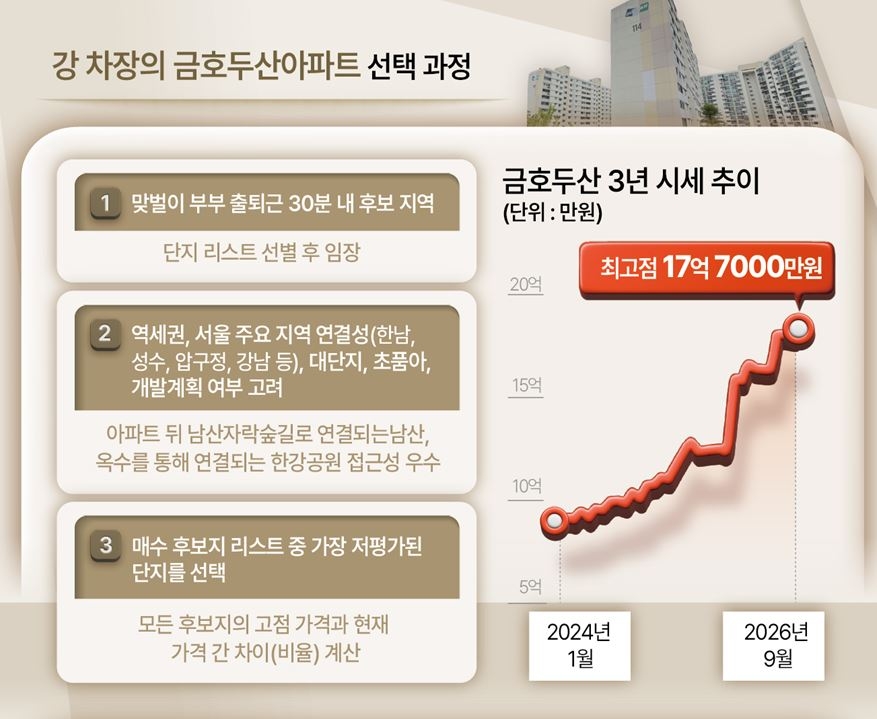
During their scouting visits, the couple personally confirmed the forest path behind the complex connecting to Namsan, and checked how easily they could reach the Han River park by walking through Oksu. The natural surroundings — appealing to residents of all ages — convinced them the complex would also be easy to sell when the time came.
The challenge was financing. The 59-square-meter unit at Geumho Doosan was priced in the 900 million won range at the time.
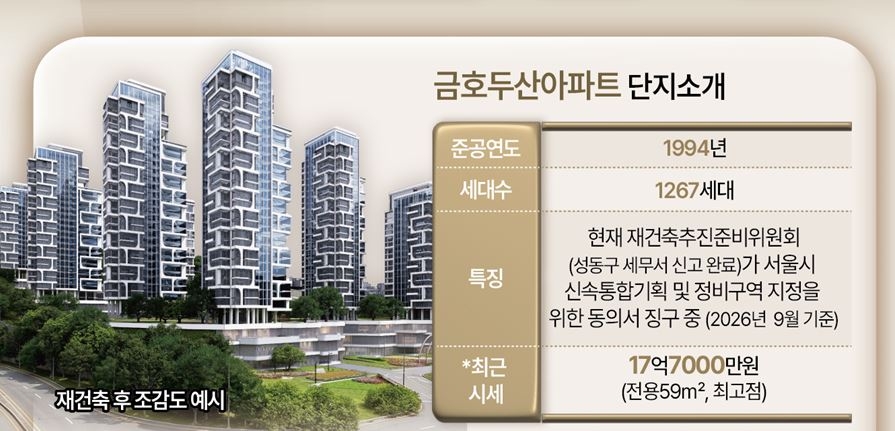
They assembled a base of 450 million won: roughly 100 million won Kang had saved over about 10 years of employment, 270 million won his wife had saved, and 80 million won in support from both families. That still left them needing a loan for more than half the purchase price.
The couple took out a first-time homebuyer mortgage of about 500 million won, with monthly payments of principal and interest totaling 2.5 million won. They also set aside a separate 37 million won for renovations — the apartment had not been touched since it was first occupied in 1998, making it a 27-year-old unit.
"We moved in after a month of renovation work following the final payment, but looking back, the asking price for an already-renovated unit at the time was only about 20 million won more," Kang said. "Factoring in the hassle of timing the move and all the effort that goes into coordinating a renovation, that experience taught me to buy an already-renovated unit next time."
Having bought so soon after getting married, the couple needed to keep an especially tight grip on spending.
Strict spending controls — the price of homeownership
For a dual-income couple at a large company with limited room to rapidly grow their earnings, the options were few. To buy their home, they gave up designer clothes, generous personal allowances and overseas travel.
Since getting married, neither Kang nor his wife has exceeded a personal monthly allowance of 250,000 won — fixed expenses managed separately.
Variable spending related to their child is handled through a dedicated "baby account," funded with 100,000 won each month.
The couple's approach is less about blanket frugality and more about having clear spending priorities. Kang's annual golf lesson membership is treated as a fixed expense. In exchange, they actively look for the most cost-effective way to buy the same goods or services.
When buying a stroller, they used local currency vouchers such as the Seoul Love Gift Card to bring the cost down. Before buying clothes at full price, they check secondhand platforms first. His wife, rather than paying for a private gym after work, enrolled in a free outdoor fitness class run by the district office and enjoys the aerobics sessions she loves.
"After getting married, the sales at fast-fashion brands became the main window I had for buying clothes," Kang said. "It felt quite different from my single days when I could comfortably wear whatever brand I liked — honestly, there were moments it felt a bit deflating. But once I had a family, I came to believe that having stable housing matters more than the name on the label I'm wearing."
![The location of the Geumho Doosan apartment complex. [Herald Business DB]](https://wimg.heraldcorp.com/news/cms/2026/09/23/news-p.v1.20260923.cc4c62940a374885a1bb94ceb737bc3a_P1.jpg)
After the purchase, prices surged. Seongsu-dong and the broader Seongdong-gu area drew strong demand from buyers seeking a single premium property, cementing the district's status as a key node in Seoul's Han River belt.
As expectations for development potential rose alongside growing interest in the Han River belt, the 59-square-meter unit the couple bought in the 900 million won range in the summer of 2024 climbed to 1.27 billion won by August 2025 — a year later.
The government's Aug. 8, 2024 real estate package also worked in Geumho Doosan's favor.
The complex had been pursuing a remodeling project but shifted course toward full reconstruction after the policy announcement. The government said it would allow floor-area ratios exceeding the legal ceiling for transit-oriented redevelopment projects — up to 390 percent — and the Seoul Metropolitan Government said it would actively push to rezone transit-adjacent complexes to a higher quasi-residential designation.
Prices kept rising even after last year's June 27 measures, which capped mortgage loans in the greater Seoul area and regulated zones at 600 million won. Following the subsequent Oct. 15 measures, which extended land transaction permit requirements across all of Seoul, the unit continued to climb. The most recent transaction — a record high — was recorded at 1.77 billion won in July this year.
What the couple gave up for a shared goal
In roughly two years since the purchase, the couple's net assets have grown by nearly 1 billion won.
Their first home gained more than 800 million won in value, and the couple's principle of directing 70 percent of their take-home pay into savings and investments compounded the gains further.
Their jobs also helped — both work in environments where lunch is provided and overseas business trips are part of the role.
Kang, in particular, chose to let go of old spending habits in pursuit of the goals he and his wife share. He moved away from the routine of staying at luxury pool villas as a reward whenever he traveled, and instead began choosing accommodations at a reasonable price point based on how much time they would actually spend there and what the itinerary called for.
![Kang and his wife continue to scout new neighborhoods on weekend dates even after buying their home in Seongdong-gu. [ChatGPT]](https://wimg.heraldcorp.com/news/cms/2026/09/23/news-p.v1.20260923.c56cd82307ca4a4ab5012f6a5deb8ee9_P1.png)
How buying a home changed Kang
"If you don't have the seed money to buy a home, I've come to think the priority is building a lump sum by cutting back — one overseas trip, ten hobby outings, a few nice outfits," he said. "The biggest change since buying is that I became someone who thinks about how each spending decision affects the next one before I spend or save."
Since buying, the couple's next goal has been to pay off their mortgage early. Their current focus is steadily building their base assets through regular purchases of US equity ETFs tracking indexes such as the QQQ and the S&P 500.
"I think what set us apart was maximizing leverage as a dual-income couple and comparing complexes side by side through hands-on scouting — that's how we managed to satisfy both the owner-occupancy and investment sides," Kang said. "What really mattered was reaching an agreement with my wife that we would start with an older building and grow our assets from there, even if it meant some inconvenience in the short term."
Even now that they own a home, the couple deliberately visits a new neighborhood whenever they go on a weekend date.
Kang's computer still holds a list of about 30 apartment complexes, complete with regular price-trend records and notes on which units within each complex — by building and floor — tend to sell well.
That is because, even as homeowners in Seongdong-gu, they are already preparing to trade up in the future.
There is a reason for that — but it will have to wait for the next installment.
Kang and his wife, now in their 30s and owners of an apartment valued at around 1.77 billion won, are already eyeing their next move. What is their goal — and what annual financial routine do they never skip? The couple also says the No. 1 asset they want to pass on to their child is not an apartment, but something else entirely. To be continued in Part 3.
hope@heraldcorp.com





