Ministry of Climate, Environment and Energy moves to designate public institutions with 100 MW or more of renewable energy capacity as mandatory suppliers; Korea Rural Community Corporation, with 165 MW, falls within scope. Ministry of Agriculture, Food and Rural Affairs formally opposes the designation, warning it would undermine the corporation's core mission. The corporation estimates a potential fine of 1.3 trillion won if it falls 1 GW short of its target. The climate ministry says not all institutions above the threshold will be designated and is collecting ministry opinions through Oct. 8.
![A floating solar power facility under construction at Saemangeum in Gunsan, North Jeolla Province, as part of the 73.2 MW Saemangeum Sunshine Sharing Project. [Korea Rural Community Corporation]](https://wimg.heraldcorp.com/news/cms/2026/10/01/news-p.v1.20261001.2e68c9b150a145f19aee33e43939a230_P1.jpg)
A government push to impose mandatory renewable energy deployment obligations on the Korea Rural Community Corporation — a public body responsible for agricultural water supply and farmland management — is setting up a clash between the agriculture and climate ministries. The Ministry of Agriculture, Food and Rural Affairs has formally opposed the plan, warning that imposing generation obligations on the corporation based solely on the size of its renewable energy capacity could erode the public services it provides to farming communities. The Ministry of Climate, Environment and Energy says no decision has been made yet on whether to designate the corporation and that the matter will be settled through interministerial consultations.
According to the government, the Ministry of Climate, Environment and Energy held a public hearing Wednesday at the Eliena Hotel in Seoul on proposed amendments to subordinate legislation under the Renewable Energy Act, which would overhaul the existing Renewable Portfolio Standard system. The hearing was held to explain the draft amendments and gather public input ahead of the planned introduction of a contract market system next year to replace the current RPS regime.
Under the proposed overhaul, the framework would shift from the current RPS — which sets obligations based on generation volume in megawatt-hours and applies to power generators above a certain scale — to a contract market-centered management system based on installed capacity in megawatts. The new system would cover target-managed entities and mandatory suppliers, among others. Public institutions that are power generators and hold either 500 MW or more of non-renewable generation capacity or 100 MW or more of renewable energy capacity could be designated as mandatory suppliers by the minister. New renewable energy transactions would move from the current renewable energy certificate issuance and trading system to long-term fixed-price contracts through government competitive bidding. Obligations would be fulfilled through the deployment of renewable energy facilities, and non-compliance could result in deferred implementation, alternative compliance payments or fines. The new system is set to take effect Jan. 1, 2027.
One of the central disputes in the draft amendments concerns the scope of entities to be designated as mandatory renewable energy suppliers. Under the proposed enforcement decree, the minister would be authorized to designate as a mandatory supplier any public institution that is a power generator and holds either 500 MW or more of non-renewable generation capacity or 100 MW or more of renewable energy capacity alone.
Corp's 165 MW puts it in scope, but climate ministry says 100 MW threshold won't trigger automatic designation
The Korea Rural Community Corporation falls within that threshold. The corporation currently holds 165 MW of renewable energy capacity on a self-owned basis. Its total development portfolio spans 162 districts and 306 MW — comprising 277 MW of solar, 24 MW of small hydropower and 5 MW of wind. Last year's generation revenue came to 43 billion won ($31.7 million).
The Ministry of Climate, Environment and Energy, however, said meeting the 100 MW threshold does not automatically result in designation as a mandatory supplier. Yun Jeong-won, director of the ministry's renewable energy policy division, said "not all institutions above 100 MW will be designated," adding that the list of obligated entities would be determined through official notices and interministerial consultations. On whether the Korea Rural Community Corporation would be designated, she said "nothing has been decided yet."
The corporation's renewable energy operations span 162 districts with a total developed capacity of 306 MW and 165 MW held on a self-owned basis. Solar accounts for 277 MW developed and 136 MW self-owned; small hydropower stands at 24 MW on both counts; and wind at 5 MW on both counts. Last year's generation revenue totaled 43 billion won. The corporation's development target for 2030 is 3 GW across 28 districts.
Once designated as a mandatory supplier, an institution would be assigned a renewable energy deployment quota by the government. Shortfalls could be partially deferred for up to three years or settled through alternative compliance payments, but failure to meet the obligation could result in a fine of up to 150 percent of the shortfall multiplied by a government-set unit price. Specific quotas for each institution and the unit price for alternative compliance payments are to be set through future official notices.
The Ministry of Agriculture, Food and Rural Affairs made clear its opposition to designating the Korea Rural Community Corporation as a mandatory supplier. Kim So-hyeong, a division director at the ministry, said the ministry had not yet sent a formal opinion to the climate ministry but confirmed its opposition to the designation, adding that it planned to submit its position within the comment period ending Oct. 8.
The Korea Rural Community Corporation's core mandate covers the maintenance and management of agricultural production infrastructure, rural development and farmland banking. The agriculture ministry is concerned that imposing generation obligations on the corporation — which is not a power company — based on the scale of its renewable energy holdings could destabilize the institution's founding purpose and core functions.
Kim said power generators have the expertise and know-how because generation is their primary business, whereas the Korea Rural Community Corporation operates in the energy sector as a means of securing funding for water resource management. "Imposing a supply obligation could cause significant disruption to the work it is actually supposed to be doing," she said.
The agriculture ministry said it prefers the corporation to participate as a "target-managed entity" — a designation with relatively flexible obligations and penalties — similar to other public institutions such as the Korea Expressway Corporation, rather than as a mandatory supplier.
Corp faces 200 billion won annual shortfall in facility upkeep — and a potential 1.3 trillion won fine
The Korea Rural Community Corporation's renewable energy business is driven less by power generation itself than by the need to fund the maintenance of agricultural infrastructure. According to the corporation, the appropriate annual maintenance cost for disaster response, farming support and facility upkeep is about 650 billion won ($479 million), but current funding falls short by around 200 billion won per year.
Of the 469 billion won spent on maintenance last year, the corporation self-funded 312.4 billion won, or 66.6 percent. Of that, 27.7 billion won came from renewable energy revenue.
The corporation's agricultural infrastructure maintenance funding shows an annual optimal maintenance cost of about 650 billion won against actual spending of 469 billion won last year. The corporation self-funded 312.4 billion won, or 66.6 percent of actual spending, with 27.7 billion won of that covered by renewable energy revenue. The annual funding shortfall stands at about 200 billion won.
The corporation plans to direct all generation revenue toward agricultural infrastructure maintenance. It aims to develop 3 GW of renewable energy across 28 districts by 2030, using large reservoirs and freshwater lakes. Another 2,333 small reservoirs are earmarked for the government's Sunshine Income Village project.
The corporation says it supports expanding renewable energy in principle, but argues that being subject to the same mandatory supply obligations as state-owned power generators does not fit its institutional character.
![A floating solar power facility under construction at Saemangeum in Gunsan, North Jeolla Province, as part of the 73.2 MW Saemangeum Sunshine Sharing Project. [Korea Rural Community Corporation]](https://wimg.heraldcorp.com/news/cms/2026/10/01/news-p.v1.20261001.e2a4135cf6c240e0870e2bce39ae9168_P1.jpg)
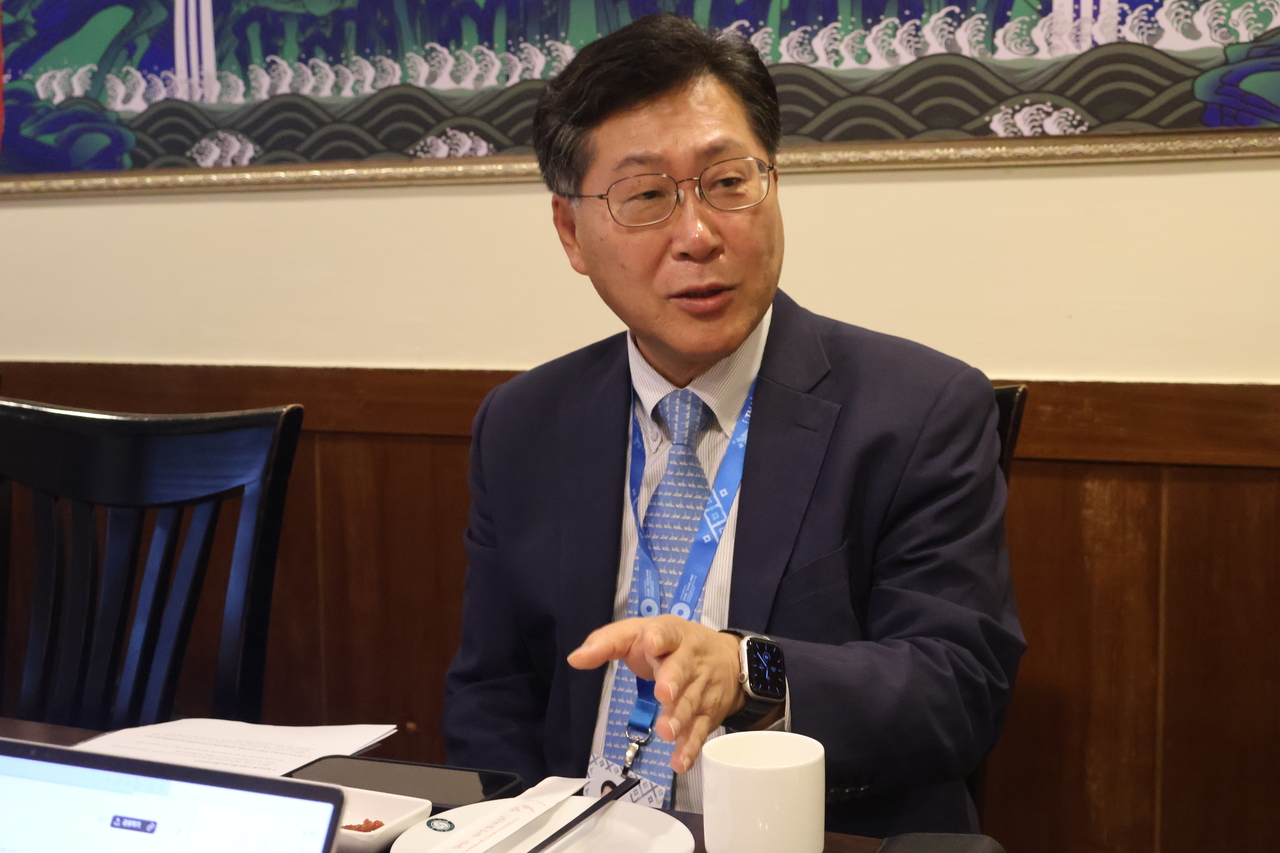
Yun Seong-eun, head of the corporation's rural energy division, said the institution must fulfill its fundamental mission of food production and food security. "We are making efforts to actively participate in the renewable energy transition, but structural limitations are inevitable," he said.
He pointed to the potential financial burden of failing to meet a mandatory supply quota. "If we assume a shortfall of 1 GW against the target, we would have to pay approximately 1.3 trillion won," Yun said. "It could reach a point where every won of the agricultural budget has to be poured into the power fund just to pay fines."
The 1.3 trillion won figure, however, is an estimate the corporation calculated on its own based on a hypothetical scenario. Whether the corporation will actually be designated as a mandatory supplier has not been decided, and neither the institution-specific quotas nor the fine criteria have been finalized.
Agriculture ministry says no to mandatory designation; climate ministry says interministerial talks will decide
The disagreement between the two ministries has been building since last month. The Ministry of Agriculture, Food and Rural Affairs conveyed its opposition to designating the Korea Rural Community Corporation as a mandatory supplier — on the same terms as power generators — at a solar energy promotion TF meeting chaired by Climate Minister Kim Sung-hwan on Sept. 17.
Kim So-hyeong said she had conveyed at the time "the agricultural sector's concern that, since the Korea Rural Community Corporation's institutional mission is not power generation, imposing the same obligations as on power generators could prevent it from properly carrying out its original duties."
The climate ministry is also weighing the fact that the Korea Rural Community Corporation, unlike other public institutions, is legally permitted to engage directly in power generation. Yun Jeong-won said institutions such as the Korea Expressway Corporation are considered candidates for target management — a role focused on opening their land to power developers — whereas the law governing the Korea Rural Community Corporation has been amended to allow it to conduct power generation directly, not just open its sites. She added, however, that "the agriculture ministry has its own position on the corporation's founding purpose, so consultations will be necessary."
The absence of the Ministry of Agriculture, Food and Rural Affairs and the Korea Rural Community Corporation from the hearing's panel also exposed the divide between the two sides.
Yun Seong-eun said the corporation had made its position clear but received no official invitation to participate in the hearing and was not included in the panel discussion. "This is a matter that requires thorough discussion with the agriculture ministry and other relevant agencies, and excluding the parties directly involved raises questions about whether the climate ministry is seriously thinking through its direction," he said.
The climate ministry said the hearing was not a venue for deciding whether any specific institution would be designated as a mandatory supplier. Yun Jeong-won said the event was not a formal announcement designating any particular institution and that, as a public hearing open to all, anyone could apply to attend. "Since interministerial consultations will take place, the climate ministry cannot make a unilateral decision," she said.
The Ministry of Agriculture, Food and Rural Affairs plans to submit its formal opinion to the climate ministry by Oct. 8, asking that the Korea Rural Community Corporation be excluded from the mandatory supplier designation. The climate ministry intends to finalize the list of obligated entities and institution-specific quotas through interministerial consultations following amendments to the enforcement decree and implementing rules. Full-scale negotiations between the two ministries over the corporation's designation are expected to begin in earnest.
adastra@heraldcorp.com