
37,440 villa transactions recorded in Seoul since Oct. 15 policy
Seoul villa prices up 6.25% cumulatively this year
Gap investment and survival buying drive transaction surge
Expert: 'Balloon effect' shifting demand from apartments to villas
![A cluster of villas in Yongsan-gu, as seen from Namsan. [Herald DB]](https://wimg.heraldcorp.com/news/cms/2026/10/15/ams.V01.photo.HDN.P.20240904.202409040641090767641539_P1.jpg)
Lee, a woman in her 30s living in Seoul who is preparing for marriage, has been making the rounds of real estate offices every day in search of a home for her and her future spouse. With loans factored in, she can scrape together around 600 million won ($448,000). With apartment prices soaring beyond her reach, she has turned her attention to villas — low-rise multi-unit housing. "Finding an apartment in the location I want within Seoul is effectively impossible with that budget," she said. "I figured that if I'm going to be renting anyway, it makes more sense to get ahead of the curve and buy a villa in an area with redevelopment potential, so I've been looking at early-stage redevelopment listings in places like Singil."
A year after the Oct. 15 housing market stabilization measures took effect, demand for homeownership is visibly shifting toward Seoul's villa market — a segment not covered by the land transaction permit regime introduced under the policy. Driven by both investors and genuine homebuyers targeting prime locations with redevelopment prospects, villa transaction volumes in Seoul have surged nearly 20% in a single year.
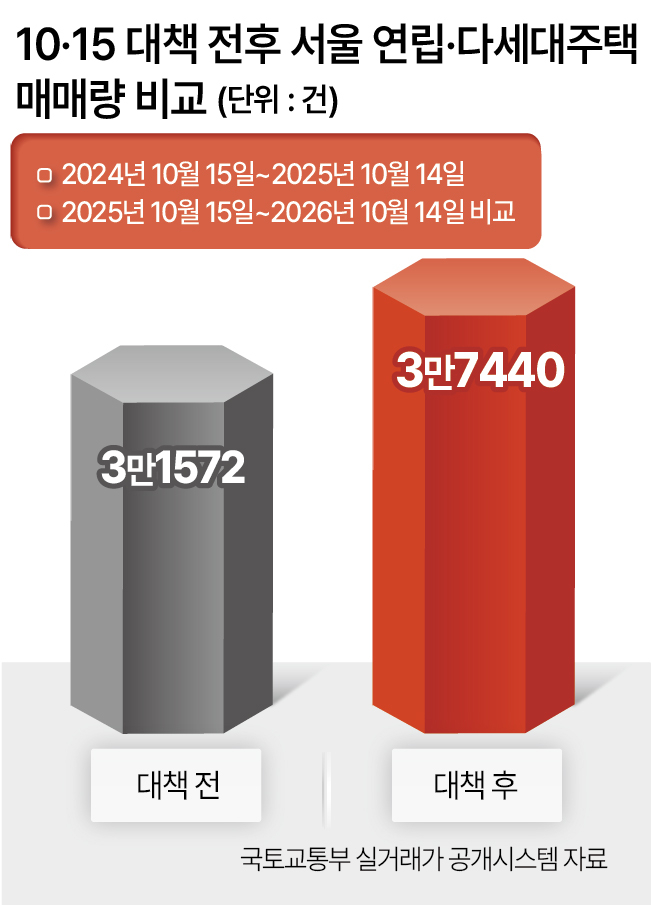
According to the Ministry of Land, Infrastructure and Transport's actual transaction price disclosure system, Seoul villa sales from Oct. 15 last year — when the Oct. 15 measures were announced — through Wednesday totaled 37,440 transactions. That represents an increase of about 19% from the 31,572 transactions logged in the same period a year earlier. With the reporting deadline for September and October transactions still pending, the gap is expected to widen further.
Compared with the 25,828 transactions recorded two years earlier — from Oct. 15, 2023, to Oct. 14, 2024 — the latest figure represents a jump of nearly 45%, an increase of more than 10,000 transactions.
The primary driver behind the surge in villa transactions is the tightening of apartment regulations under the Oct. 15 measures. The government expanded the land transaction permit zone beyond the existing three Gangnam districts — Gangnam, Seocho and Songpa-gu — and Yongsan-gu to cover all of Seoul and 12 areas in southern Gyeonggi Province: Gwacheon, Gwangmyeong, Seongnam (Bundang, Sujeong and Jungwon), Suwon (Yeongtong, Jangan and Paldal), Anyang Dongan, Uiwang, Hanam and Yongin Suji. The permit requirement was limited to apartments and villa complexes containing at least one apartment building.
Ordinary villas not subject to those restrictions — excluding sites designated under the fast-track integrated redevelopment planning scheme — carry no owner-occupancy requirement, allowing them to absorb both investment and homebuying demand at the same time. Because gap investment, in which a buyer purchases a property already under a jeonse lease, remains possible, the upfront capital burden is lower than for apartments, drawing in buyers hoping to eventually secure redevelopment move-in rights.
Ko Joon-seok, a professor at Yonsei University's Sangnam School of Management, said the balloon effect driven by regulation manifests not only geographically but also across real estate asset types. "Buyers who cannot move to the outskirts of Seoul or Gyeonggi Province are increasingly choosing villas over apartments while staying in their preferred locations," he said.
Ko added that with more than 300 areas in Seoul now designated as redevelopment zones, and a steady stream of announcements about project numbering and site designations, younger buyers are flocking to the villa market on the expectation that waiting a decade could yield an apartment. "For buyers who cannot afford an apartment, villas with redevelopment upside and a relatively lower price tag are becoming a realistic alternative," he said.
Analysts say the worsening jeonse and monthly rent crunch is adding another layer of demand. As rental costs — whether for an apartment or a villa — continue to climb, more tenants are concluding that buying makes more financial sense, and survival-driven buying is increasingly flowing toward villas in areas slated for redevelopment.
The influx of demand this year has also steepened the price trajectory. According to the Korea Real Estate Board's national housing price trend survey, the cumulative increase in Seoul villa sale prices from January through August reached 6.25% — 3.7 times the 1.68% rise recorded over the same period last year.
Market watchers expect the trend to persist. Ko said that while the villa market had remained depressed during the COVID-19 pandemic in the wake of widespread jeonse fraud, tighter apartment regulations are now redirecting demand toward villas, producing a broad recovery in both prices and transaction volumes. "The balloon effect means this trend will continue for now," he said.
hwshin@heraldcorp.com





