
Civil society, academics and BPA join roundtable on North Port transit center
Participants call for re-verification of transit functions and stronger administrative oversight
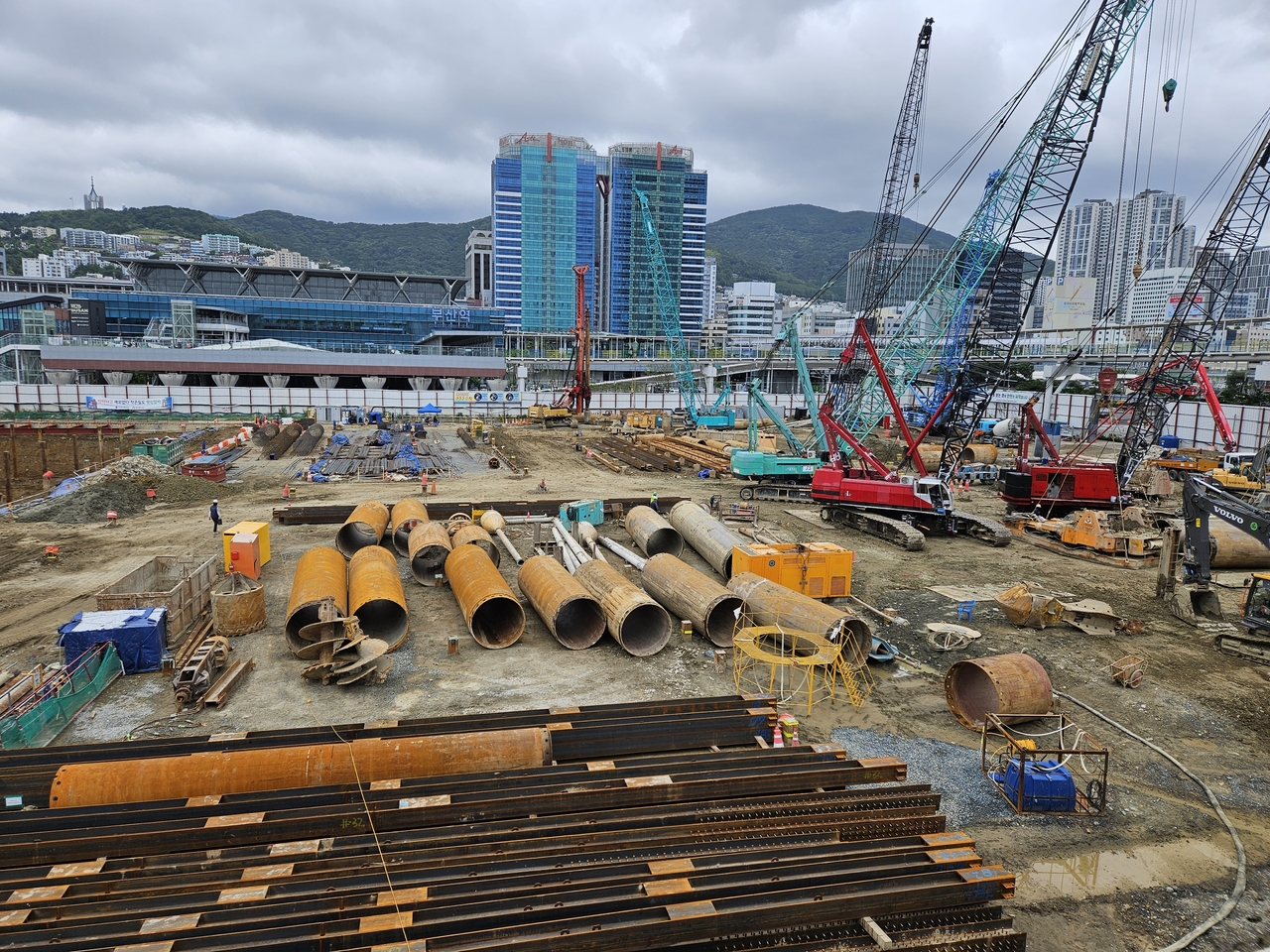
Calls are growing for Busan's North Port complex transit center to restore its transportation and pedestrian functions and serve as genuine public infrastructure for residents. At a public-private roundtable held Thursday afternoon at the Busan City Council's main conference room, participants identified transit functionality and public purpose as the core benchmarks for evaluating the project.
At the heart of the debate is whether the facility's transit functions meet the required standard. Kim Kyung-soo, a professor at Korea Maritime and Ocean University who presented at the forum, said the district-unit plan guidelines require transit facilities to occupy at least 40 percent of the total site area, but that disputes have arisen over whether outdoor pedestrian walkways and exterior spaces — which are excluded from gross floor area calculations — can legitimately be counted toward that threshold. He added that the floor area dedicated to transit convenience facilities stands at 515 square meters, no more than 6 percent of the building's total gross floor area.
Participants focused on the public-interest dimension of the North Port transit center. Park Jae-yul, chairman of the steering committee of the North Port Redevelopment Pan-Citizen Promotion Council, said the North Port redevelopment is a public project meant to reconnect the original city center with the sea, and called for an integrated design of the pedestrian and public-transit network linking Busan Station, North Port and the international passenger terminal — one that people with disabilities and the elderly can use without difficulty. Kim Hyun-soo, a professor at Pukyong National University, said the situation should be treated not as a simple contract dispute but as an opportunity to redesign Busan's urban space and its future.
Jeong Young-seok, a professor at Korea Maritime and Ocean University, highlighted the clash between public interest and profitability exposed by the contract cancellation, as well as gaps in oversight, and called for strengthening the effectiveness of the district-unit plan and establishing a cross-verification system between the Busan Port Authority and Dong-gu. Yang Jae-hyeok, a professor at Dong-eui University, called for a review of permits to secure adequate transit facility space and for the creation of an independent expert body to improve transparency throughout the development of public land.
Kim Hoe-kyung, a professor at Dong-A University, said that even if private business viability is acknowledged, it must be rigorously verified that aggressive project expansion or profit-driven design does not encroach on public functions. Lee Sang-guk, a senior researcher at the Busan Research Institute, said transit facilities should not be fitted into whatever space remains after commercial facilities and building scale are determined. Instead, he said, the location and scale of transit facilities and their connection routes to Busan Station should be secured first, with the commercial viability of revenue-generating facilities examined within those constraints.
Song Hun, head of the BPA's port regeneration project division, said that if the court's compulsory mediation ruling is finalized, the developer will prepare a revised design correcting violations of the district-unit plan and seek an amended building permit. He added that the BPA would closely review whether the public-interest reinforcement measures are actually reflected in the final design.
Meanwhile, a representative of Hyupsung General Construction, the project developer, said a court mediation ruling was issued earlier this month covering disputed points including the resolution of level differences on the pedestrian deck, development delay penalties and demolition performance deposits, and that both sides have agreed to accept it. "In effect, an agreement has been reached — all that remains is signing," the representative said.
kaf2002@heraldcorp.com





