
- Daedeok Special Zone holds aerospace open innovation briefing
- Up to three companies to be selected for one-on-one technology matching with Korean Air
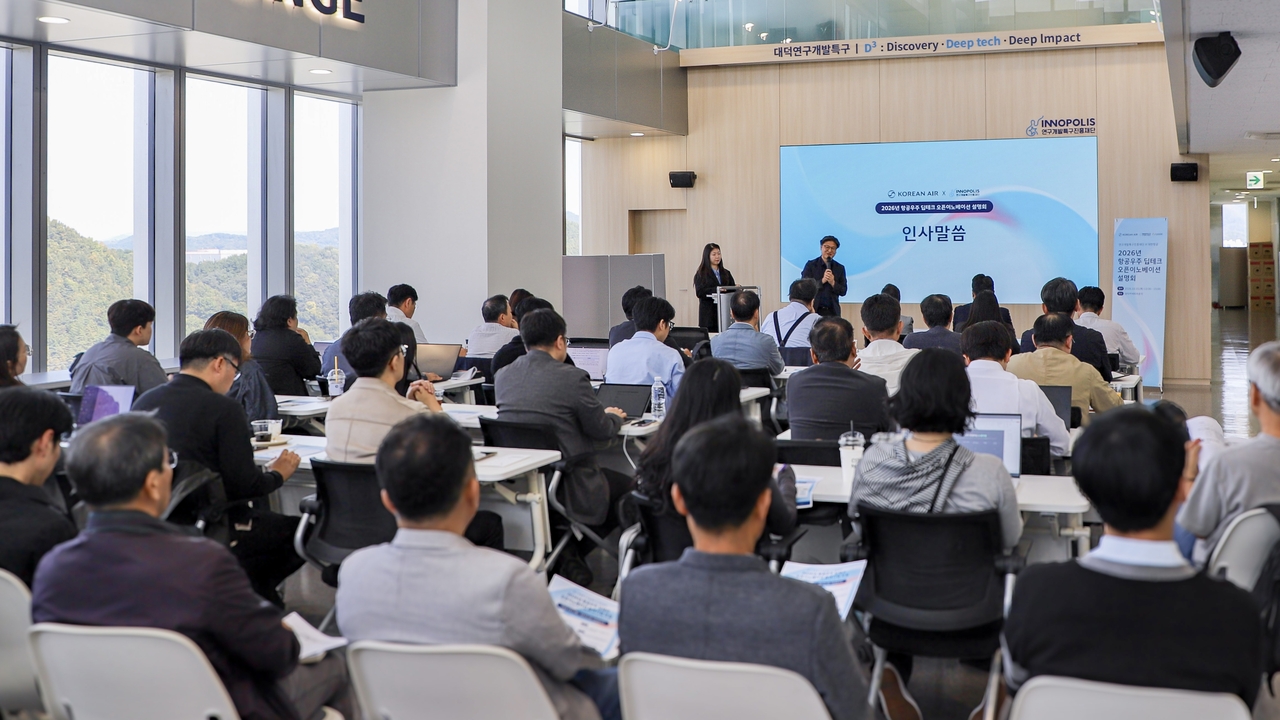
Korean Air is teaming up with deep tech companies in the Daedeok Research and Development Special Zone to secure key drone technologies, expanding cooperation in the aerospace and defense sectors — from GPS-independent navigation systems to test and evaluation software.
The Daedeok Research and Development Special Zone, operated by the Korea Research Institute of Science and Technology Promotion, said Thursday it co-hosted the "2026 Aerospace Deep Tech Open Innovation Briefing" with Korean Air at the Daedeok Connect Lounge inside the Daejeon Science Center.
The event was organized to help deep tech companies in the Daedeok Special Zone break into the aerospace and defense markets, sectors that demand high levels of technical reliability and proven field experience.
Central to the initiative is Korean Air disclosing the specific technologies it needs for real-world operations, then connecting with special zone companies that possess those capabilities to pursue joint R&D and technology demonstration.
About 60 representatives from aerospace and defense companies in the special zone attended the briefing. Korean Air outlined its major business activities, the key technologies it requires for drone development, the company selection process, and follow-up support plans.
The primary technology needs include integrated navigation systems capable of accurately determining a drone's position and orientation without GPS signals, and software for drone testing and evaluation based on international standards.
Companies are also invited to propose technologies of their own choosing that could support medium- to long-term cooperation in future aerospace fields, including unmanned aerial vehicles, military aircraft, urban air mobility and space.
The Daedeok Special Zone and Korean Air will accept applications through Oct. 23, after which they plan to select up to three companies whose technologies best match the stated needs.
Selected companies will undergo one-on-one technology matching sessions with Korean Air researchers to assess how their technologies could be applied in the field and to map out concrete plans for demonstration projects and joint R&D.
The Daedeok Special Zone said it will continue to support special zone companies in entering the aerospace and defense markets after the technology matching phase, through regulatory support, demonstration linkages and investment attraction.
"The deep tech capabilities built up in the Daedeok Special Zone over more than 50 years, combined with the expertise of Korean Air as a leader in South Korea's aerospace industry, will create new opportunities for collaboration," said Im Moon-taek, head of the Daedeok Special Zone. "We will continue to create opportunities for cooperation with industry so that special zone companies with outstanding technology can break into the high-barrier aerospace and defense markets."
nbgkoo@heraldcorp.com





