NH-Amundi Asset Management press briefing
'Even extreme scenario puts 5,000 level at undervalued'
Samsung, SK hynix shareholder returns seen as rerating catalyst
Batteries, EVs and SMRs among sectors to watch
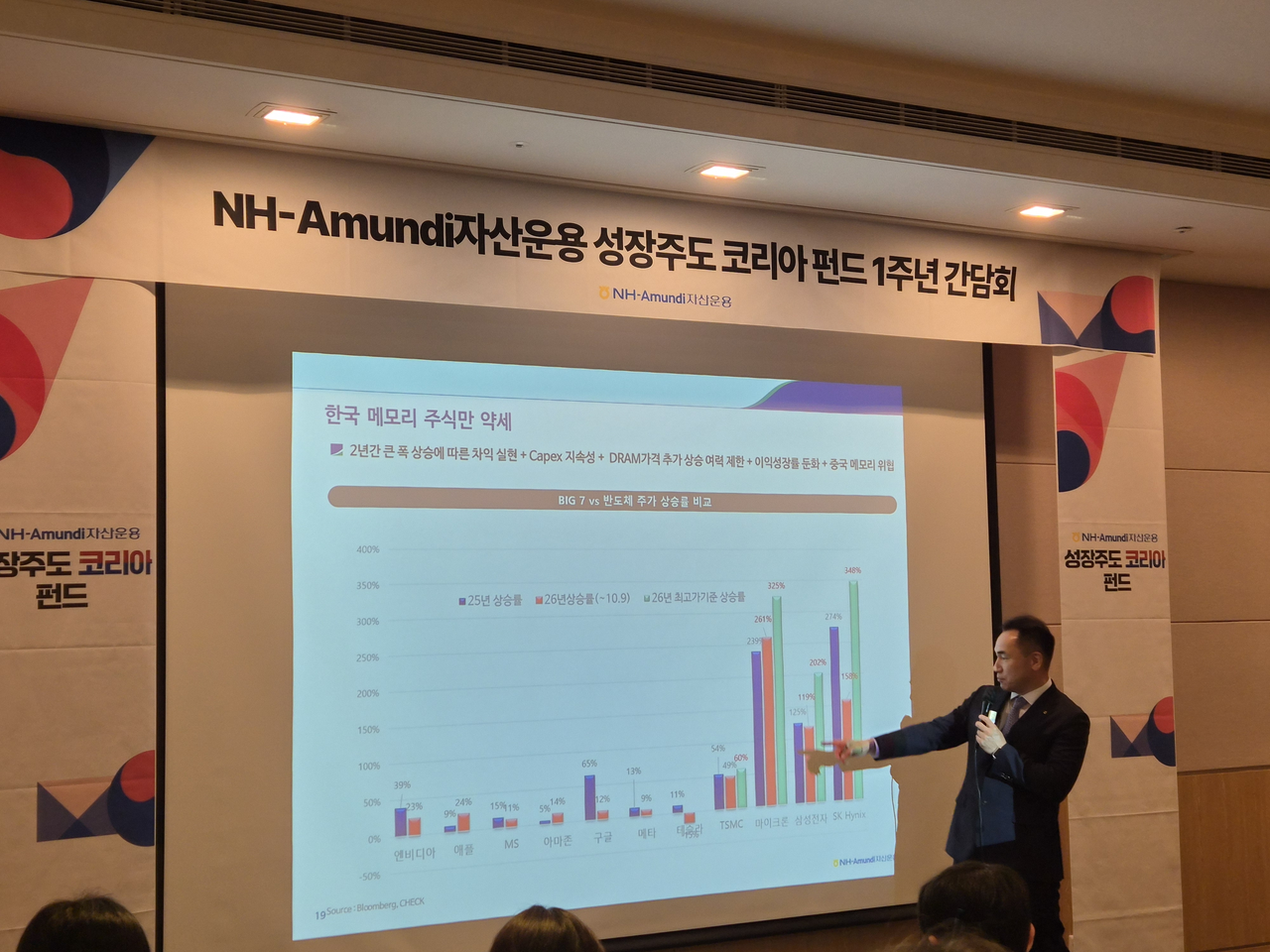
Amid heavy foreign selling centered on semiconductor stocks, an analyst has said the Kospi is approaching its floor. Even applying the market's most extreme pessimism, Korean equities remain undervalued, and shareholder return policies from the country's top two chipmakers are expected to serve as the main catalyst for a market rerating, the analyst said.
Park Jin-ho, chief investment officer and head of equity management at NH-Amundi Asset Management, said Monday at the NH-Amundi Growth-Led Korea Fund one-year anniversary press briefing at FKI Tower in Yeouido, Seoul, that "even if we make 100 concessions and discount next year's earnings from Samsung Electronics and SK hynix by 60 percent — assuming they earn only 300 trillion to 400 trillion won ($298 billion) — the current Kospi level in the 5,000s is still the bottom."
Samsung, SK hynix shareholder returns seen hitting 300 trillion won next year
Park projected that even after applying a 60 percent haircut to the combined earnings forecast of roughly 900 trillion won for Samsung Electronics and SK hynix next year, adding the remaining listed companies' earnings of around 300 trillion won would still yield a total of about 600 trillion won. Given that the domestic stock market's total market capitalization stands at around 4,500 trillion won, that implies a price-to-earnings ratio in the single digits.
In other words, even under the worst-case scenario of a semiconductor earnings slump, Korean equities are clearly in undervalued territory, he said.
Park also noted that large-scale buybacks by Samsung Electronics and SK hynix have filled the gap left by foreign outflows and will continue to play an important role in the domestic market. "Foreigners sold 200 trillion won worth of shares this year, while buybacks reached 66 trillion won," he said. "A significant portion of what foreigners sold was absorbed."
Samsung Electronics has pledged to return 50 percent of its free cash flow to shareholders. "This year's FCF is around 230 trillion won, so the company said it would return 110 trillion won, and it has already executed 70 trillion won of that," Park said. "Next year, FCF could reach 400 trillion won, and half of that would be 200 trillion won."
The combined shareholder return from Samsung Electronics and SK hynix is expected to reach around 300 trillion won next year. A similar scale is anticipated for 2028 if long-term supply contracts account for more than 50 percent of sales.
'Hold Samsung Electronics 3 years and dividends alone return 30%'
Park was particularly bullish on Samsung Electronics, saying that "if you hold on for three years, you can pocket 30 percent from dividends alone."
The math is based on the scale of shareholder returns. The total amount Samsung Electronics returns to shareholders through dividends and buybacks — measured against market capitalization — is estimated to rise from 2.3 percent in 2025 to 7.1 percent this year and 12.9 percent next year. If next year's return rate is sustained for three years, the cumulative return would reach 30 percent even without any share price appreciation. The projection, however, rests on the assumption that Samsung Electronics' free cash flow reaches 400 trillion won next year. If the memory market turns down and earnings shrink, the scale of returns would shrink accordingly.
Park acknowledged that "dividends alone do not drive share prices up," but pointed to Apple as a precedent — a company that delivered share price gains through massive shareholder returns during a period of slowing earnings growth.
After its high-growth phase in the 2010s gave way to slower expansion, Apple pushed its shareholder return ratio above 100 percent starting in 2018. Its share price did not rise in the first year, but once the returns kept coming, the stock surged roughly 90 percent in 2019 without any earnings growth. Samsung Electronics, Park argued, could see a similar rerating if it consistently follows through on its shareholder return commitments.
Park cited three reasons why Korean memory stocks are relatively vulnerable. The first is the customer base: debt-laden, early-stage cloud companies such as CoreWeave have been rattled by rising interest rates, weighing on demand. The second is competition: unlike GPUs and foundry services, which are effectively monopolistic, the memory market is intensely competitive.
The third factor is that the stocks simply ran up too much. Last year, Nvidia gained 39 percent, Apple 9 percent and Amazon 5 percent — relatively modest moves. But Samsung Electronics surged 125 percent and SK hynix 274 percent, both posting triple-digit gains. This year, measured from each company's peak, the respective gains stand at 202 percent and 348 percent — an overwhelming outperformance.
Park nonetheless maintained that the AI investment cycle has not peaked. The combined order backlog of the three major cloud providers — Amazon, Google and Microsoft — stands at $1.7 trillion, 2.5 times higher than a year ago. Hyperscaler capital expenditure is forecast to grow from $491 billion in 2025 to $950 billion this year and $3 trillion by 2030. "New business models are emerging alongside the spread of AI agents, and the AI cycle is now entering full swing," he said.
Investment continues despite high rates — a 60-40 Korea-US strategy
Park offered a contrarian view on concerns about high interest rates. "People think investment happens when rates are low and stops when they are high, but I think it is the opposite," he said. "If you are sure you can make money by investing, you do it even at high rates."
He added that during the 2000 IT bubble, corporate debt ratios climbed by 10 percentage points in just a few years, whereas US corporate debt ratios have actually fallen recently. "A debt crisis among hyperscalers is not imminent," he said.
Park forecast that the Korean stock market would gradually trend upward through the first half of next year, even as high interest rates persist. In line with that view, he proposed a two-track strategy: investing simultaneously in the semiconductor-centered AI value chain and in quality stocks resilient to high rates.
On asset allocation between domestic and overseas markets, he said: "We have to acknowledge what we have to acknowledge — the US is stable. But because Korea's short-term drawdowns are far steeper, I recommend 60 percent Korea and 40 percent US."
Beyond AI, Park highlighted the green transition as a sector to watch. The government announced its Korean Green Transformation strategy on Oct. 7, pledging 1,000 trillion won in climate finance over 10 years and targeting a 2.7-fold increase in renewable energy capacity — from 37 gigawatts to 100 gigawatts by 2030. "Wherever money flows, new companies inevitably emerge," Park said, singling out batteries, electric vehicles and small modular reactors as areas of interest.
The NH-Amundi Growth-Led Korea Fund posted a return of 84.86 percent in its first year as of Wednesday, outperforming the Kospi's 67.63 percent gain over the same period by 17.23 percentage points.
jiyun@heraldcorp.com