2026 Capital Future Vision Forum
Non-auto lease share of equipment investment falls from 21% to 1.3%
Experts call for expansion into GPU servers, logistics robots and other future industries
Auto-backed loans may qualify as mid-rate lending; FSC pledges regulatory overhaul
Experts are calling on capital finance companies to move beyond their heavy reliance on auto installment lending and expand into equipment financing for future industries such as robotics and AI infrastructure. They argue that capital firms should leverage their accumulated expertise in asset valuation and management to support corporate equipment investment — and that their permitted business scope should be broadened to include used-car trading and insurance sales to make that possible.
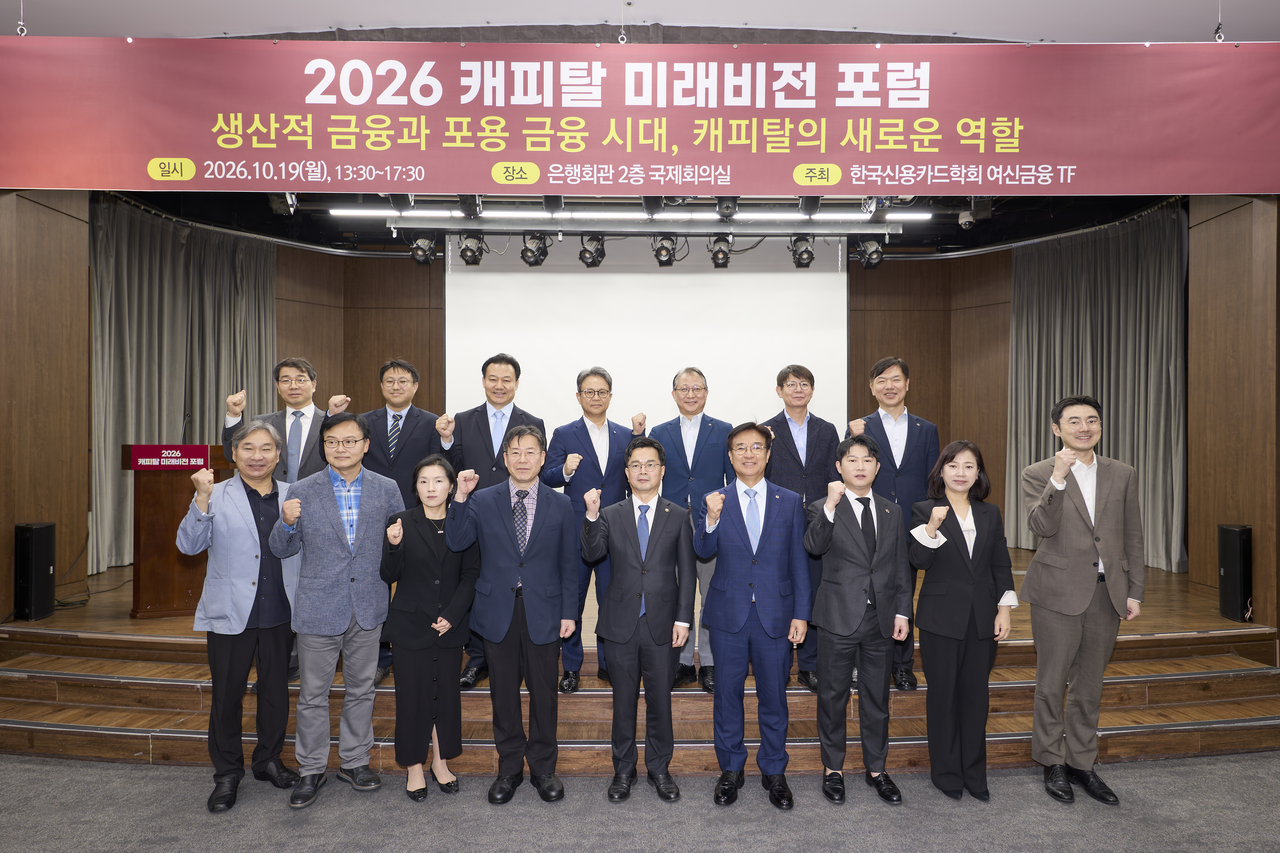
Those proposals were among the topics discussed Monday at the 2026 Capital Future Vision Forum, held at the Korea Federation of Banks building in Jung-gu, Seoul, and organized by the Korean Credit Card Studies Association. The forum focused on expanding the productive and inclusive finance roles of capital companies and the regulatory reforms needed to support them.
Yoon Jong-moon, a research director at the Credit Finance Association's financial research institute, said the domestic leasing industry is overly concentrated in auto finance. Presentation data showed that the share of non-auto leases in total domestic equipment investment plunged from 21.0 percent in 1995 to 1.3 percent in 2025. Meanwhile, automobiles accounted for 81.6 percent of total lease originations last year.
"The government has said it will invest 200 trillion won ($149 billion) over the next five years through the National Growth Fund, but I believe leasing and asset-based finance have been left out," Yoon said. "Investing in the AI industry requires facility investment in things like GPUs, and we need to think carefully about who will bear the risk tied to the residual value of those assets."
He particularly stressed the need to draw on capital companies' asset management expertise, noting that the value of future-industry assets such as GPU servers, data center equipment and logistics robots can shift rapidly with technological change. "A leasing company's profitability depends on how well it manages residual-value risk," he said. "We need companies with the expertise to manage that uncertainty while supplying financing to businesses that need it."
Yoon also proposed regulatory reforms to support the shift. "Capital companies should be allowed to trade used cars and sell insurance, expanding the asset management and service scope of existing auto leases," he said. "The asset management capabilities built there can then be extended to future mobility, AI, robotics and other equipment finance segments."
Calls were also raised for capital regulation reform to expand the corporate finance and investment functions of capital companies. According to Kim Gyu-rim, a managing director at Samjong KPMG Economic Research Institute, total assets held by 55 capital companies grew from 178.4 trillion won at end-2020 to 263.1 trillion won at end-June this year. Over the same period, the share of corporate loans rose from 31.4 percent to 36.1 percent, while the share of investment assets climbed from 10.8 percent to 15.9 percent.
"Even before the government began emphasizing productive finance, capital companies were already shifting their asset mix away from household lending and toward corporate loans and investment finance," Kim said. "They should treat productive finance not merely as a policy response but as an opportunity to secure new growth engines."
She added that capital regulation should be refined to reflect the actual risk level of each asset class. "The current capital regulation framework for capital companies lacks a risk-weighting system by asset type, making it difficult for regulations on high-risk assets or incentives for productive finance to function properly," Kim said. "Capital requirements need to be rationalized by taking into account loss rates and recovery rates for each asset." She added that equity investment and investment regulations should also be rationalized to match the investment functions of new-technology finance.
Proposals were also put forward to ease regulations on auto-backed loans in the name of expanding inclusive finance. Seo Ji-yong, a professor in the business administration department at Sangmyung University, said self-employed workers who rely on vehicles for their livelihood struggle to generate income without a car. "We should support them in continuing to use their vehicles, borrowing the funds they need against them as collateral, and repaying the loans from their business income," he said.
Seo proposed that auto-backed loans meeting certain interest rate and consumer protection requirements be recognized as mid-rate loans and considered for exclusion from aggregate household lending caps. "Mechanically excluding collateral-backed loans from mid-rate loan classification simply because they are secured loans is something that needs to be fixed," he said.
He also called for reforms to rental business regulations tied to the size of lease assets, and for greater activation of joint lending and linked financing between banks and capital companies. He further identified cash-flow-based loan screening and expanded pre-delinquency repayment support as priorities.
Financial regulators signaled their support for expanding the role of capital companies. FSC Vice Chairman Shin Jin-chang, appointed Friday, said in a congratulatory address that the scale of capital companies' corporate finance is approaching 100 trillion won, and called on the industry to become a solid pillar of productive finance by supporting equipment investment in advanced industries and the growth of innovative companies.
"The government will also actively support the capital industry in expanding its role in productive and inclusive finance," Shin said. "We will pursue regulatory reforms to enhance the industry's autonomy and continue to identify regulatory improvement tasks to advance inclusive finance."
snsd@heraldcorp.com