64 billion won allocated for agricultural and seafood discounts; Hanaro Mart to sell discount vouchers at 20% off
Cost of kimchi-making ingredients for family of four falls 4.2% from last year to 238,280 won
October consumer prices rise 2.8%; Vice Minister Kwon says prices should be judged by shopping basket, not statistics

The government will roll out a record 64 billion won ($47.9 million) in discount support as the kimchi-making season gets underway.
Discounts will reach up to 40% on agricultural products such as napa cabbage and radish, and up to 50% on seafood items including salted shrimp and sea salt. The initiative aims to ease the burden on household budgets, which remain strained by accumulated price increases even as consumer price growth eased to 2.8% last month.
The government discussed the measures — titled the "2026 Kimchi-Making Ingredient Supply Stabilization Plan" — at a deputy minister-level price meeting Tuesday, chaired by First Vice Minister of Economy and Finance Kwon Dae-young.
A record 44 billion won will go toward discounts on agricultural and livestock products during the kimchi-making season, up 14 billion won from 30 billion won last year. Of that, 40 billion won will fund online and offline discount events tied to the Korea Grand Festival.
From Thursday through Dec. 2, discounts of up to 40% — combining a 20% government subsidy with up to an additional 20% from individual retailers — will be available at more than 4,000 locations nationwide, including hypermarkets, smaller supermarkets and online shopping platforms. The program covers 17 items in total, including napa cabbage, salted cabbage, radish, red pepper powder and garlic, as well as pork for bossam and rice.
The remaining 4 billion won will fund discounted sales of agricultural product vouchers. Mobile vouchers redeemable for domestically produced agricultural and livestock goods will be issued in a total face value of 20 billion won and sold at a 20% discount. Senior citizens may purchase them Friday through Sunday, and all age groups from Friday through Nov. 15.
Another 20 billion won will be directed toward seafood. Through a special "Korea Seafood Festival — Kimchi Season" event running from Wednesday through Nov. 29, with 56 companies participating, shoppers can receive discounts of up to 50% — a 20% government subsidy combined with up to 30% from individual vendors. Eligible items include kimchi-making staples such as salted shrimp, anchovy fish sauce, sea salt and oysters, as well as major seafood products including pollock, mackerel and squid.
Producer groups will also join the effort. Using the Korean pork industry's self-promotion fund, samgyeopsal and front-leg pork cuts for bossam will be discounted by around 20% from Friday through Nov. 30. A separate garlic industry fund will support discounts of up to 20% on garlic at Hanaro Mart locations nationwide from Nov. 12 through Nov. 25.
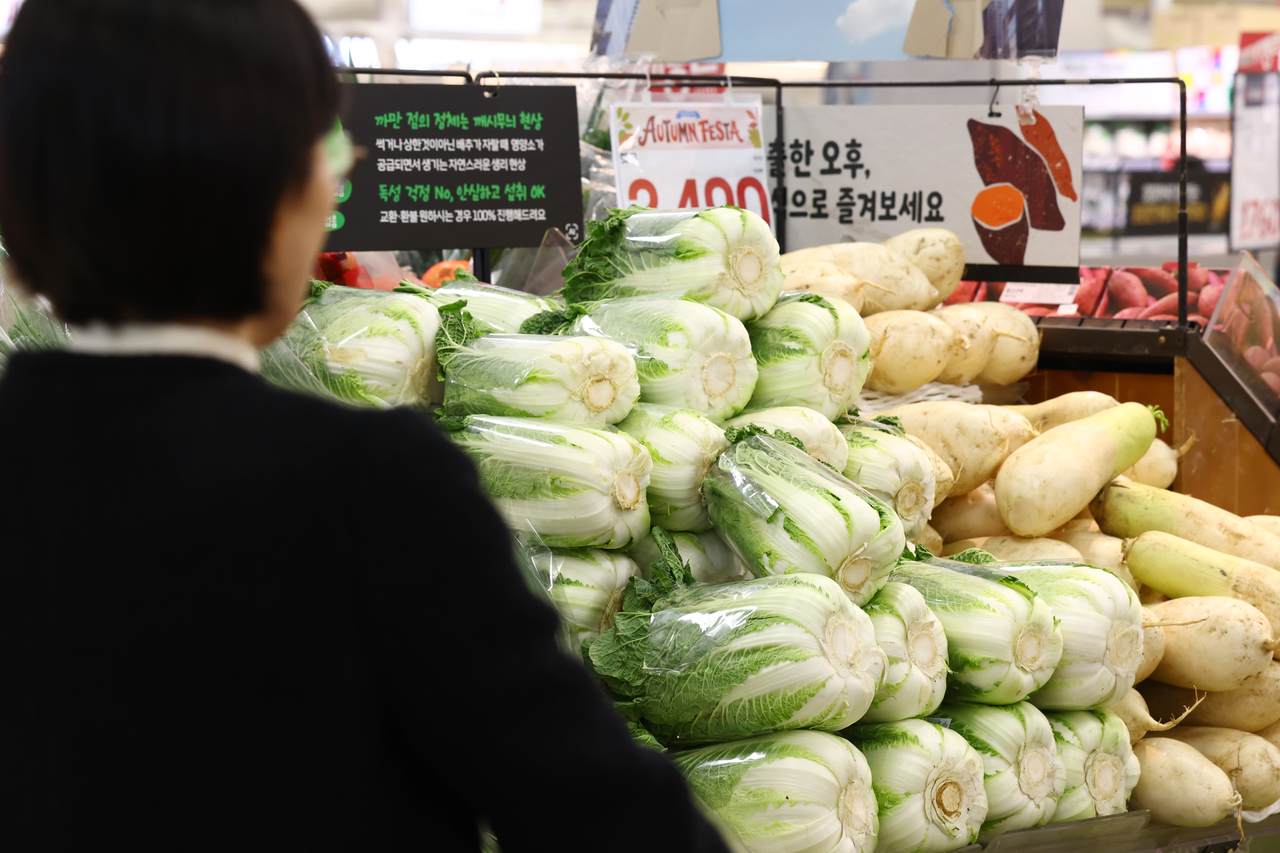
The government views overall supply conditions for kimchi-making ingredients this year as favorable. According to projections by the Korea Rural Economic Institute, autumn napa cabbage output is expected to reach 11.214 million tons, up 18.5% from last year, while autumn radish output is forecast at 372,000 tons, an 11.1% increase. Although garlic and onion stockpiles and output of some salted seafood products have declined, the government said the risk of supply disruptions remains low.
As of late October, the estimated cost of kimchi-making ingredients for a family of four stood at 238,280 won, down 4.2% from 248,609 won a year earlier. The government plans to survey prices of 13 kimchi-making ingredient categories at 53 locations across 23 regions and regularly publish cost estimates along with retailer discount information.
Demand for home kimchi-making, however, is expected to decline. A consumer survey found that 58.6% of households intend to make kimchi themselves this year, down 5.6 percentage points from 64.2% last year. While the average batch size per household remains similar to last year at 23.4 heads of cabbage, total demand for kimchi-making cabbage is estimated to fall 9.1% to 583,000 tons. The government plans to work with local governments and agricultural cooperatives to promote campaigns encouraging people to make an extra head of kimchi and share it with neighbors, in a bid to boost consumption of domestic agricultural and fishery products.
The government is also preparing for potential supply disruptions from sudden cold snaps. It will release government and agricultural cooperative stockpiles and contract-farmed produce in line with market conditions, and will encourage early shipments of winter cabbage and radish if crop conditions deteriorate. Conversely, if prices drop sharply, the government will minimize or halt the release of its available supply onto the market. Planned releases of stockpiled garlic and onions — whose reserves have thinned — will be expanded to 515 tons and 1,500 tons, respectively.
Tuesday's meeting also reviewed October price trends and winter risk factors. Last month, processed food prices rose, but prices for agricultural, livestock and fishery products fell for the third consecutive month compared with a year earlier, slowing the overall pace of price increases. The government estimated that its petroleum price cap lowered the October inflation rate by about 0.8 percentage points.
Vice Minister Kwon said perceived inflation remains high due to the cumulative effect of past price increases, and that upward pressure on prices has not fully dissipated. The government will conduct regular monitoring of everyday items including agricultural, livestock, fishery and petroleum products, while stepping up efforts to improve distribution structures and crack down on collusion and other unfair practices. It will also check whether tariff rate quotas and discount support are actually translating into lower prices for consumers.
The government will also activate its winter response framework, covering disease prevention measures against highly pathogenic avian influenza and other livestock epidemics, as well as stockpiling and early shipment preparations for El Niño conditions and cold waves.
"Prices are judged not by statistics but by what people pay at the checkout," Kwon said. "We will see this through until government support translates into real price stability in people's daily lives."
fact0514@heraldcorp.com