Government unveils sweeping measures to secure national qualification exams
Nonwoven aprons, phone collection and random mid-exam calls introduced
Detectors to find powered-off devices also coming
Score disclosure, top finishers' results to strengthen post-exam detection
Prison term for technical qualification fraud to rise from 2 to 5 years
Practical and interview-based testing to expand; on-site career certification eyed

The government plans to deploy supervisor body cameras and mobile closed-circuit television systems at rented exam venues to combat cheating using AI and miniature cameras in national qualification exams. It will also procure detection equipment capable of locating devices even when powered off, and pursue legislation to raise the maximum prison sentence for cheating on national technical qualification exams from two years to five.
The Ministry of Employment and Labor presented the measures to the Cabinet on Tuesday, outlining a reinforced anti-cheating framework covering every stage of the exam process — before, during and after testing. The package builds on steps announced at the first meeting of the National Qualification System Review and Countermeasures TF on Thursday, adding new detection tools and tougher penalties.
The strengthened supervision procedures were applied for the first time on Saturday at the security supervisor licensing exam, which drew 11,554 candidates, and six cases of cheating were detected. The government aims to complete additional remedial measures by the first half of next year, pending budget approval and regulatory amendments.
Cheating on national qualification exams has traditionally involved smuggled notes or smartphones. Smart glasses were caught being used for the first time in May, and the most recent tax accountant exam saw the appearance of miniature cameras and modified calculators. The Ministry of Employment and Labor concluded that relying primarily on supervisors' visual checks is no longer sufficient.
Mobile CCTV, body cams at rented venues; 5-year prison term sought for technical qualification fraud
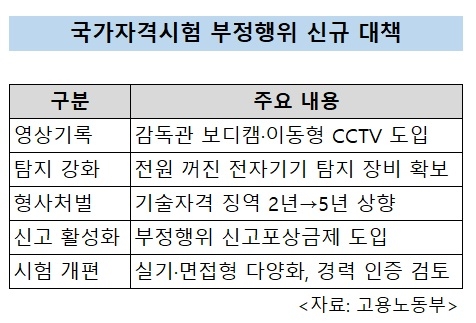
The Human Resources Development Service of Korea will expand its video-recording infrastructure so that cheating can be identified even after an exam concludes. The agency will increase the number of dedicated exam centers and introduce mobile CCTV units and supervisor body cameras at rented venues.
Detection equipment will also be upgraded. The agency will adopt radio-frequency detectors being developed by the Korea Radio Promotion Association and procure nonlinear junction detectors capable of identifying devices even when switched off. Supervisors dedicated to smart-device monitoring will be deployed in greater numbers, and a specialist workforce will be maintained through regular training and hands-on drills.
Penalties will be tightened as well. For national technical qualifications, the ban on retaking exams will be extended from the current three years to 10, and the government will pursue legislation raising the maximum prison term from two years to five. The Thursday TF meeting had proposed only the extended retake ban; the prison-term increase was added in Tuesday's package.
For national professional qualifications, the government will work with relevant ministries to establish a uniform standard for retake bans and introduce new criminal penalty provisions. A whistleblower reward program will also be launched to encourage reporting of cheating.
Score disclosure is also on the agenda. The government plans to publish the scores of the top two finishers, the overall average score and the score distribution by subject. The Thursday meeting had only indicated that a disclosure plan would be reviewed; Tuesday's announcement moved it to an active commitment.
A regular consultative body among national qualification exam administrators will be established. The agency's dedicated research function will be strengthened so that detected cases and identification technologies can be shared across relevant institutions. The government also plans to diversify exam formats for the AI era — expanding practical and interview-based assessments and streamlining redundant qualifications. A mechanism to certify individual competency through on-site work experience is under consideration.
Nonwoven aprons, phone collection — 6 violations caught at security supervisor exam
Measures available for immediate implementation were applied for the first time at the security supervisor licensing exam on Saturday. Supervisors personally verified that all mobile phones were powered off before collecting them, and placed random calls to candidates' phones before each subject began to confirm the devices remained off.
Nonwoven apron-style covers were also used to block miniature cameras from capturing exam materials. Additional supervisory staff were deployed, and a smart-device app capable of detecting Bluetooth signals was put to use.
Six violations were detected at the exam — candidates found carrying a tablet PC or smartwatch, or failing to power off a mobile phone. Starting with the remaining national qualification exams this year, exam papers and answer sheets will carry a warning stating that cheating carries a maximum prison term of two years, citing the current criminal penalty provisions to heighten candidates' awareness ahead of any legislative change.
Post-exam tracking will continue. The Ministry of Employment and Labor is conducting a comprehensive review of every national qualification exam the agency administered this year. A cheating tip-off center is also in operation, and confirmed suspicious cases will be analyzed and referred for investigation as needed.
The ministry said it would focus its efforts on restoring the credibility and fairness of national qualification exams under the principle of "thorough preparation against cheating and relentless pursuit of violations." It also plans to finalize a detailed implementation roadmap by year-end through the TF, which is headed by the vice minister.
fact0514@heraldcorp.com