① A shortfall in the co-owner's holding period threatened the buyer's right to inherit cooperative membership — resolved by transferring title before receiving the remaining balance. ② If the interest-free benefit is split equally between the two buyers, each share falls just below the gift-tax exemption threshold. ③ A seller claiming the long-term holding deduction may net more after tax by adding the financing benefit to the sale price rather than charging interest. ④ The sale was concluded before the government announced reforms to the long-term holding deduction and property-tax rules, locking in current tax benefits. ⑤ Living in the presidential residence, Lee faces no urgency to secure new housing after the sale.
The joint-ownership variable — and how seller financing cleared it
On July 17, 2017, President Lee Jae Myung and his wife Kim Hye-kyung appeared together on the SBS variety program "Dongsang Imong 2 — You Are My Destiny."
During a meal, Kim turned to Lee, who was then serving as Seongnam mayor, and said:
"There isn't even a house in my name."
She was asking to be added as a co-owner. Lee replied:
"You already own me."
The home in question was an apartment in Bundang's Yangji Village. About 16 months after that broadcast, on Nov. 29, 2018, Kim received a half-share of the property as a gift. Nearly seven years and eight months later, the couple sold the apartment through seller financing — a method in which the seller extends credit to the buyer in lieu of a conventional mortgage. The transaction brought seller financing, previously known only to a small circle of specialists, into wide public awareness.
Lee and Kim signed a sale contract on July 14 for 2.9 billion won ($2.16 million) and transferred ownership on July 16. The unpaid balance of 1.48 billion won was to be held until the end of October. The maximum secured amount on the mortgage registered against that balance — approximately 1.77 billion won — was discharged Tuesday. The discharge application was filed Saturday, effectively closing the transaction.
The reason Lee moved quickly to transfer title has been attributed to the need to preserve the buyer's right to inherit cooperative membership in the reconstruction project. The designation and announcement of the project operator for Yangji Village took place on July 27 — 11 days after the ownership transfer. In a reconstruction project carried out through a trust arrangement in a speculative-pressure zone, transferring membership status after the project operator designation is subject to restrictions. Unless an exemption applies, ownership must change hands before July 27 for the buyer to inherit cooperative membership.
There is, however, an exemption. A single-household homeowner who has held the property for at least 10 years and lived in it for at least five may transfer cooperative membership even after the announcement. Lee acquired the apartment in 1998, held it for about 28 years and lived there for more than five. Had the property been registered in his name alone, he could have relied on that exemption and transferred membership after the announcement.
The complication arose from the joint ownership. The long-term holding and residency exemption is assessed separately for each transferor. Kim received her half-share as a gift and had not yet held it for 10 years. The buyers, too, are a couple holding the property jointly.
No interest on the balance — and staying below the gift-tax threshold
When announcing the sale, Cheong Wa Dae said the couple had agreed to waive interest on the deferred balance and that any gift-tax implications would be handled in accordance with applicable rules. Han Moon-do, a professor who appeared alongside the couple on the official presidential broadcast, cited consideration for the buyers and the short duration of the deferral as reasons for the interest-free arrangement.
Under tax law, the standard interest rate used to calculate the benefit from an interest-free personal loan is 4.6 percent per year. If the calculated benefit falls below 10 million won, it is exempt from taxation. Applying 4.6 percent to 1.48 billion won over 107 days — from July 16 through Oct. 31 — yields an implied interest amount of approximately 19.96 million won. That figure is an estimate, as the actual date of the final payment has not been confirmed. If the debt and the financial benefit are each split equally between the two buyers, each share comes to roughly 9.98 million won, just under the 10 million won exemption threshold.
Im Gwang-hyeon, who was National Tax Service commissioner at the time of the transaction and is now chief of staff at Cheong Wa Dae, told the National Assembly's national audit on Oct. 13 that the agency had reviewed publicly available information and concluded the transaction did not appear to be subject to taxation.
The gift-tax obligation, if any, falls on the buyers who received the financial benefit. Did the couple's "consideration" save the buyers nearly 20 million won in interest costs?
Interest on a personal loan is typically treated as income from a non-business lending arrangement and subject to withholding tax of 25 percent — 27.5 percent including local income tax. On 20 million won in interest, the withholding amount would be 5.5 million won. The final tax burden could vary depending on how the income is aggregated with other financial income.
For a seller of a single home who qualifies for the long-term holding special deduction, reflecting the value of the financing arrangement in the sale price rather than charging interest may produce a better after-tax return. The relevant comparison is not the average effective tax rate on the total capital gain, but the incremental capital gains tax triggered by a higher sale price. If raising the sale price by 20 million won generates less additional capital gains tax than the tax on 20 million won of interest income, the seller nets more after tax by the difference.
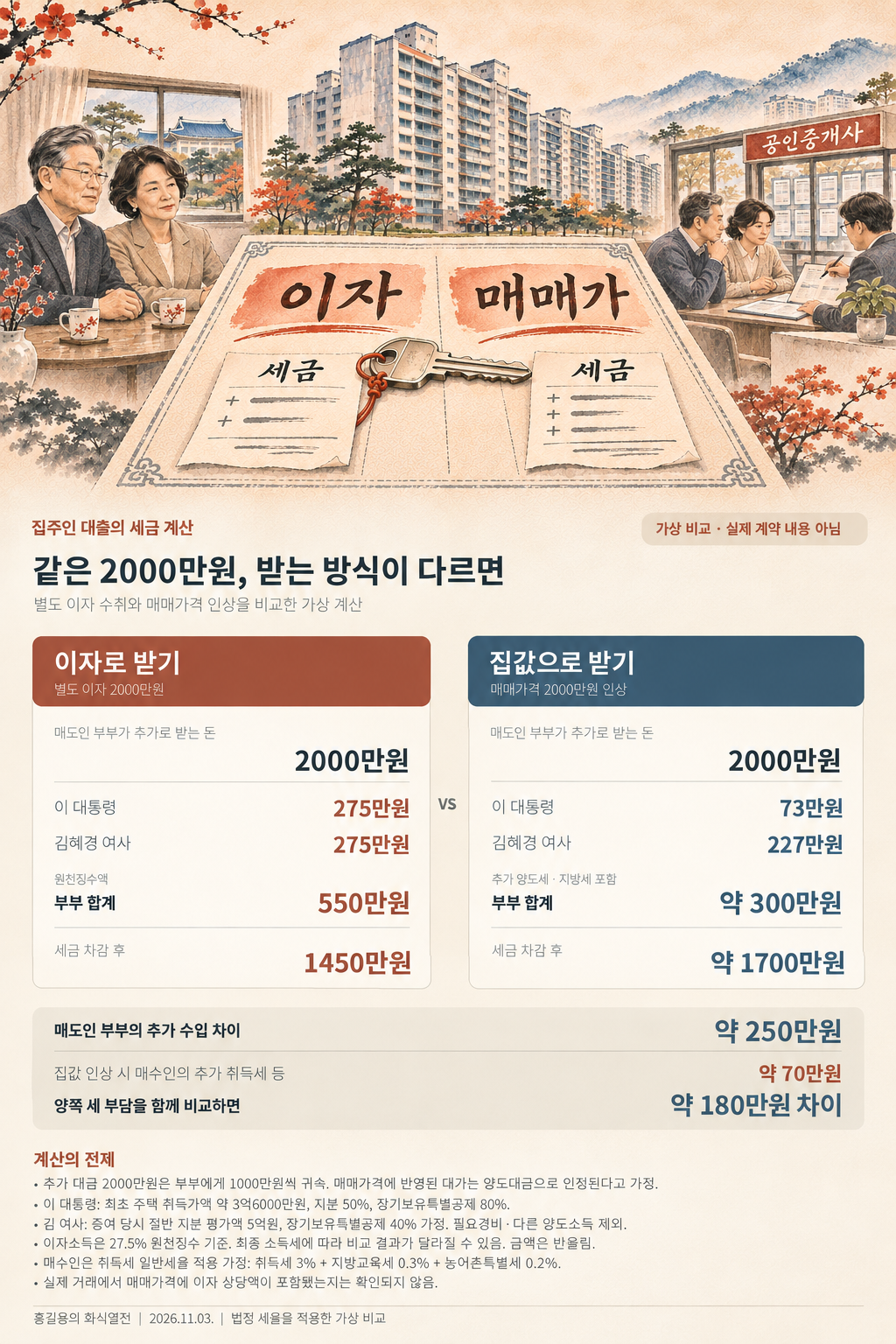
Interest income or a higher sale price — which pays more?
Does the math actually work out that way? A precise calculation is impossible without full information, but a rough estimate is instructive.
For a single-household homeowner, capital gains tax applies only to the portion of the gain attributable to the amount exceeding 1.2 billion won of the total sale price. With a holding period and residency period each of at least 10 years, the long-term holding special deduction reaches a maximum of 80 percent. Assuming an original acquisition price of approximately 360 million won, Lee's share at one-half and no deduction for necessary expenses, the estimated capital gains tax owed by Lee — including local tax — comes to approximately 39.38 million won.
If the total sale price rises by 20 million won and Lee's share of the proceeds increases by 10 million won, the additional capital gains tax would be roughly 730,000 won — about 2.02 million won less than the 2.75 million won that would be withheld on 10 million won of interest income.
Kim received her half-share as a gift in November 2018 and moved to Incheon in the first half of 2022. If she did not live in the apartment after that, her estimated long-term holding deduction rate — based on a seven-year holding period and three-year residency — would be 40 percent. Assuming the assessed value of her share at the time of the gift was 500 million won and applying no deduction for necessary expenses, her capital gains tax, including local tax, is estimated at approximately 117.39 million won.
Under the same assumptions, if Kim's share of the proceeds rises by 10 million won, the additional capital gains tax would be roughly 2.27 million won — about 480,000 won less than the 2.75 million won withheld on 10 million won of interest.
The buyers, for their part, would pay more in acquisition tax on a higher sale price. If the standard tax rate applies to this apartment, a 20 million won increase in the sale price would add a combined 700,000 won in acquisition tax, local education tax and special rural development tax. This comparison assumes the same amount is received either as interest or as a higher sale price. Whether the actual sale price of 2.9 billion won already incorporated a premium for the financing arrangement has not been confirmed.
A preview of the tax reform that would have cut these benefits
The real estate tax reform plan the government announced in August shifts the long-term holding special deduction away from rewarding long ownership toward rewarding long residency. Under the plan, the deduction for single-household homeowners — currently 4 percent per year for holding and 4 percent per year for residency — would change to 2 percent and 6 percent respectively by 2028, with only the residency component remaining at 8 percent per year from 2029 onward. A cap on the total deduction amount would also be introduced.
The comprehensive real estate tax reform would expand the basic deduction for owner-occupiers of a single home while raising the fair market value ratio and capping the tax credit. These are the terms of the government bill currently under National Assembly review.
Living in the official residence — no rush to find the next home
For a single homeowner currently living in the property, the calculation becomes more complicated. Someone who has held the home for a long time but lived there only briefly may find it advantageous to sell before 2028, when the deduction cuts begin. Continuing to live there would accumulate more residency-based deductions, but for high-value properties the deduction cap could bite, or the property-tax burden could grow substantially.
A sitting president lives in the official residence, so selling the family home creates no immediate need to find new housing. Ordinary homeowners, by contrast, must weigh the purchase price and acquisition tax on a new home, or the deposit and rent on a jeonse and monthly rent arrangement. The presidential couple sold their Bundang apartment under the current tax regime — but the ability to sell and simply wait, without scrambling for a new place to live, is not a condition most people share.
kyhong@heraldcorp.com