Climate observation satellite Shikisai's imagery reborn through advanced jacquard weaving
Exhibition runs through Nov. 19 at Tokyo's 21_21 Design Sight; future materials for space and polar use also unveiled
The vast ice sheet of Antarctica as seen from space — its deep blue seas and fractured expanses — has been rendered onto a single piece of fabric. Japanese fashion brand Issey Miyake and the Japan Aerospace Exploration Agency (JAXA) have joined forces to reinterpret satellite imagery of Earth as clothing and next-generation materials.
A-POC ABLE ISSEY MIYAKE and JAXA are presenting the collaboration at Gallery 3 of 21_21 Design Sight in Minato-gu, Tokyo, under the title "The Possibilities of a Piece of Cloth (TYPE-XVII JAXA project by A-POC ABLE ISSEY MIYAKE)."
The exhibition, which opened Oct. 21, runs through Nov. 19. At its core is an effort to merge science and fashion — extending Issey Miyake's long-pursued concept of "a piece of cloth" into the future of clothing and living environments.
The project begins with JAXA's Global Change Observation Mission for Climate, known as Shikisai (GCOM-C).
Shikisai observes Earth using not only visible light but also wavelengths ranging from near-ultraviolet to thermal infrared. It continuously monitors the state and changes of oceans, land, vegetation, snow and ice, collecting data needed to analyze and predict climate change.
What caught the attention of the fashion designers was the satellite's imagery of Antarctica.
The continent's vast ice sheet — averaging about 2 kilometers in thickness — its fractures and crevasses, and the deep indigo sea revealed between them appeared as a single abstract pattern. That vision of Antarctica, shaped by nature itself, became the starting point for translating the landscape into clothing design.
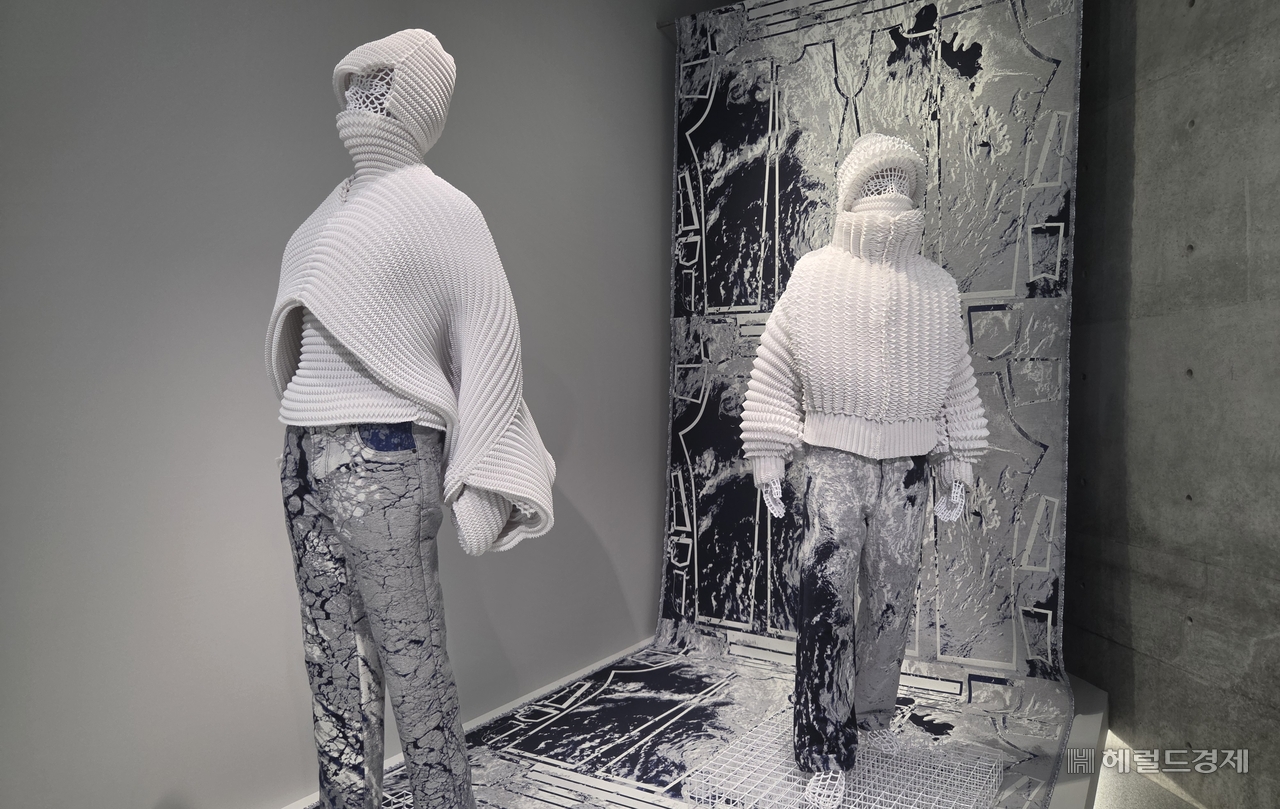
A-POC ABLE ISSEY MIYAKE translated the satellite observation imagery into a pair of jeans using advanced jacquard weaving. Rather than simply printing the satellite photograph onto fabric, the team varied the density of the weave structure itself to capture the contrasts, gradations and tonal shifts produced by ice and sea.
Antarctic satellite data had traveled from digital image to textile to wearable garment.
The exhibition goes a step further. Beyond the jeans made from JAXA's observation imagery, it proposes new possibilities in fabric structure that could be applied to future clothing and living environments.
The project also involved collaboration with the laboratory of Tomohiro Tachi at the University of Tokyo — which has long studied the geometry and structure of origami — to develop materials that give fabric a three-dimensional structure of its own.
The exhibition features prototypes using "Steam Stretch" technology, in which applying heat causes specific sections of the fabric to contract and form three-dimensional shapes.
The design principle is that a single piece of cloth folds and contracts to create its own three-dimensional form. The approach explores the possibility of constructing a wide variety of garments while reducing dependence on sewing.
The research does not stop at the conventional fashion market.
The scope extends to expanding the role of textiles beyond clothing to interior materials and architectural components — the full range of spaces that surround the human body. The long-term vision is to develop materials and structures suited to the extreme environments where human activity will expand, including space and polar regions.
In space and at the poles, available materials, equipment and space are severely limited. Rather than treating those constraints as mere inconvenience, the project frames them as conditions for creation — a catalyst for new structures and functions.
A-POC stands for "A Piece of Cloth." The late Issey Miyake introduced the concept in Paris in 1998, born from an effort to rethink the very process by which a garment emerges from a single piece of fabric.
A-POC ABLE ISSEY MIYAKE, launched in 2021, has continued to extend that concept beyond fashion, connecting it with technology, science, craft and other fields.
The collaboration with JAXA follows that same trajectory — linking the view of Earth captured by a satellite hundreds of kilometers above with the clothing that sits closest to the human body, within a single project.
Ice from Antarctica, seen from space, becomes a pair of jeans; research into a piece of cloth turns back toward the living environments of space and the polar regions.
"The Possibilities of a Piece of Cloth" is proving to be more than a fashion exhibition — it is a testing ground for how far the role of clothing can be extended when Earth observation technology and design converge.
sjkim@heraldcorp.com