Forum hears plan to cluster Korea Development Bank, Industrial Bank of Korea, Export-Import Bank of Korea and Financial Supervisory Service in Yeouido
KDB relocation to Busan seen as dropped; regional investment corporations proposed instead
Administrative capital bill targeting year-end passage; special apartment supply for civil servants to be revived
'Seoul like New York, Sejong like Washington'
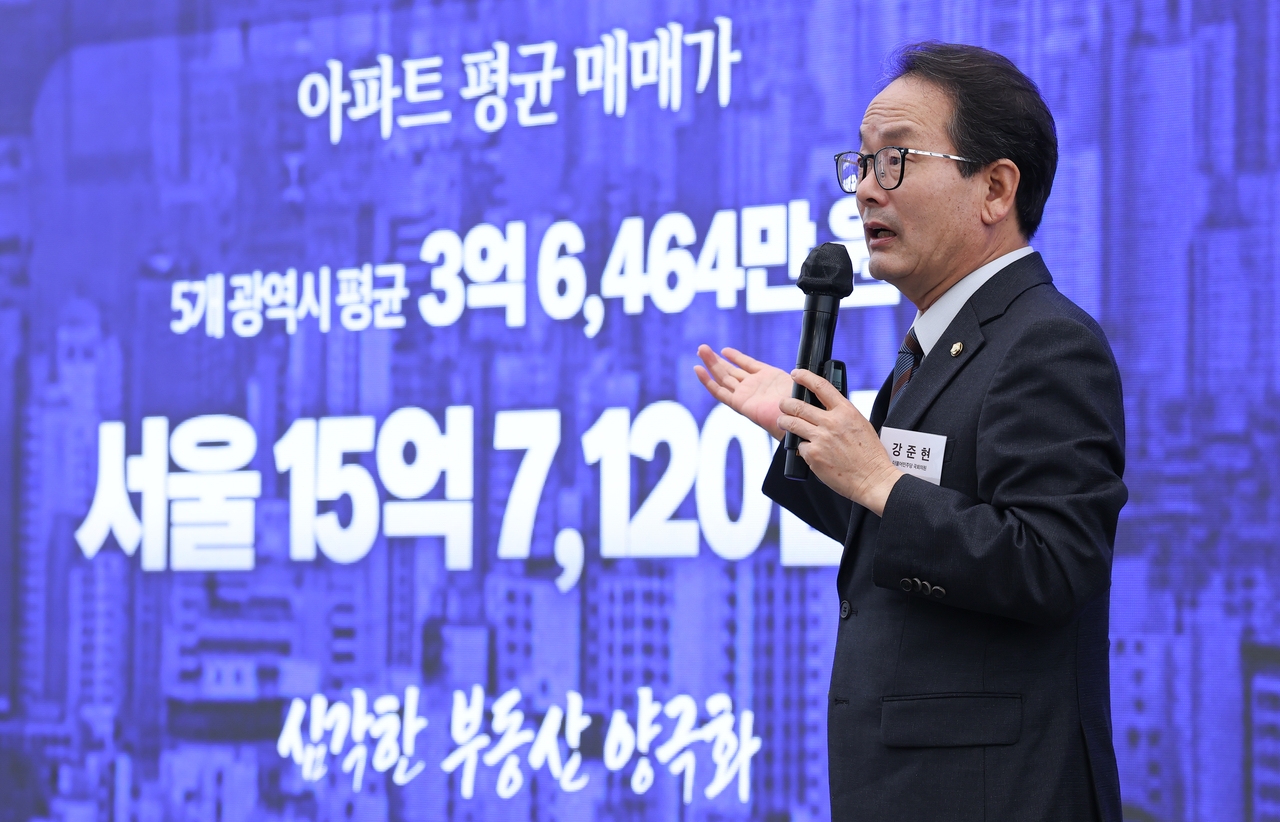
Major public financial institutions — with the exception of the Financial Services Commission — are set to remain in Seoul amid ongoing discussions over relocating the administrative capital and public agencies. The plan envisions clustering Korea Development Bank, Industrial Bank of Korea, the Export-Import Bank of Korea and the Financial Supervisory Service in Yeouido to create a financial hub, while establishing regional investment corporations across the country.
Democratic Party of Korea lawmaker Kang Jun-hyeon, a member of the National Assembly's Political Affairs Committee, laid out the vision Wednesday at the Future Leaders Forum, co-hosted by The Herald Business and law firm Daelyuk Aju at Ambassador Seoul Pullman Hotel in Jung-gu. "The idea is to build a financial hub town in Yeouido," Kang said. "Financial institutions need to be gathered together so they can talk to each other and keep each other in check." On the FSC, Kang said its relocation was unavoidable given its role as a policy body.
To support regional finance, Kang proposed establishing investment corporations for each major region — the southeastern corridor, South Jeolla Province and Gwangju, and the Chungcheong provinces. The aim is to use some of Korea Development Bank's functions to build a regional investment base rather than relocating the bank wholesale.
Kang said Korea Development Bank "appears to have been decided against relocating" to Busan, adding that a southeastern regional investment corporation had been put forward as an alternative.
Kang said the administrative capital project is part of a population-dispersal policy aimed at easing the concentration of people in the greater Seoul area, and reaffirmed President Lee Jae Myung's commitment to building a presidential office and a National Assembly annex in Sejong. Kang noted, however, that the Sejong assembly building currently under development is only an annex — designing a full plenary chamber would require passage of a special administrative capital law and a Constitutional Court ruling that it is constitutional.
Kang said the goal is to pass the special administrative capital law by year-end, though a delay could push National Assembly action to January or February next year. "The atmosphere is good because the ruling and opposition parties introduced the bill together," Kang said, adding that People Power Party leader Jang Dong-hyeok, who is from Boryeong, had raised no objections. Kang cautioned, however, that unfavorable public sentiment in Seoul could slow the process.
Kang also noted that because the New Administrative Capital Act was ruled unconstitutional in 2004, a Constitutional Court ruling confirming the new law's constitutionality would still be needed even after its passage. "At public hearings, people said a constitutional ruling would come through," Kang said. "Many believe the outcome will be different from the past."
As a way to improve living conditions for civil servants relocating with public agencies, Kang proposed reviving the special apartment supply scheme for government employees. "We need to bring back the special supply apartments," Kang said. "The program was scrapped in 2021 after it became controversial, but it can be reintroduced with stronger owner-occupancy requirements." Kang said discussions with the Office for Government Policy Coordination are underway and pledged to work toward establishing the system.
Kang also called for measures to address the housing shortage in Sejong. "There are no apartment units available right now and the jeonse and monthly rent market is completely locked up," Kang said. "We need to increase the volume of permits and ground-breakings by the end of this year at the latest and get supply moving quickly."
Kang traced the need for decentralization and an administrative capital to the housing burden and regional imbalance caused by the concentration of population in the greater Seoul area. "Real estate tax policy is a short-term fix," Kang said. "In the long run, what President Roh Moo-hyun and President Lee Jae Myung both pursued is a population-dispersal policy."
Kang said housing policy should focus on easing the burden on the middle class and ordinary citizens. "Personally, I think we should accept that apartments in Gangnam worth 5 billion or 10 billion won ($7.46 million) exist," Kang said. "What matters is what we do about housing policy for the middle class and vulnerable groups." Kang added that apartment prices for middle-class and ordinary citizens must come down, and that public rental housing should be built to give lower-income residents stable, long-term options.
Kang also proposed that discussions begin now on how to use the space in Seoul after government agencies move out. "I think about what to do with Seoul, what to do with Yeouido, what to do with Yongsan," Kang said. "The question is how to create an environment where young people can live with some breathing room." Kang went on to say that Seoul should become an economic capital like New York, while Sejong becomes an administrative capital like Washington. "Let's start thinking now about what Seoul will become," Kang said.
thanks@heraldcorp.com