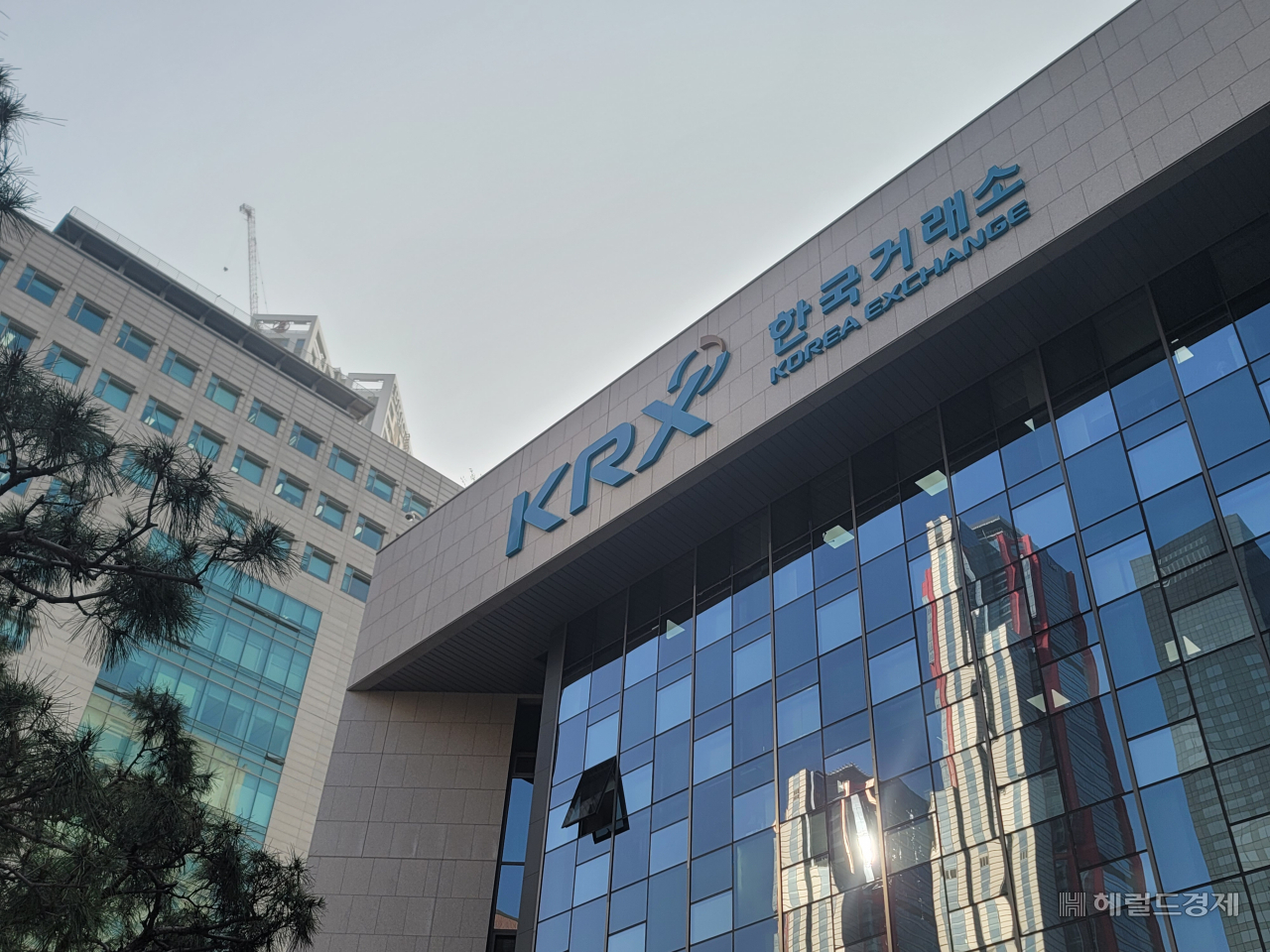
Kosdaq-listed companies are struggling to raise capital, increasingly offering investor-friendly terms or pulling back fundraising plans worth hundreds of billions of won. With some firms seeing capital injections fall through or renegotiating repayment terms on existing convertible bonds, the financing burden on Kosdaq growth companies is intensifying. Industry observers say a vicious cycle has taken hold: as high interest rates persist and investor sentiment weakens, the companies most in need of cash are finding it hardest to attract investors.
According to investment banking industry sources Tuesday, Voronoi is working with Kiwoom Securities as lead manager to issue 80 billion won ($59.6 million) in five-year unsecured private convertible bonds. The proceeds are earmarked for research and development — including global clinical trials for VRN11, a lung cancer drug candidate — as well as operating expenses. The company sounded out institutional investors last month and aims to complete the issuance this month.
According to an investment proposal obtained by The Herald Business, the convertible bond offering does not include a call option for the company. Investors, by contrast, may exercise a put option on the full amount of their bonds every three months starting two years after issuance. The conversion price will be adjusted every seven months and may be lowered to as little as 70 percent of the initial conversion price. The coupon rate is set at zero percent, with a yield to maturity of 2 percent compounded annually and a yield to put of 2 percent.
Notably, the call option included in a 50 billion won convertible bond issued last year is absent from this offering. That removes one of the company's tools for managing future share dilution by buying back the bonds, while investors retain the ability to convert to shares and pocket gains if the share price rises — or demand early repayment. The adjustable conversion price, combined with the maturity and early-redemption yields on offer, also gives investors a hedge against a falling share price. Analysts say the terms reflect a company willing to accept unfavorable conditions in order to secure funding.
Some companies have seen fundraising plans collapse entirely or have had to renegotiate terms on existing convertible bonds. Kosdaq-listed The Cody scrapped a decision to issue 33 billion won in convertible bonds on Oct. 6 after investors failed to make their payments. Enchem, a battery electrolyte maker, passed a bondholder resolution in August to remove the put option from its 14th-series convertible bonds, which had about 238 billion won in outstanding principal. In exchange, the company pledged to provide equity in its overseas subsidiaries in the United States and Europe as collateral and to buy back and retire 75 billion won worth of convertible bonds over the next three years.
The high-rate environment is widely cited as a key factor driving up financing costs for small and mid-cap Kosdaq companies. As market interest rates rise, so do the returns investors demand, forcing higher-risk companies to offer more attractive issuance terms to draw capital. Growth companies without stable cash flows face particular constraints on bank borrowing and corporate bond issuance, making convertible bonds and rights offerings increasingly critical funding channels.
Jin Seong-hun, head of the research and policy group at the Korea Kosdaq Association, said institutional investors are reluctant to make new commitments heading into year-end, with rising interest rates and oil prices compounding stock market volatility. "Institutional investors have to think about year-end performance bonuses, so if they rush into an investment and take a loss, it affects their results," Jin said.
Companies are calling for expanded bank lending and broader securities firm financing to ease the fundraising burden. A survey on corporate financing conditions and policy priorities released by the Korea Chamber of Commerce and Industry in the second half of this year found that 52.5 percent of respondents said bank lending regulations should be eased to increase loans to businesses. That was followed by calls for expanded corporate financing through securities firms' issued notes and IMA accounts, at 23.5 percent, and for more low-interest loans from policy finance institutions, at 13.7 percent.
The findings point to a need to broaden financing channels beyond bank loans by activating corporate finance through securities firms and policy lenders. "Regardless of index movements, the ability of companies to raise capital reliably is becoming increasingly critical," said Song Seung-hyeok, head of the financial industry team at the Korea Chamber of Commerce and Industry. "As the shift toward productive finance gets fully under way, we need to ensure its effects reach companies on the ground — by expanding banks' corporate lending capacity and taking a close look at conditions in the primary market," Song added.
Alongside improving financing conditions, analysts say companies must also work to strengthen the credibility of their disclosures. Inaccurate disclosures of fundraising plans or delays in communicating changes can erode investor confidence and make it harder for companies to attract capital.
"Sanctions and warnings for disclosure violations are functioning to some degree, but the mechanisms for prevention and improving internal controls are limited, which is why some companies keep committing the same types of violations," said Hong Ji-yeon, a senior researcher at the Korea Capital Market Institute. "Rather than simply tightening sanctions, the regime needs to be strengthened in a way that raises the quality of companies' internal disclosure management systems and accountability," Hong said.
Hong added that "in particular, there is a need to strengthen oversight and support systems so that repeat violators can improve their disclosure management capabilities and internal controls."
However, analysts caution that expanded financial support and better disclosure management alone will not resolve the fundraising difficulties facing small and mid-cap Kosdaq companies. Tightened delisting requirements based on market capitalization thresholds are adding to financing uncertainty for some smaller firms, they say.
"Ultimately, the companies that need money right now can't raise it, while the ones that don't need it can," said Jin of the Korea Kosdaq Association. "If your market cap isn't there to back you up, it's not easy to do a rights offering in the current environment."
The concern is that as delisting risks grow, investors will increasingly weigh the chances of recovering their money and pull back from new commitments. "Venture capital ultimately needs to be able to exit its investments, and if a company gets delisted, that exit becomes very difficult," Jin said.

hajun825@heraldcorp.com