Revised agricultural machinery certification standards take effect Friday
New rules cover electric and hydrogen-powered equipment
Reverse entrapment guards and night reflectors also strengthened
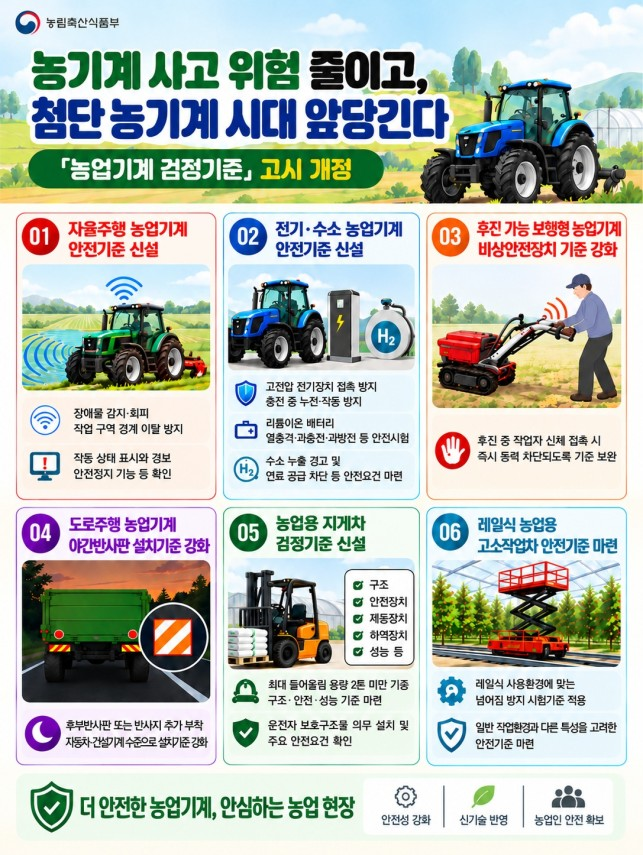
Safety certification standards will now apply to autonomous farm equipment that operates without a driver on board. Such machinery will be required to stop automatically when it detects an obstacle or strays from its designated work path. New safety requirements will also take effect for electric and hydrogen-powered farm equipment to prevent electric shocks and fires, and existing safeguards against reverse-entrapment accidents and nighttime road collisions will be tightened.
South Korea's Ministry of Agriculture, Food and Rural Affairs announced Thursday that a revised notice on agricultural machinery certification standards will take effect Friday. The revision follows a comprehensive farm-sector safety management plan announced in June, and its core aim is to expand the scope of safety certification in line with advances in farm machinery technology while strengthening accident-prevention standards for existing equipment.
The most significant change involves safety standards for autonomous farm machinery. Previous certification criteria focused on limited autonomous functions such as automatic steering, leaving gaps in the assessment of equipment that operates without a driver.
Under the new rules, machinery that travels under on-site or remote supervision — without a driver physically aboard — will be subject to certification. Such equipment must automatically stop when it detects an obstacle, deviates from its work path or experiences a mechanical fault.
Display device standards have also been established so operators can monitor a machine's operating status and detect anomalies. Safety requirements will apply to handheld control devices used to operate autonomous driving modes as well. The new standards reflect ISO 18497, the international standard for autonomous agricultural machinery.
Safety standards for electric and hydrogen-powered farm equipment have been introduced for the first time. Electric machinery must be designed to prevent direct contact with high-voltage components and must guard against electrical leakage or unexpected movement during charging.
Lithium-ion batteries will be subject to safety testing standards covering rapid temperature changes, overcharging and over-discharging. Hydrogen-powered equipment must be fitted with devices that warn of fuel leaks and automatically cut off the supply.
Safety devices on existing farm machinery will also be reinforced. For walk-behind farm equipment capable of reversing, standards have been tightened so that power is cut the moment a worker's body makes contact with the emergency safety device — ensuring the machine can stop even when the operator is caught in the machinery and cannot reach the stop switch.
Farm equipment driven on public roads will be required to attach a rear reflector or reflective sheeting to the back of the machine, in addition to existing night reflectors. Installation standards have been raised to the level required for automobiles and construction equipment, making it easier for following vehicles to spot farm machinery in low-light conditions.
The ministry said it expects the revision to establish an institutional foundation for verifying the safety of advanced farm machinery and to reduce the risk of accidents during farm work and road travel.
"This revision is aimed at improving the safety of agricultural machinery in line with technological change and preventing farm work accidents," said Lee Si-hye, director of the ministry's Agricultural Industry Innovation Policy Bureau. "We will continue to refine safety standards by incorporating the experiences and opinions of farmers."
adastra@heraldcorp.com