Rhodium Group report on China's chemical industry
China unscathed even as crude imports fell by up to 5 million barrels a day
Report says Beijing likely more convinced than ever of energy security strategy
China's PE imports down two-thirds in five years as domestic output surges
Specialty chemicals next in Beijing's sights
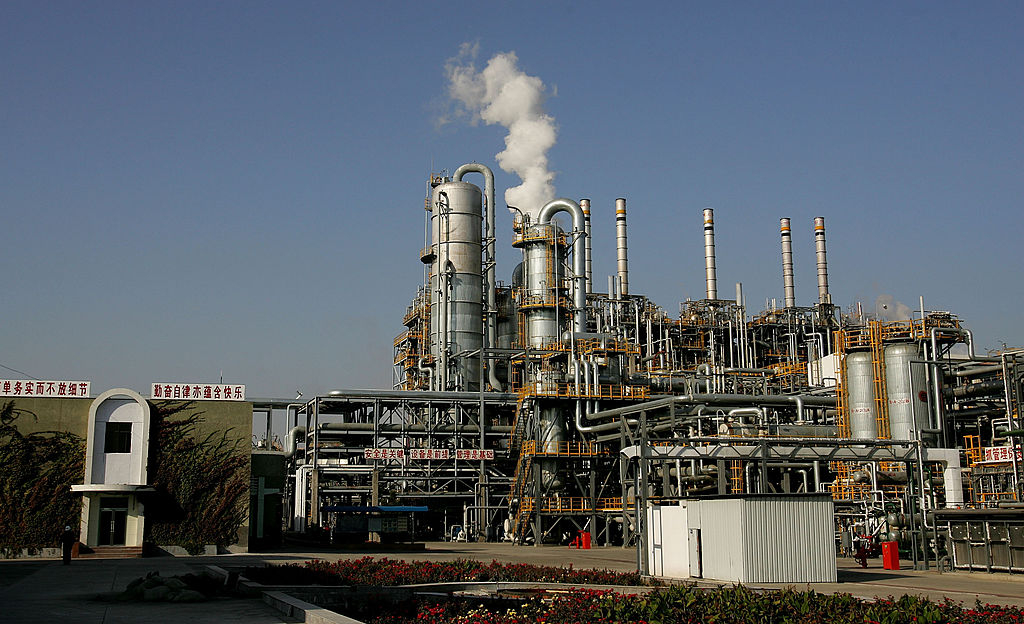
China's petrochemical industry maintained ethylene production throughout the Middle East war by drawing on massive strategic reserves, while South Korea and Japan suffered the greatest damage of any countries worldwide, according to a new analysis. The report also projected that China will accelerate both capacity expansion and high-value specialty chemical development for the foreseeable future, widening the gap further.
The findings came Thursday from Rhodium Group, a US economic and policy research firm, in a report titled "Global Impacts of China's Chemicals Buildout."
The group said China's petrochemical supply chain experienced disruptions from the Middle East war but remained relatively intact compared with other countries, crediting Beijing's large-scale stockpiling of raw materials and its strategy of diversifying feedstock sources.
"Petrochemical producers in Japan and South Korea, which are heavily dependent on crude oil and naphtha supplied from the Persian Gulf region, were hit the hardest," the report said.
China's ability to weather a Strait of Hormuz blockade stemmed from its enormous crude reserves, which Reuters has reported stand at a minimum of 1.2 billion barrels — the largest in the world. South Korea's combined government and private reserves, by contrast, total around 200 million barrels. The South Korean government earlier announced plans to expand storage capacity to 20 million barrels by 2030 in response to tightening crude supplies caused by the Hormuz blockade.
China responded by drawing on stockpiled crude and naphtha while switching to natural gas- and coal-based feedstocks, the report added. That approach allowed Beijing to cut crude imports by 4 million to 5 million barrels a day while still sustaining ethylene output.
The report also predicted that China's capacity expansion drive will continue for now. "The existing belief among Chinese policymakers that energy security and self-sufficiency are strategically important has likely been reinforced," it said, adding that Beijing would therefore be even less inclined to scale back domestic petrochemical production capacity.
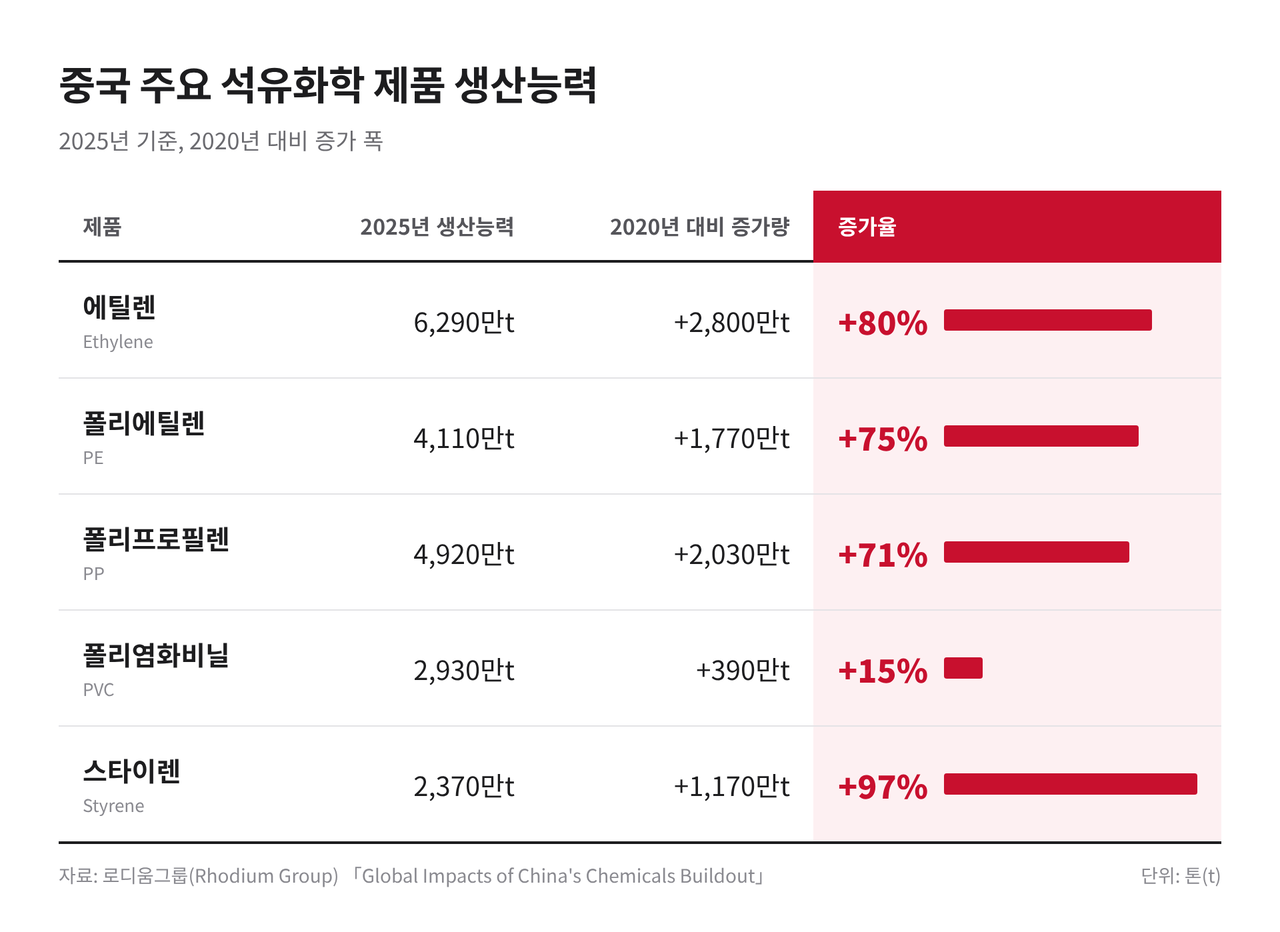
China is currently pursuing a two-track strategy — shutting down aging petrochemical facilities on a large scale while simultaneously expanding new ones. According to the report, China's production capacity for major petrochemical products rose sharply between 2020 and 2025: ethylene climbed 80 percent to 62.9 million tons, polyethylene (PE) rose 75 percent to 41.1 million tons, polypropylene (PP) gained 71 percent to 49.2 million tons, polyvinyl chloride (PVC) increased 15 percent to 29.3 million tons, and styrene surged 97 percent to 23.7 million tons.
As a result, China has been cutting petrochemical imports and meeting more of its own demand domestically. For PE, the report said, import dependence stood at 21 percent in the first half of this year — down by nearly two-thirds compared with 2020.
The report also warned that China is rapidly closing in on the specialty chemicals segment that South Korea's petrochemical industry has been counting on as an escape route.
"The Chinese government has elevated the upgrading of chemical production technology and the development of specialty products to the top priority of its industrial policy," the report said. "Whereas the focus was previously on supplementing insufficient domestic feedstock supply and meeting rising domestic demand, the emphasis has now shifted to eliminating dependence on foreign sources that could become vulnerabilities in terms of economic security."
As a concrete example, Beijing offers grants of up to 20 million yuan ($2.99 million) per company developing chemical materials, along with low-interest loan support. A new regime also allows research and development costs to be deducted at 200 percent as pre-tax expenses.
The report further noted that "China is actively moving into specialty and fine chemicals to secure supplies of key materials and pursue higher profit margins," adding that "this suggests foreign chemical companies will face increasingly intense competitive pressure even in the product segments that are the core profit drivers of advanced-economy chemical industries."

klee@heraldcorp.com