Marking the 30th anniversary of Ulsan's elevation to metropolitan city status
Exhibition themed 'Industrial Dreams, Human Time'
On view at Ulsan Art Museum through Feb. 21 next year
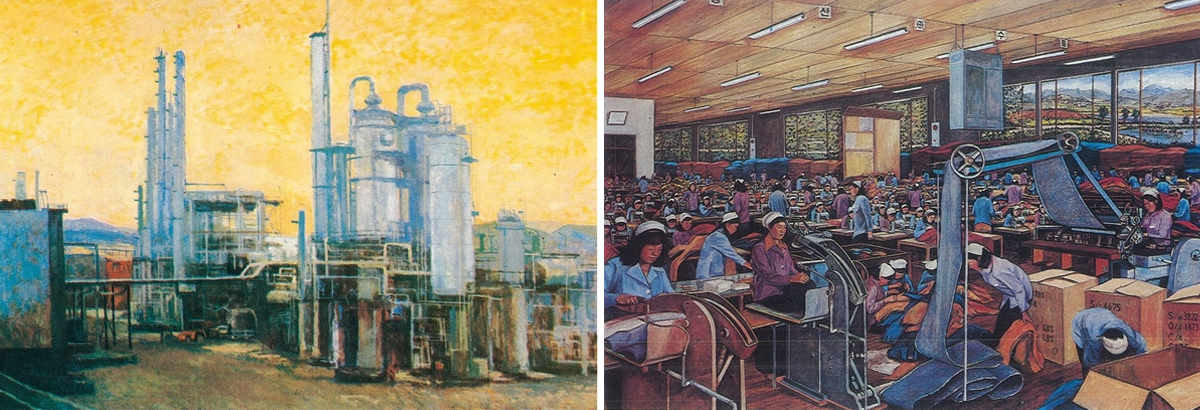
Four national record paintings depicting Ulsan's industrial scene in the 1970s have been unveiled, offering a rare visual chronicle of the city that led South Korea's industrialization after it was designated a special industrial zone in 1962.
The Ulsan Art Museum is presenting the works in its first exhibition hall from Thursday through Feb. 21 next year as part of a special exhibition titled "Industrial Dreams, Human Time." The show features 11 large-scale paintings in total — the four historical works alongside seven newly commissioned pieces by six contemporary artists.
"Petrochemical Industrial Complex" (1973) by the late Lim Jik-soon, known as the "painter of flowers and women," captures the area around Bugok-dong in Nam-gu where Korea Petro Chemical IND and other companies set up operations in the 1970s. "Hyundai Shipyard" (1973) by Park Deuk-soon depicts the dry dock used to build the earliest vessels at what is now HD Hyundai Heavy Industries.
"Hanyang Chemical Industry" (1975) by the late Park Hang-seop shows the early petrochemical factory before it was acquired by what is now Hanwha Solutions' chemicals division. "Samdo" (1975) by the late Lee Yong-hwan portrays a garment factory in Seobu-ri, Eonyang-eup, Ulju-gun, where workers are shown sewing blue jeans and other clothing — a vivid historical record of the export-driven industrial labor of the era. All four works are size-300 canvases.
The museum also commissioned six contemporary artists to reimagine Ulsan's industry and the lives of the people who built it, viewed through the lens of 2026 — half a century on. Their seven large-scale paintings are displayed alongside the historical works.
Jeong Jae-ho's "Rest" depicts a ship that has returned to port for repairs. Placed beside Park Deuk-soon's "Hyundai Shipyard," the pairing invites comparison: where Park captured a city's anticipation as it began building ships, Jeong uses a vessel under repair to evoke the time it takes for a body, worn down by labor, to heal.
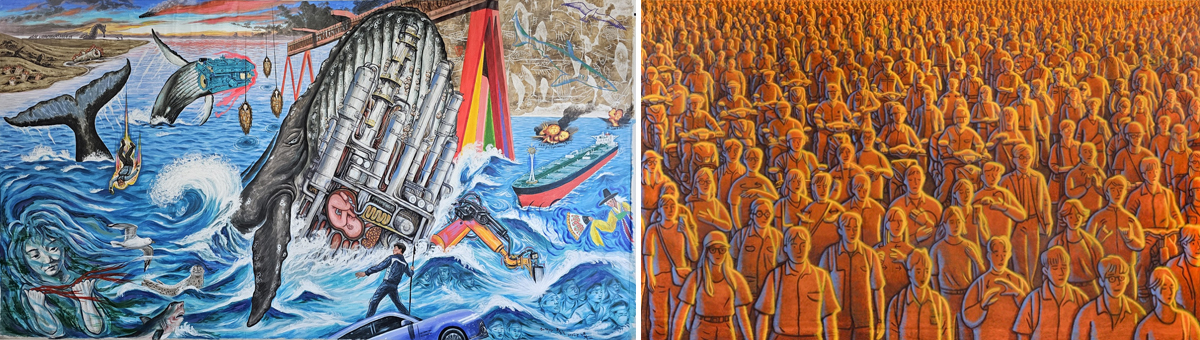
Kwon Se-jin's "Document" is a large-scale work measuring 5.4 meters wide by 3 meters tall, transferring onto hanji in ink photographs of the late Hyundai founder Chung Ju-yung's shipyard-construction negotiations and the Pony automobile production line. In Lee Woo-seong's "We Go to Work Again Today," the expressions and gestures of workers heading to their jobs emerge one by one as the eye moves deeper into a golden crowd.
Bang Jeong-ah's "Had to Live I" and "Had to Live II" draw on oral accounts — one from a woman who moved from welding shifts straight into housework, another from a haenyeo diver who continued diving while pregnant. Park Gyeong-hyo's "Dancing with Whales" renders the sea as two worlds at once: the ocean where whales live and the waters where massive ships are built.
cityblue@heraldcorp.com