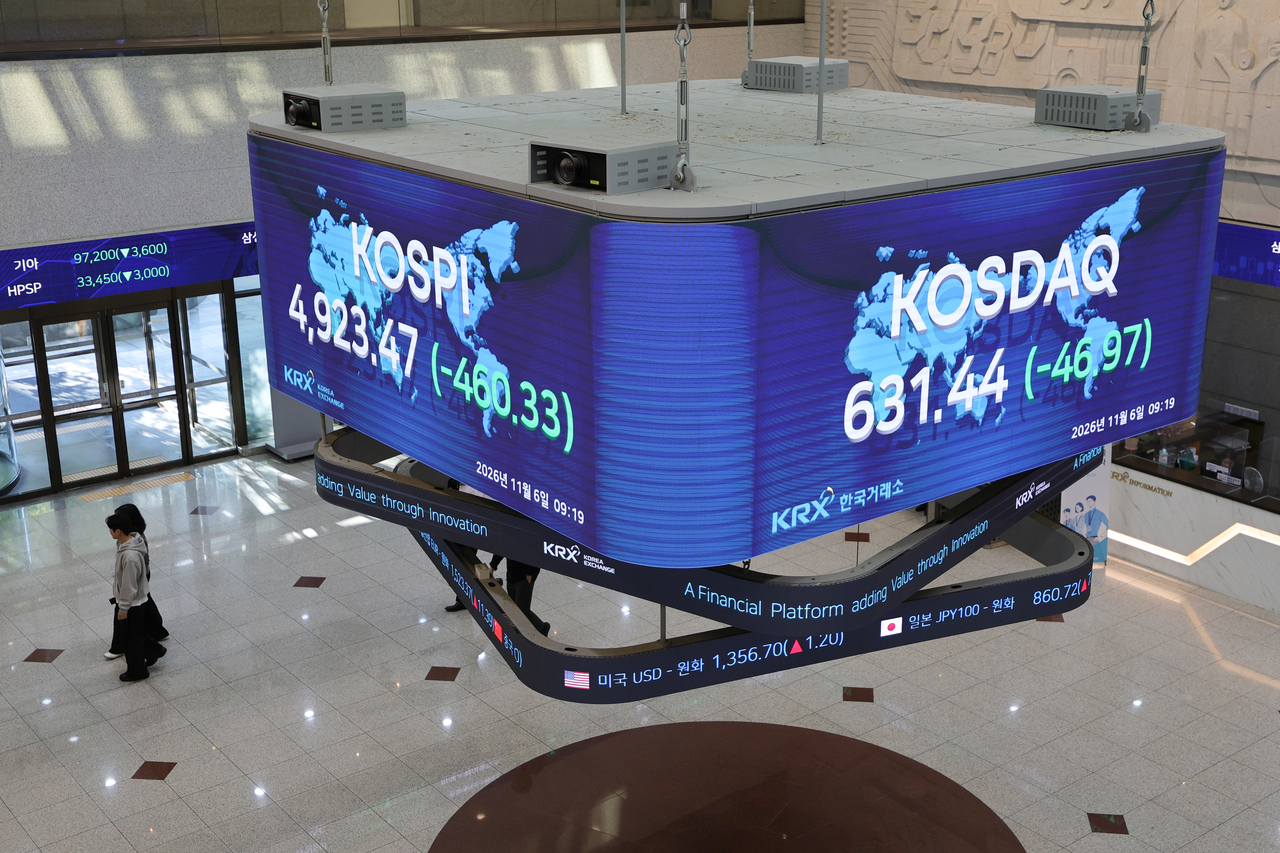
The Kospi plunged more than 8% within about three minutes of Friday's opening bell, bringing the stock market to a halt for 20 minutes. The circuit breaker was triggered to cushion the shock of the sharp sell-off. South Korea's markets have a second-level circuit breaker that kicks in when the index falls 15% or more, but it has never been activated.
According to the Korea Exchange, the Kospi stood at 4,924.61 at 9:03:33 a.m. Friday — down 459.19 points, or 8.52 percent, from the previous session. The exchange immediately activated a Level 1 circuit breaker on the Kospi market, suspending all trading for 20 minutes. A sell-side sidecar was triggered on the Kosdaq market at 9:06:02 a.m. A sell-side sidecar was also activated on the Kospi at 9:34 a.m., just after trading resumed.
A circuit breaker is a mechanism that temporarily halts trading when the stock market falls sharply. The name comes from the principle of an electrical circuit breaker that automatically cuts power under overload. The idea is to pause trading briefly so the market can stabilize, preventing investors from panic-selling en masse when prices drop steeply in a short period.
South Korea's circuit breaker system has three levels. Level 1 is triggered when the Kospi or Kosdaq falls 8 percent or more from the previous session's close and holds that level for one minute. Trading in the affected market is then suspended for 20 minutes, followed by a 10-minute single-price auction before normal trading resumes. In a single-price auction, orders are collected over a set period and matched at one price.
Level 2 is triggered when the index falls 15 percent or more from the previous close and drops at least 1 percent further from the Level 1 trigger level, with both conditions sustained for one minute. Trading is again suspended for 20 minutes. Level 3 activates when the index falls 20 percent or more from the previous close and drops at least 1 percent further from the Level 2 trigger level for one minute — at which point trading in that market is closed for the rest of the day.
The sidecar that often accompanies a circuit breaker targets a different type of trading. While a circuit breaker halts all transactions across the entire market, a sidecar suspends program trading orders for five minutes. It is designed to prevent sharp price swings in the futures market from spilling over into the spot market. As a result, a sidecar activation does not stop ordinary stock trading.
South Korea restructured its circuit breaker system into the current three-level format in June 2015. Since then, trading has been halted multiple times during market crashes, but Level 2 and Level 3 have never been triggered. Every circuit breaker activation since the three-tier system was introduced has been limited to Level 1.
The first circuit breaker in South Korean market history was triggered on April 17, 2000, when the Kospi plunged in the wake of a sharp sell-off on Wall Street. It has since been activated during other major shocks — the Sept. 11, 2001 attacks in the United States, the spread of COVID-19 in 2020, and fears of a US recession in 2024. This year has seen a particularly sharp rise in activations. Friday's Kospi circuit breaker was the 17th ever and the 11th this year since the system was introduced. On the Kosdaq, the mechanism has been triggered 15 times in total, including five times this year. Combined across both markets, 16 of the 32 all-time activations have occurred this year — exactly half.
Volatility has surged this year as the US-Iran war, concerns over the semiconductor industry cycle, and the launch of single-stock leveraged products converged. Selling pressure concentrated particularly on large-cap semiconductor stocks such as Samsung Electronics and SK hynix, widening the Kospi's losses.
A circuit breaker does not guarantee that a decline will stop. If selling pressure continues after trading resumes, the index can fall further. Because the mechanism is designed to give investors time to assess the situation, its activation alone should not be read as a signal that the market is about to rebound.
Han Ji-young, a researcher at Kiwoom Securities, said the domestic market was likely to open lower and remain volatile during the session, citing a 12 percent plunge in the Philadelphia Semiconductor Index driven by concerns over reduced AI investment stemming from data center regulations, as well as a roughly 7 percent decline in KOSPI 200 overnight futures.
hajun825@heraldcorp.com