
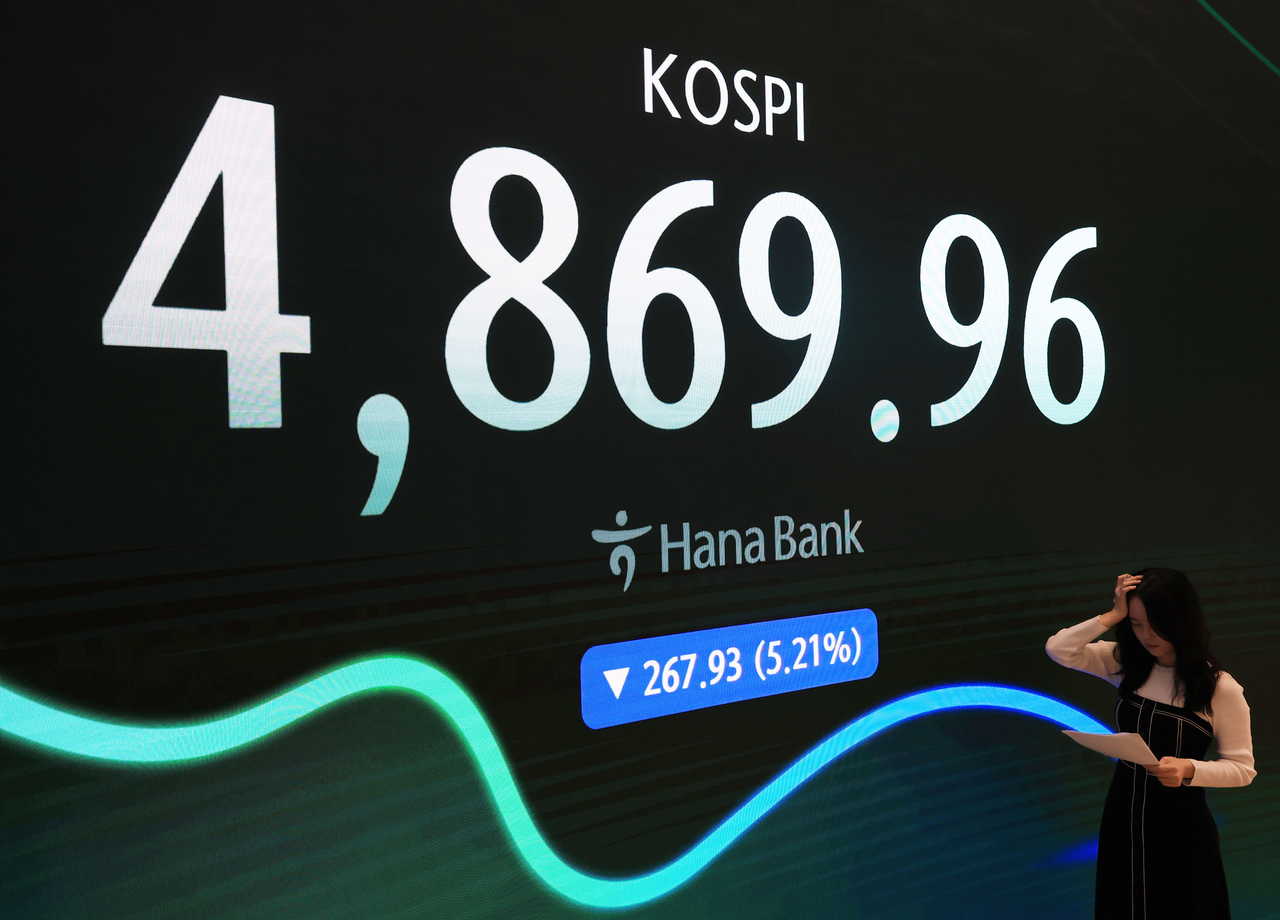
As the Kospi fell from its all-time high of around 9,000 to the 4,800 range, three of the top 10 stocks by market capitalization on the domestic bourse changed. Samsung Biologics, Celltrion and KB Financial Group were among the new entrants, reflecting a broader shift in market leadership away from the AI semiconductor stocks that dominated the first half of the year.
According to Korea Exchange, the Kospi closed at 4,869.96 on Friday — down 46.57 percent from its all-time closing high of 9,114.55 recorded on June 22.
On June 22, the top 10 stocks by market cap were, in order: SK hynix, Samsung Electronics, SK Square, Samsung Electronics preferred shares, Samsung Electro-Mechanics, Hyundai Motor, LG Energy Solution, Samsung Life Insurance, Samsung C&T and HD Hyundai Heavy Industries.
By Friday, the ranking had shifted to Samsung Electronics, SK hynix, Samsung Electronics preferred shares, SK Square, LG Energy Solution, Samsung Biologics, Samsung Electro-Mechanics, KB Financial Group, Hyundai Motor and Celltrion.
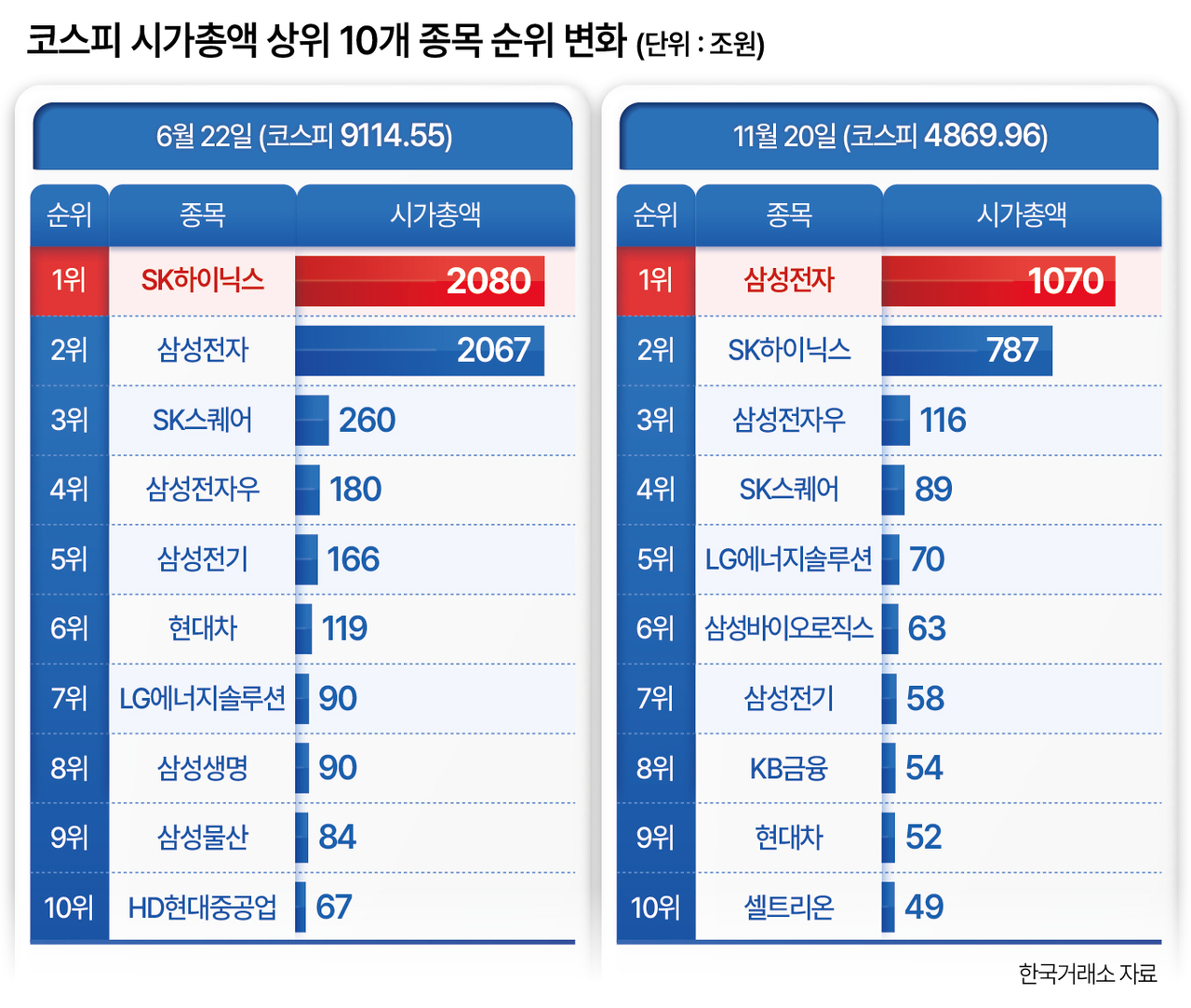
Among the new entrants, pharmaceutical and biotech companies stood out. Samsung Biologics climbed from 12th to 6th place, with its market cap rising from 59.95 trillion won ($44.8 billion) on June 22 to 62.72 trillion won on Friday. Celltrion surged from 20th to 10th after its market cap rose 12.1 trillion won, or 32.4 percent, from 37.35 trillion won to 49.44 trillion won over the same period.
KB Financial Group's market cap edged down 1.63 trillion won, from 55.69 trillion won to 54.05 trillion won, yet its ranking rose from 15th to 8th — a reflection of steeper declines among other large-cap stocks.
The pecking order among the market's two biggest names also flipped. On June 22, SK hynix led with a market cap of 2,080.38 trillion won, ahead of Samsung Electronics at 2,066.66 trillion won. SK hynix has since shed value at a faster pace, ceding the top spot. As of Friday, Samsung Electronics' market cap stood at 1,070.45 trillion won, while SK hynix's had fallen to 786.67 trillion won.
Combined, the two stocks lost about 2,290 trillion won in market cap over the period, falling from 4,147 trillion won to 1,857 trillion won. Samsung Electronics shed 48.2 percent of its value; SK hynix fell even further, dropping 62.2 percent.
Rankings among other established top-tier stocks were mixed. Samsung Electro-Mechanics slipped from 5th to 7th, Hyundai Motor from 6th to 9th, and SK Square from 3rd to 4th. LG Energy Solution, by contrast, moved up from 7th to 5th despite its market cap shrinking from 90.21 trillion won to 70.08 trillion won.
Analysts point to the sharp selloff in AI-related stocks — particularly semiconductors, which had driven the market's first-half rally — as the primary cause of the reshuffling. Concerns about prolonged high inflation and elevated interest rates, combined with the financing burden of AI investment and uncertainty over the semiconductor industry's outlook, amplified foreign selling.
"The stock market's decline in the second half of this year reflects a combination of factors: fears of prolonged high inflation and interest rates, slowing semiconductor momentum, large-scale net selling by foreign investors, and concerns about the sustainability of AI investment and its financing costs," said Kim Ji-woo, a researcher at KB Securities. "Corporate earnings forecasts remain solid, but valuations have already tumbled sharply."
Large pharmaceutical and biotech companies, meanwhile, held up relatively well on the back of solid earnings. The operating profit of five major Kospi-listed pharma and biotech firms — Samsung Biologics, Celltrion, SK Biopharm, Hanmi Pharm and Yuhan — has grown consistently over the past three years. Sustained earnings growth drew investor attention to these companies, helping lead a recovery in the Kospi's healthcare sector. "Fund flows are recovering, centered on Kospi healthcare stocks, and there is still considerable room for further gains," said Kim Seon-a, a researcher at Hana Securities.
Market watchers expect investment to diversify across large-cap pharma and biotech, financials and other sectors as semiconductors rebound, broadening the market's leadership base. Semiconductors remain central to the domestic bourse, but the concentrated gains seen in a handful of stocks during the first half are likely to spread to other industries. "To reduce volatility, investors should pay attention to banks, insurers and large healthcare companies with low AI exposure," said Kim Jae-seung, a researcher at Hyundai Motor Securities.
hajun825@heraldcorp.com





