- Optical data secured from ultraviolet to far-infrared range
- Findings applicable to electro-optic modulators and quantum circuits
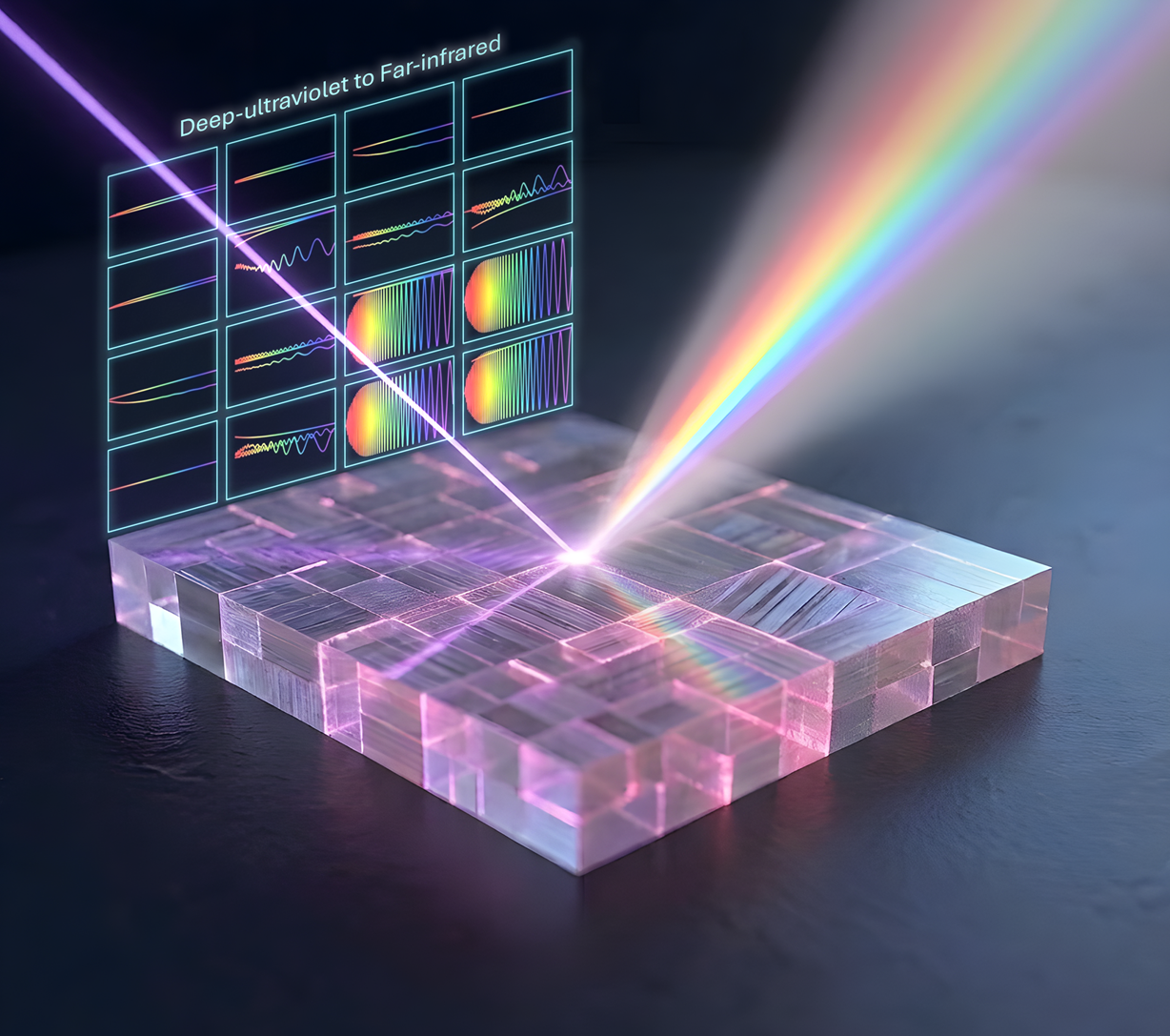
South Korean researchers have precisely mapped how light travels through and is absorbed by a key material for next-generation optical communications, findings expected to aid the development of ultra-fast optical components operating at around 100 GHz and quantum photonic devices.
KAIST announced Sunday that a research team led by Professor Jang Min-seok of the School of Electrical Engineering had precisely characterized the optical properties of barium titanate (BTO), a next-generation optical communications material, in collaboration with the California Institute of Technology (Caltech), the Korea Research Institute of Standards and Science (KRISS) and J.A. Woollam of the United States.
Barium titanate is a ferroelectric material whose light-propagation characteristics change when an electric field is applied. It has drawn attention as a key material for next-generation optical communications because it can be used in electro-optic modulators, which convert electrical signals into light to transmit information.
The challenge lies in the material's complex internal crystal structure. Within the material exist microscopic crystalline regions called domains, each oriented in a different direction. Because each domain responds to light differently, accurately determining how light travels through the material and how much is absorbed has proved difficult.
To overcome this limitation, the research team employed Mueller matrix spectroscopic ellipsometry, a technique that analyzes changes in the polarization of light during reflection and transmission.
By analyzing two types of single-crystal samples with relatively uniform domain orientations, the team separated the complex, overlapping light responses and identified the material's intrinsic optical properties.
The team precisely measured the refractive index and absorption characteristics of the material across a broad wavelength range — from 193 nanometers in the ultraviolet to 40 micrometers in the far-infrared.
Particularly in the 2–10 micrometer range, the team succeeded in quantifying extinction coefficients as small as 10⁻⁵. The extinction coefficient indicates how much light is absorbed as it passes through a material.
The results allow researchers to more accurately predict the path light will take and how much it will attenuate before optical communication components are actually fabricated.
The potential applications of the research extend beyond optical communications.

The data can be applied to the design of electro-optic modulators targeting high-speed operation at around 100 GHz and silicon photonics-based integrated optical circuits. The findings are expected to reduce light loss, improve communication efficiency and cut down on the trial and error involved in component development.
The research also opens new possibilities for next-generation infrared sensor development. The mid- and far-infrared optical data the team obtained can be used in gas sensors that detect greenhouse gases and chemical substances, as well as in thermal radiation control devices.
The measurement method the team developed can also be applied to analyze the optical properties of other materials with complex crystal structures, including lithium niobate and vanadium dioxide, beyond barium titanate.
"This research has uncovered the long-mysterious light-response characteristics of barium titanate, essentially creating a 'user manual for light' for the material," Jang said. "We expect it to contribute to the development of optical communication components that reduce light loss and transmit information rapidly, as well as precise quantum photonic devices."
The findings were published in ACS Photonics, an international journal in the field of optics.
nbgkoo@heraldcorp.com