Interest coverage ratio gap between large firms and SMEs hits widest since 2015
Deposits over 1 billion won reach record high, topping half of all savings deposits
Corporate dollar deposits surge 44% in a year as export proceeds flood in
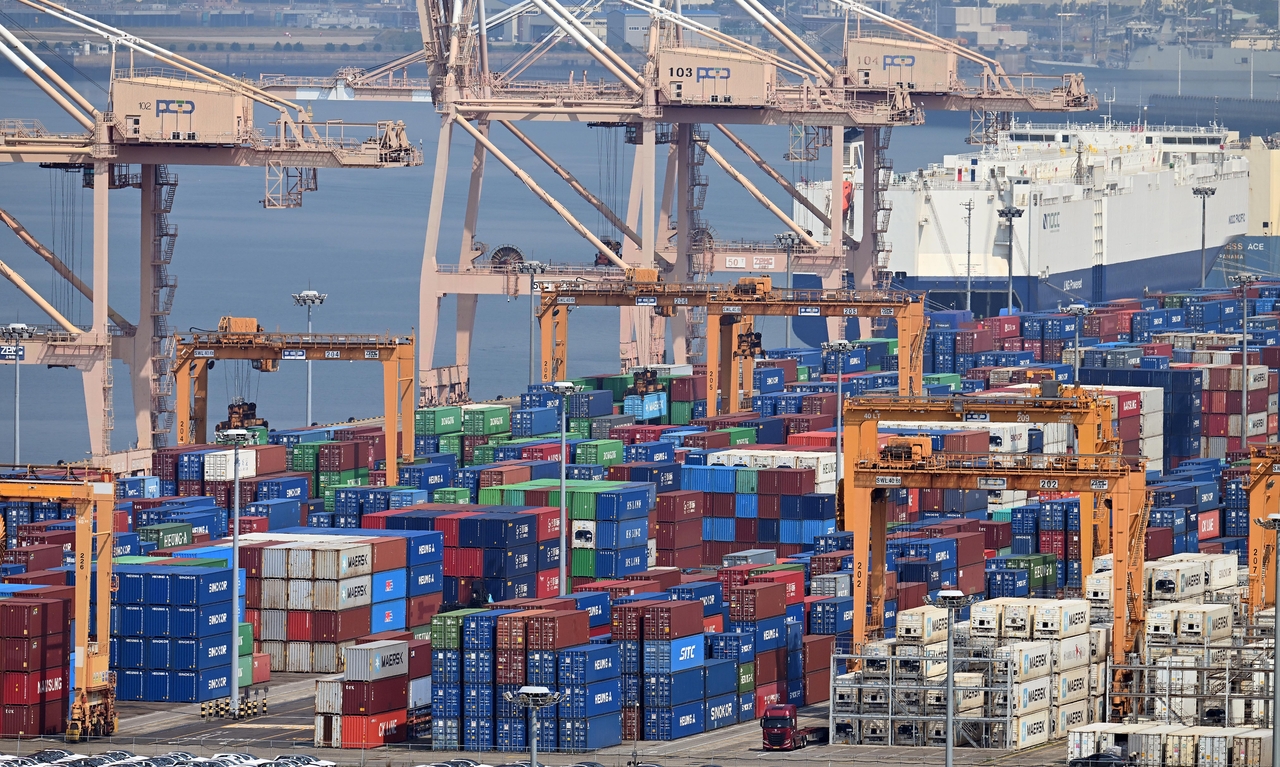
A semiconductor-driven surge in exports and corporate earnings has pushed high-value bank deposits close to 1,000 trillion won ($745 billion). Even as corporate cash reserves grow, the gap in debt-servicing capacity between large conglomerates and small and medium-sized enterprises has widened to its largest on record — a sign that the gains from the export boom are not spreading evenly across industries and company sizes.
Concerns are mounting that if corporate surplus funds continue to pile up in bank accounts rather than flowing into investment, hiring and support for suppliers, the benefits of growth may remain concentrated among a handful of firms. Rising high-value deposits alone do not prove a pullback in corporate investment, but whether the export boom can translate into broader economic vitality — beyond simply expanding the financial cushion of top-tier companies — has emerged as a pressing challenge.
According to the Bank of Korea's economic statistics system, savings deposits at domestic deposit-taking banks with balances exceeding 1 billion won totaled 960.12 trillion won as of the end of June — the largest figure since the data series began in 2002. The total was up 91.64 trillion won, or 10.6 percent, from the end of last year, and up 138.7 trillion won, or 16.9 percent, from a year earlier.
The balance of high-value deposits first surpassed 700 trillion won at the end of June 2021, then broke through 800 trillion won at the end of 2024. In the first half of this year, it crossed the 900 trillion won threshold for the first time. The half-year increase was also the largest on record. High-value deposits accounted for 50.6 percent of total savings deposits — the first time the share has exceeded half since June 2022.
By deposit type, fixed-term deposits over 1 billion won stood at 666.16 trillion won, up 58.99 trillion won, or 9.7 percent, from the end of last year. Corporate demand deposits — used by corporations and sole proprietors to park temporary surplus funds — reached 278.08 trillion won, an increase of 30.47 trillion won, or 12.3 percent. That contrasts sharply with a 2.4 percent decline in the first half of last year.
"Accounts with balances exceeding 1 billion won are estimated to be mostly corporate accounts," a Bank of Korea official said. "The sharp improvement in corporate earnings in the first half of this year appears to have driven the increase in deposit balances." However, high-value deposits include both corporate and individual accounts, so the full increase cannot be attributed solely to corporate funds.
The trend of growing corporate financial capacity is also visible in fund-flow statistics. Net financial asset accumulation by non-financial corporations reached 67.1 trillion won in the second quarter of this year, up sharply from 20.8 trillion won in the first quarter and the highest since the data series began in 2009. Corporate deposits at financial institutions also rose from 17.8 trillion won in the first quarter to 84.3 trillion won in the second. The Bank of Korea attributed the increase to higher corporate profits driven by strong semiconductor exports.
Inflows of export proceeds and corporate foreign-currency deposits also jumped. The five major banks — KB Kookmin, Shinhan, Hana, Woori Bank and NH NongHyup Bank — handled $621.79 billion in inward remittances in the first 10 months of this year, up 30.1 percent from the same period last year. Export bill purchases — transactions in which companies sell their foreign-currency receivables to banks in exchange for early payment — rose 31.5 percent. In October alone, export bill purchases reached $20.24 billion, up 84.2 percent from a year earlier.
Corporate dollar deposit balances at the five major banks stood at $64.55 billion at the end of October, up 44.0 percent from a year earlier. Corporations accounted for 89.3 percent of the total increase in dollar deposits across all customers. Total corporate foreign-currency deposits — including yen and other currencies — reached $76.88 billion at the end of October, up 42.5 percent from a year ago.
Even as export proceeds flowed into corporate accounts, conditions diverged sharply by company size. The interest coverage ratio for large enterprises in the second quarter of this year was 1,882 percent, compared with 322 percent for small and medium-sized enterprises — a gap of 1,560 percentage points. Large firms earned roughly 19 times their interest expenses in operating profit, while SMEs managed only about three times. The gap was the widest since the data series began in the first quarter of 2015.
In the second quarter of last year, the interest coverage ratio gap between large enterprises and SMEs was 136 percentage points. It widened to 345 percentage points by the end of last year and to 864 percentage points in the first quarter of this year, before expanding further in the second quarter. The improvement in the semiconductor cycle is seen as the main driver of the surge in large-firm profitability. The interest coverage ratio for large manufacturing firms hit 3,903 percent in the second quarter — roughly nine times the level a year earlier. The ratio for small manufacturing firms also improved, rising from 263 percent to 401 percent over the same period, but the gain was far smaller.
Differences also emerged in how companies are using loans. Facility investment loan balances at the five major banks for large enterprises stood at 75.8 trillion won at the end of September, up 16 percent from a year earlier. By contrast, facility investment loan balances for SMEs edged up just 1.3 percent, from 333.63 trillion won to 337.85 trillion won.
Total SME loan balances grew by 17.5 trillion won over the same period, but 13.28 trillion won of that increase came from working capital loans. This suggests that demand for funds to cover day-to-day costs — such as payroll and raw materials purchases — outweighed demand for capital to expand capacity or grow the business. Large-enterprise loan balances rose 19 percent over the year, with facility investment and working capital loans up 16 percent and 21 percent, respectively.
Bankers say that rising corporate bond yields have pushed more large companies to seek bank loans, and that a broader push to expand productive lending has also contributed to the increase. "For small and mid-sized corporations, borrowing to expand their businesses is becoming more burdensome as loan rates rise on top of already high global economic volatility," an official at a commercial bank said.
The rise in corporate deposits alone does not necessarily mean investment has declined. Some companies are holding foreign-currency proceeds rather than converting them, or building up foreign-currency liquidity to cover overseas raw material purchases, import payments and foreign investment. "Rather than immediately converting incoming dollars into won, some companies are watching exchange rate movements and timing their conversions," a commercial bank official said. "Demand to secure foreign currency for overseas payments and investment also appears to be adding to the buildup."
However, if SMEs' capacity to invest and service debt continues to lag while corporate surplus funds accumulate in deposits, the semiconductor boom may have limited reach in driving broader economic growth. Analysts warn of a vicious cycle in which financial disparities between companies translate into gaps in investment, productivity and employment — with gains concentrating once again in a handful of industries and large conglomerates.
"When some sectors are doing very well, overall indicators inevitably improve — but if the gains are skewed to one side, many economic actors will inevitably perceive the improvement as an 'optical illusion,'" said Jo Young-moo, head of NH Financial Research Institute. "If the AI semiconductor cycle continues to expand, export performance and tax revenues will rise and benefit the economy — but if the cycle turns, corporate tax receipts and government spending capacity could deteriorate together," Jo added.
attom@heraldcorp.com