Don Tapscott, co-founder and chairman of the Blockchain Research Institute, delivers welcome remarks on the transformation of assets in a new technological environment
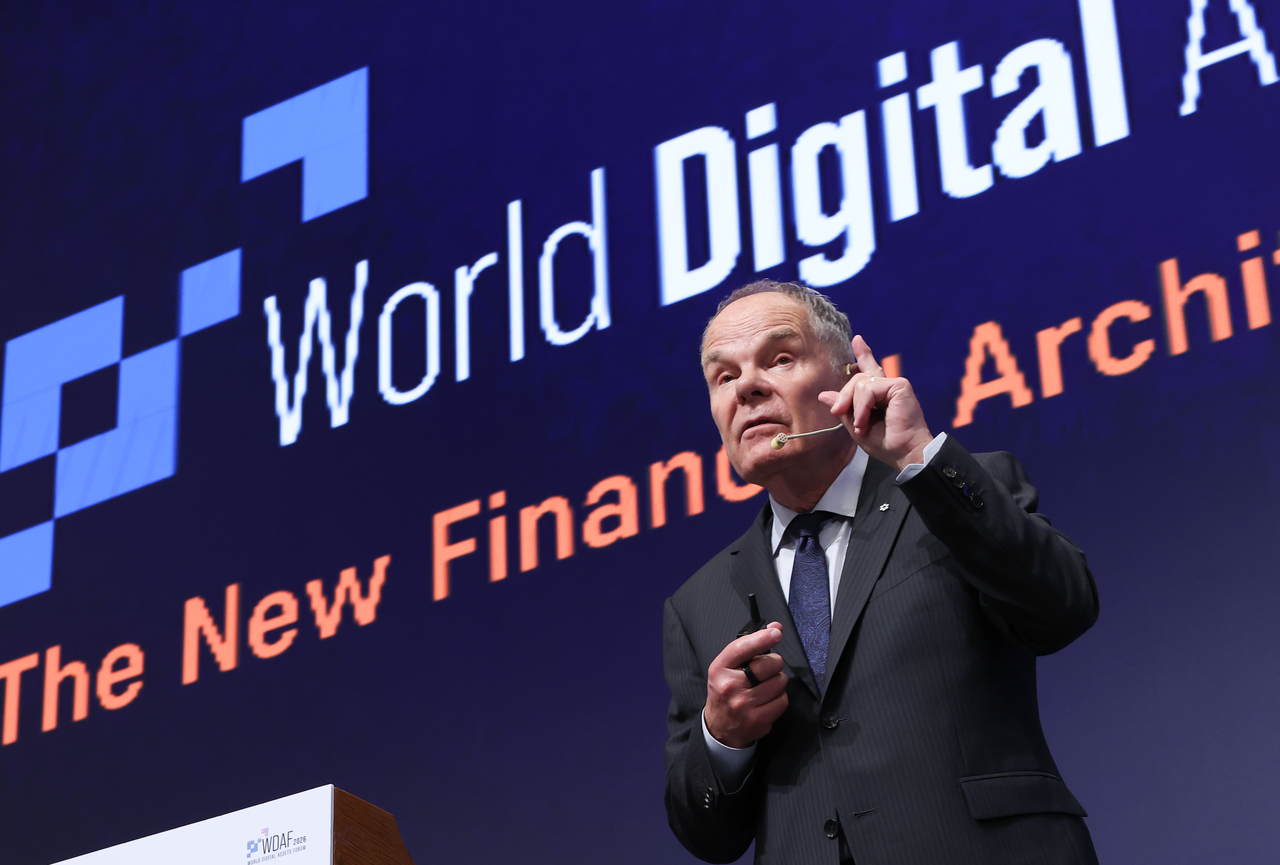
"Korea, which built its industries through the Miracle on the Han River, is one of the countries best positioned to successfully build a new paradigm economy — one where AI, blockchain, robotics and quantum technology converge."
Don Tapscott, co-founder and chairman of the Blockchain Research Institute, made the remarks Monday in a welcome address at the inaugural World Digital Assets Forum (WDAF), hosted by The Herald Business and The Korea Herald at The Grand Lotte Seoul in Sogong-dong.
Now in its first year, WDAF brings together global financial market leaders to assess shifts and the outlook under the theme "The New Financial Architecture." Speaking on the transformation of assets in a new technological environment, Tapscott outlined the sweeping financial paradigm shift that the convergence of digital assets and AI will bring, and what individuals and nations must do to prepare.
Tapscott said Korea must develop a sovereignty strategy for AI and financial systems at the national level if it hopes to lead the new financial paradigm. "Do not rely on a handful of frontier companies from the United States," he said. "You must build your own independent infrastructure."
The centerpiece of his address was "agentic finance" — a concept born from the fusion of digital assets, blockchain and AI. "We are facing not merely a reshaping of the international order, but a new technological order driven by AI, blockchain, robotics and quantum computing," he said. "Changes in the international order repeat across centuries, but a new technological order that deals with intelligence — a domain uniquely human — is a transformation that happens only once in human history."
Tapscott traced the evolution of asset management across three stages. In the first, physical assets such as currency, securities, bonds and real estate were managed directly by people. The emergence of blockchain ushered in a second stage — rule-based asset management, in which smart contracts written in code execute and settle automatically once conditions are met. Now, he said, humanity has entered a third stage: the era of agentic AI, which acts and executes on its own without separate instructions.
"There are agents across many domains — supply chains, call centers, financial systems — but the most important is the personal agent, one that represents the individual," Tapscott said. He predicted that within 10 years every person will have a personal AI agent capable of acting as a physician, financial planner, teacher, negotiator and legal representative at an IQ-1000 level. "These agents will manage and trade assets on behalf of individuals directly within the financial system," he said, "and that is the agentic economy that is coming."
Tapscott also stressed the need for regulation to safely govern an era in which AI agents become the primary actors in financial transactions. He said verifiable agent identities and accountable human principals are essential, as are clear limits on the scope of agent delegation and authority. Controls and audit trails to establish accountability, he added, will be equally critical.
Tapscott advised Korea and other middle powers to comprehensively rebuild their economic, institutional, security and social-contract frameworks within the new international and technological order. "Positive discussions on digital asset legislation are already under way in Korea," he said, "but there is a need to move one step faster."
jiyun@heraldcorp.com