Current economic conditions index drops 4 points; job outlook falls 3 points
Household savings index posts largest monthly decline in 6 years, 7 months
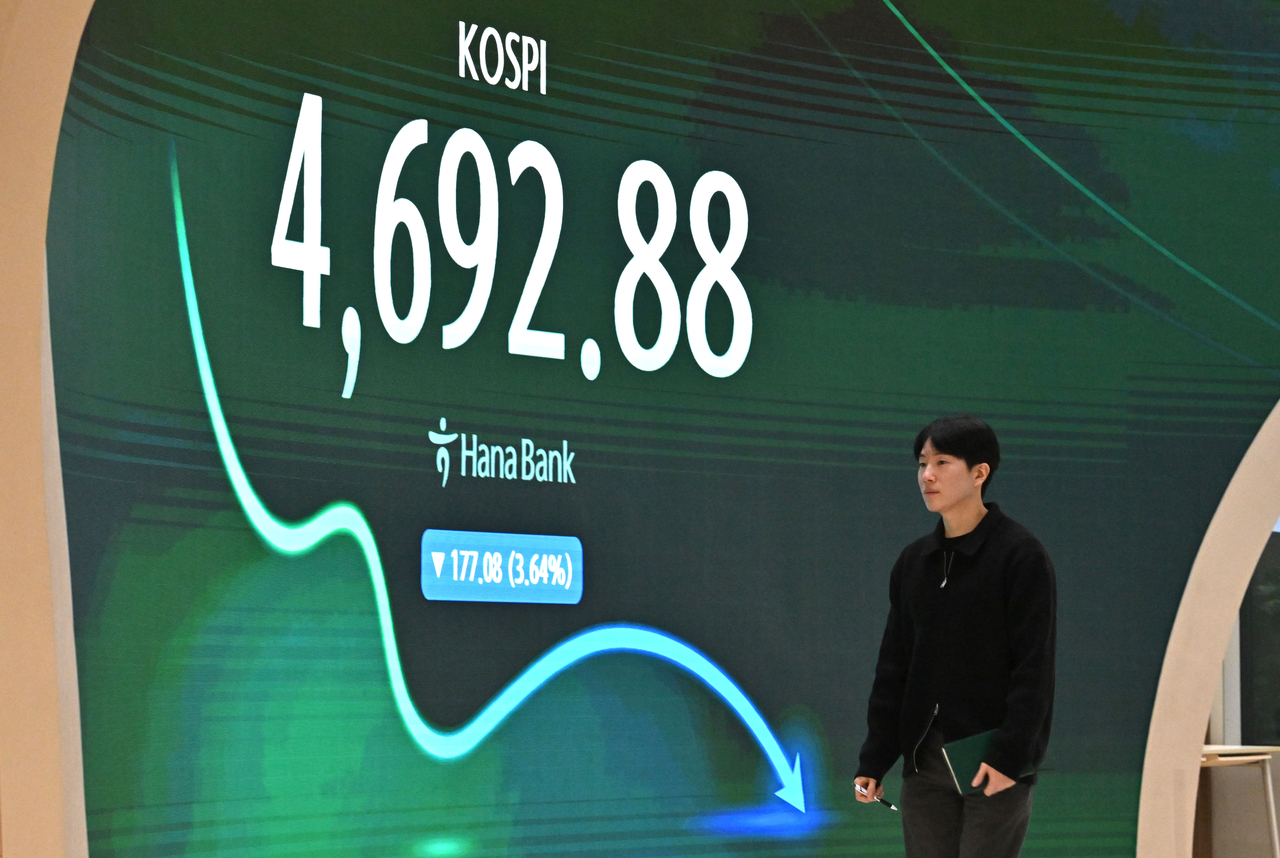
Consumer sentiment deteriorated for two consecutive months as a prolonged stock market slump weighed on the public mood, while expectations for housing prices fell at their steepest pace in eight months amid declining home values in Seoul's Gangnam area.
The Bank of Korea's November 2026 consumer survey, released Tuesday, showed the composite consumer sentiment index (CCSI) fell 2.3 points from the previous month to 103.1 — its lowest reading since April (99.2) and a seven-month low. The decline was also the steepest in seven months.
The CCSI had risen 2.1 points in September but fell back in both October (down 1.2 points) and November as equity markets pulled back.
"The index fell as pessimistic views on economic conditions increased, driven by continued corrections in domestic and overseas stock markets and rising lending rates," said Kim Se-yong, a senior official at the Bank of Korea's economic sentiment survey team.
The CCSI is a composite indicator of consumer attitudes toward economic conditions. It is calculated using six sub-indexes — current living standards, living standards outlook, household income outlook, consumer spending outlook, current economic conditions assessment and future economic outlook. A reading above 100 indicates consumer sentiment is more optimistic than the long-term average, while a reading below 100 signals pessimism.
Among the individual sub-indexes, the current living standards index fell 2 points to 91, weighed down by declining share prices and rising lending rates.
The current economic conditions index dropped 4 points to 78, reflecting stock market corrections at home and abroad and growing uncertainty in the semiconductor industry. Park Yong-min, head of the Bank of Korea's economic sentiment survey team, said many respondents cited domestic and overseas market corrections. "Lending rates are also rising, and uncertainty about semiconductor industry conditions is being highlighted as a factor behind the domestic market correction," Park said. "Negative assessments of economic conditions driven by such news have increased."
The current household savings index fell 4 points from the previous month — its largest single-month decline since April 2020, a drop spanning 6 years and 7 months. Park attributed the decline overwhelmingly to falling share prices.
The job opportunities outlook index fell 3 points to 83, reflecting persistent weakness in youth employment and growing concern that advances in AI technology could reduce available jobs. The wage level outlook index also slipped 1 point to 121.
The housing price outlook index fell 6 points to 118, its lowest since May (112) and a six-month low. The decline was the steepest since March, when the index dropped 12 points, making it the largest fall in eight months. Park said many respondents were aware of actual home price declines in parts of Seoul, particularly Gangnam and Seocho. "Some respondents also mentioned the government's housing supply measures, regulations and rising interest rates," Park said. "The index fell by a larger margin in Seoul."
The expected inflation rate over the next year edged down 0.1 percentage point from the previous month to 2.6 percent. The figure had held steady at 2.7 percent for four consecutive months from July before turning lower this month. Park said falling international oil prices and repeated government price-stabilization measures had helped ease inflation anxiety. "Concerns about prices for agricultural, livestock and fishery products and petroleum products have eased, supported by measures such as a petroleum price cap and supply management for farm and livestock products," Park said.
Expected inflation rates three and five years out both held steady at 2.6 percent, unchanged from the previous month.
Petroleum products (49.7 percent), public utility charges (34.8 percent) and agricultural, livestock and fishery products (33.3 percent) were cited as the items most likely to drive price increases over the next year. Compared with the previous month, the share of respondents citing public utility charges rose 4.4 percentage points, while those citing petroleum products fell 2.9 percentage points and agricultural, livestock and fishery products fell 2.7 percentage points.
kimstar@heraldcorp.com