
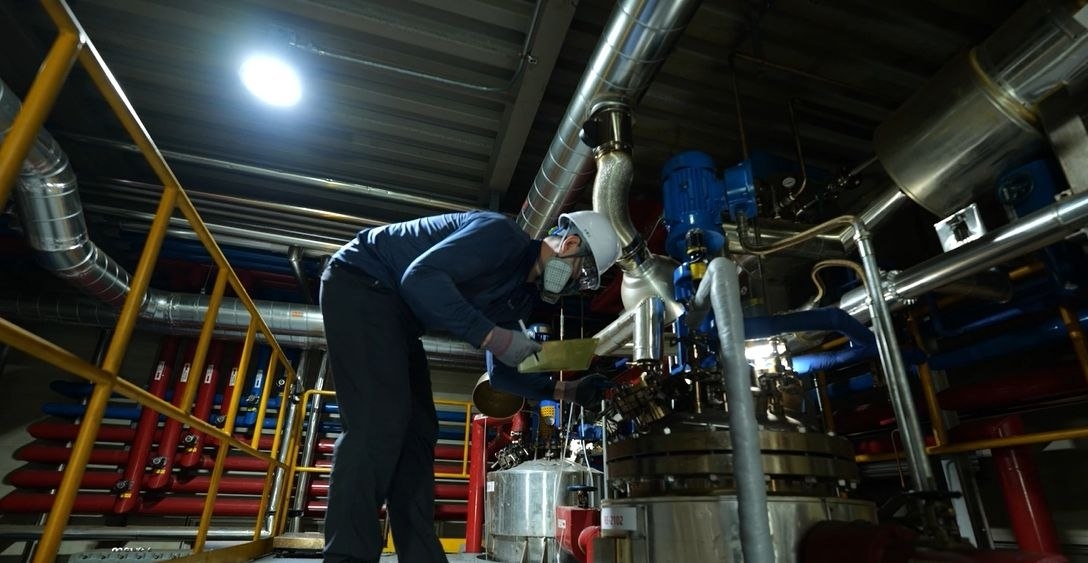
SME R&D headcount falls 13% in four years as large firms add 14%
Share of SMEs in total research workforce drops from 53.8% to 46.2%
Half of small firms say new research hires leave within 2 years; 1 in 5 firms hit by turnover losses
Large companies have expanded their research and development workforces while small and medium-sized enterprises have seen a statistically significant decline, according to a new report. The share of SME researchers in the total corporate R&D workforce has fallen below half, and roughly 50 percent of research hires at small firms leave within two years of joining.
A report released Tuesday by the Korea Institute for Small and Medium Enterprises and Startups, titled "Crisis and Opportunity for SME R&D Personnel in the Age of AI Transition," found that the number of R&D personnel at small and medium-sized enterprises fell from 214,642 in 2022 to 186,795 in October this year — a drop of 27,847, or 13 percent. Over the same period, R&D headcount at large companies rose 14 percent, from 133,519 to 152,201, while mid-sized firms saw a 29.3 percent increase, from 50,505 to 65,298.
The share of SME researchers in the overall corporate R&D workforce has also shrunk sharply. SMEs accounted for 53.8 percent of all corporate research personnel in 2022, but that figure fell to 46.2 percent by October this year. The share dipped below 50 percent for the first time in 2024, at 49.4 percent, and has continued to decline since. By contrast, the combined share of large and mid-sized firms rose from 46.2 percent to 53.8 percent over the same period.
The shrinking R&D workforce reflects a broader weakening of the technology innovation base at small firms. Data from the Korea Industrial Technology Association show that the number of in-house corporate research centers at SMEs fell 7.9 percent, from 40,140 in 2020 to 36,953 in 2025. R&D spending by venture companies also declined 2.1 percent, from 12.6 trillion won ($9.43 billion) in 2023 to 12.35 trillion won in 2024.
The aging of SME research personnel is an additional concern. Researchers aged 50 or older made up 13.4 percent of the total SME research workforce in 2020, but that share climbed to 21 percent by 2025, a rise of 7.6 percentage points. Over the same period, the share of researchers aged 29 or younger fell from 18.4 percent to 16 percent, and those in their 30s declined from 37.7 percent to 35.2 percent.
An educational gap is also evident. As of 2025, researchers with master's degrees accounted for 19.7 percent of SME R&D personnel, while those with doctorates made up 5.6 percent — trailing large companies by 12.5 percentage points and 4.1 percentage points, respectively, where master's holders represent 32.2 percent and doctorate holders 9.7 percent.
Small firms struggle even at the hiring stage. A survey of 283 SMEs with in-house research centers, conducted by the institute in October, found that 86.2 percent reported difficulty recruiting the research personnel they needed. The most commonly cited reason was an inability to match salary and welfare levels, at 47.1 percent, followed by a mismatch between the skills companies require and those applicants possess, at 35.7 percent. Only 7.4 percent said they received almost no applicants at all.
High turnover compounds the problem. Among the surveyed firms, 48.4 percent said newly hired research staff typically stay for less than two years — 18.4 percent reported tenures of under one year, and 30 percent said between one and two years. Only 27.2 percent of firms said new research hires generally remain for three years or more.
In many cases, the departures translate into real business damage. Some 20.1 percent of surveyed firms said they had suffered operational losses due to research staff turnover in the past three years. The figure was higher in manufacturing, at 23.7 percent, compared with 13.4 percent in non-manufacturing sectors — a gap of 10.3 percentage points. Regionally, firms outside Greater Seoul reported a higher rate of damage, at 21.3 percent, than those in the metropolitan area, at 18.8 percent.
Securing personnel for the AI transition is proving equally difficult. While 85.2 percent of surveyed SMEs said they felt the need to hire AI specialists, 45.6 percent said they lacked the capacity to do so despite recognizing the need. Among firms already using AI in their R&D work, 89.1 percent said AI adoption had reduced the time required for research and development.
"The decline in SME R&D personnel and frequent turnover can erode the capacity for technological innovation," said Noh Min-seon, a research fellow at the Korea Institute for Small and Medium Enterprises and Startups. "Comprehensive policy support is needed that links workforce acquisition, retention and growth — including measures to ease the burden of hiring R&D staff, support long-term employment and regional settlement, and strengthen on-site AI capabilities tailored to actual working conditions."
hong@heraldcorp.com





