- Material shows birefringence 120 times stronger than quartz, enabling 173-nanometer-thick components
- Simultaneous light transmission and polarization control opens door to miniaturized AR glasses and optical communications gear
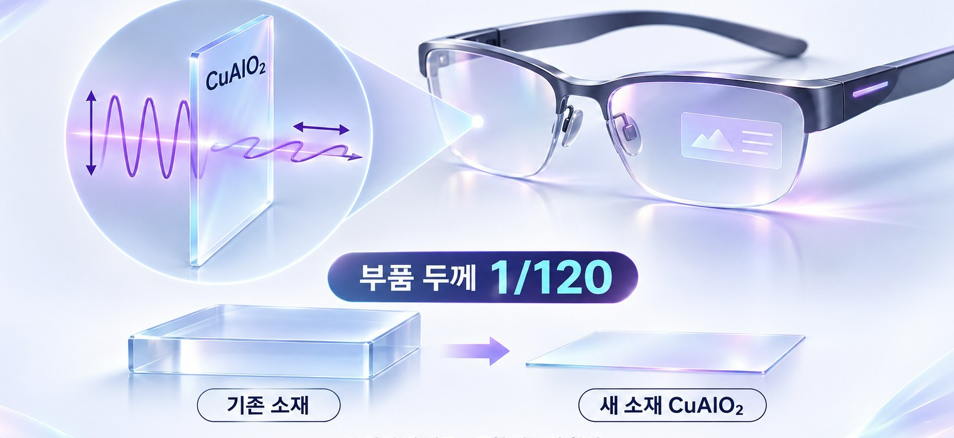
South Korean researchers have developed a key technology that could make smart glasses as thin and light as ordinary eyewear, potentially accelerating the miniaturization of next-generation augmented reality glasses and optical communications equipment.
KAIST announced Tuesday that a research team led by Son Chang-hee, a professor in the university's physics department, working jointly with the Ulsan National Institute of Science and Technology (UNIST) and Pusan National University, had discovered that copper aluminum oxide (CuAlO₂), an oxide semiconductor, possesses a rare combination of high light transmittance and strong polarization control.
Smart glasses and optical communications devices rely on optical components that control polarization — the direction in which light vibrates. A key such component, the half-wave plate, exploits "birefringence," a phenomenon in which a material's refractive index differs depending on the direction of light vibration. The stronger the birefringence, the thinner the component can be made while still performing the same function.
Quartz, the material most widely used in conventional half-wave plates, has relatively weak birefringence, limiting how small such components can be made. Controlling violet light with quartz requires a component roughly 52 times the wavelength of that light in thickness.
The copper aluminum oxide analyzed by the research team exhibited birefringence about 120 times stronger than quartz in the violet light range. The team calculated that this would allow a half-wave plate just 173 nanometers thick — thinner than half the wavelength of light — to control polarization effectively.
The team also identified the mechanism behind this exceptionally strong light-control capability.
The key lies in a dumbbell-shaped atomic structure inside the material, in which oxygen, copper and oxygen atoms are connected in a straight line. This structure either promotes or suppresses light absorption depending on the direction of light vibration, producing a large difference in optical properties.
Particularly in the ultraviolet range, the team also discovered "hyperbolic optical" characteristics, in which light propagates differently than in conventional materials. The researchers said this property could also be harnessed in the development of next-generation ultraviolet optical devices.

The significance of the research lies in achieving both high optical transparency and strong birefringence simultaneously — presenting a materials design principle that could dramatically reduce the thickness of existing optical components.
However, applying the material to actual smart glasses will require further work to fabricate it into thin, uniform films and to minimize optical loss.
"We have confirmed the possibility of making light-polarization-control components to about one-120th the thickness of conventional ones while maintaining high light transmittance," Son said. "This could contribute to making smart glasses and optical communications equipment smaller and lighter."
Son added that the team is conducting follow-up research to develop high-quality thin-film fabrication techniques and reduce optical loss so the material can be used in real components.
KAIST's Kang Baek-jun and UNIST's Shin Jun-hee served as co-first authors on the study, which was published in Nature Communications on Oct. 13.
nbgkoo@heraldcorp.com