
20 firms selected since program launched in 2017
810 billion won in cumulative sales over nine years
4 companies completed IPOs; 14 continue collaboration after contracts end
New 'R&D challenge compensation' scheme rewards even failed research
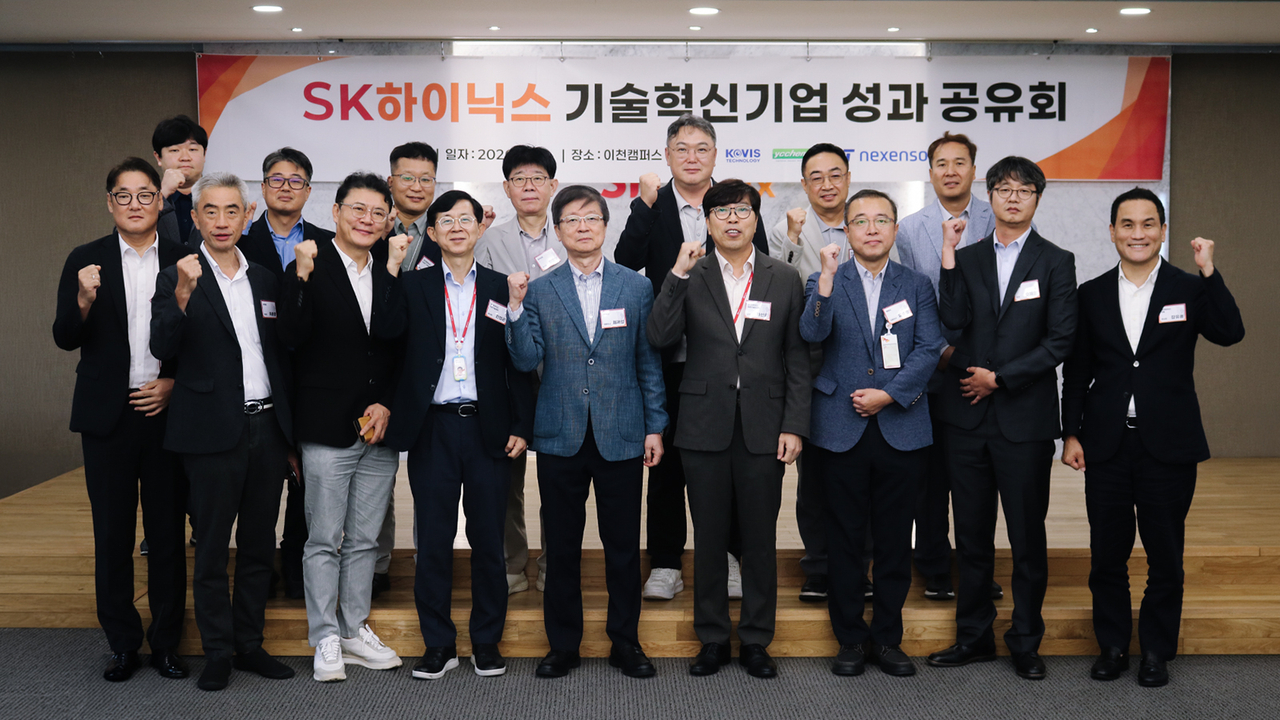
Materials, parts and equipment companies supported through SK hynix's co-growth program have generated cumulative sales of more than 800 billion won ($598 million) over nine years. The milestone reflects a push to build domestic technology independence in a sector long reliant on foreign-made equipment and materials.
SK hynix's newsroom said Tuesday that a total of 20 promising partner firms have been selected through its "Tech Innovation Company" co-growth program since its launch in 2017. The cumulative sales generated by projects developed under the program have reached 810 billion won as of 2025.
Four of the participating companies have completed initial public offerings and grown into competitive mid-sized firms, while 14 continue joint development and supply agreements with SK hynix even after their contracts — which run up to three years — have ended.
Under the program, SK hynix provides comprehensive support to selected small and medium-sized enterprises, covering funding, verification and market access, while engaging in joint technology development for up to three years. Development funds are provided as interest-free loans, and management consulting is also offered.
Partner firms are given the opportunity to test their products on SK hynix's actual production lines, and those that successfully complete development are guaranteed a minimum purchase volume, giving them a stable initial sales base.
As a result, the program has helped achieve domestic production of previously imported items, including etching equipment, semiconductor inspection components (probe cards) and specialty gases such as neon.
Kim Il-gwang, chief technology officer of Kovis Technology, a seventh-cohort Tech Innovation Company, said the biggest challenge for small businesses is not the development work itself but the lack of any way to verify whether they are heading in the right direction. "Being able to check our direction at multiple points throughout the three years of development was critically helpful," Kim said.
Starting this year, SK hynix has introduced an "R&D challenge compensation" scheme that rewards partner firms even for failed research and development efforts. The program will run for five years with a budget of 100 billion won, broadening the scope of co-growth to encourage partner firms to take on more ambitious technological challenges.
SK hynix has structured the challenge categories to match each partner firm's stage of growth and role in the supply chain. The three tracks are: a semiconductor ecosystem development track for joint technology development with mid-sized materials, parts and equipment firms and second- and third-tier suppliers; a top-tier advancement track to build the global competitiveness of high-performing partners; and a technology entry track to help promising firms with proprietary technology potential enter the supply chain.
Upon signing an agreement, SK hynix immediately disburses up to 50 percent of the initial development funding, with additional tranches released after interim reviews for longer-term projects. Full remaining development costs are covered upon achievement of the final target.
Even when targets are not fully met or development does not lead to an actual purchase, SK hynix compensates development costs on a sliding scale based on technical achievement and contribution, rated across four tiers — S, A, B and C. Next year, the company also plans to introduce an "open innovation" model in which partner firms can directly propose their own advanced technologies.
joze@heraldcorp.com





