
SK Telecom holds 39%, KT 23%, LG Uplus 19% — shares unmoved
Capital expenditure nears 4 trillion won as carriers chase AI demand
'Token efficiency will define the next phase of telecom competition'
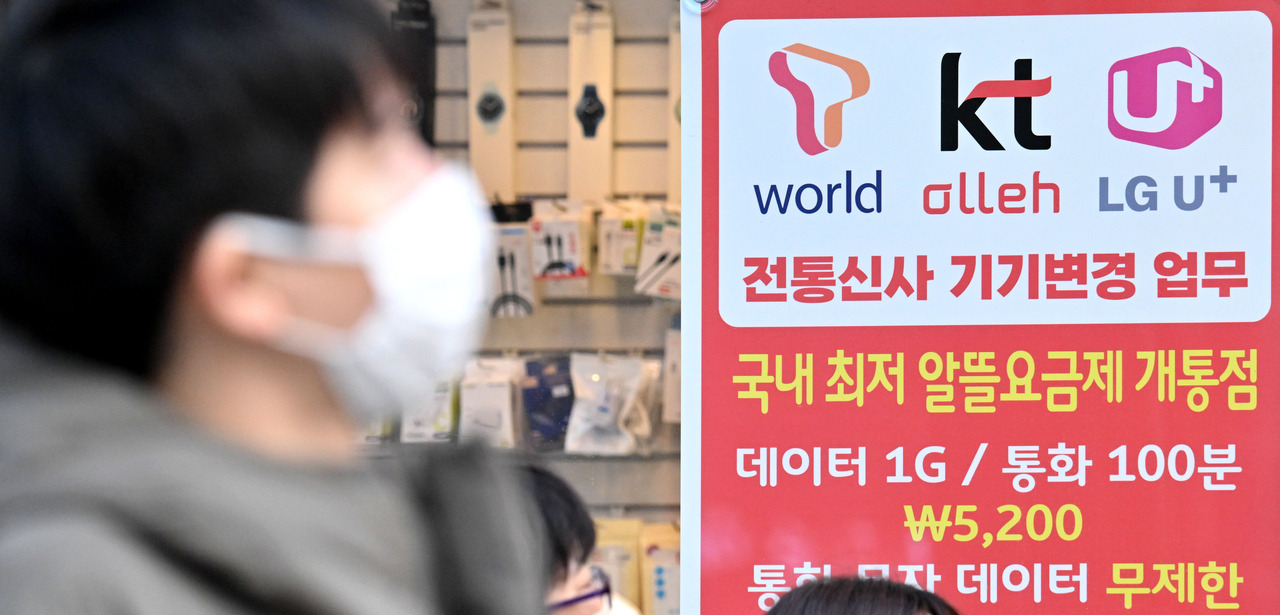
As number portability driven by penalty-free switching — which surged from last year through early this year — has tapered off, the subscriber battle among South Korea's three major telecoms has lost steam. The carriers collectively poured more than 2 trillion won ($1.5 billion) into marketing in the third quarter alone, yet their mobile network operator market shares have barely budged.
In response, all three are accelerating their transformation into AI companies. They have recently moved beyond AI infrastructure to enter the token business, which aims to cut AI costs for corporate clients. The government has also been actively urging the carriers to make the shift.
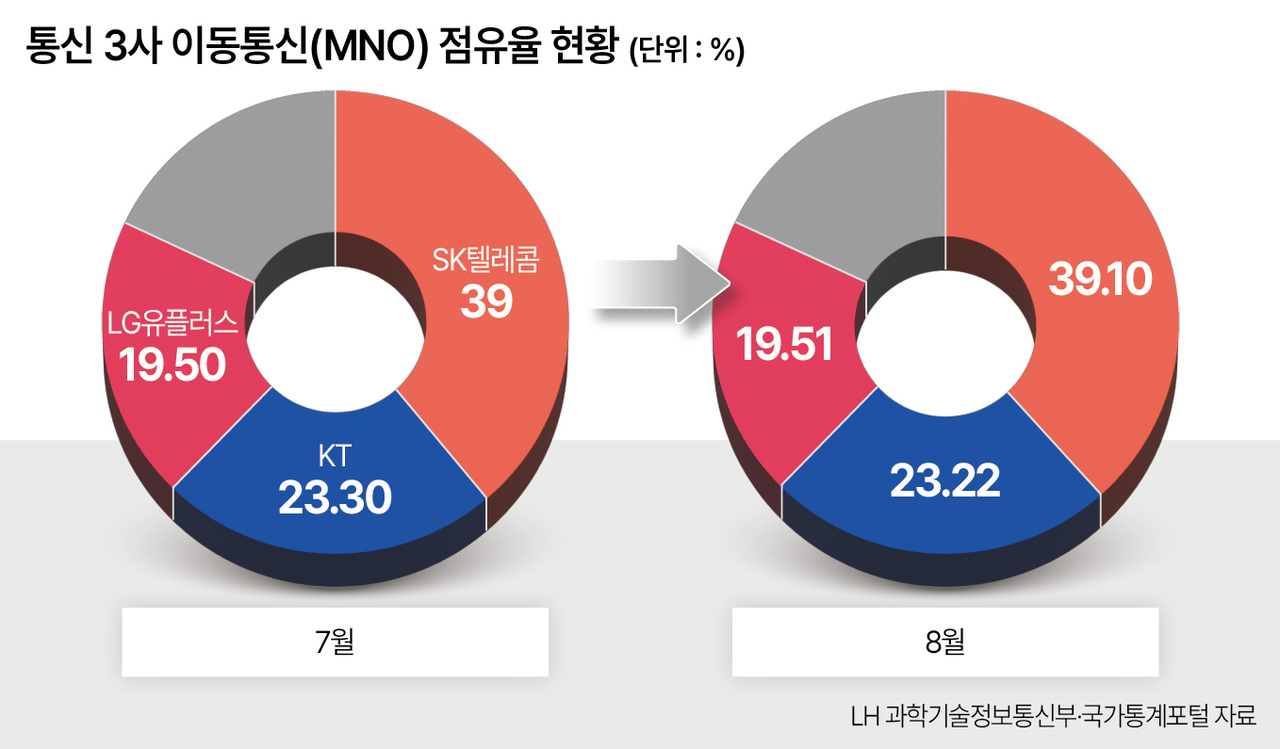
According to industry data as of August, mobile market shares stood at 39.10 percent for SK Telecom, 23.22 percent for KT Corp and 19.51 percent for LG Uplus.
During the penalty-free switching period that stretched from last year into early this year, all three carriers fought hard to win subscribers. Even so, SK Telecom fell short of the 40 percent threshold, and LG Uplus never broke into the 20s.
The repeal of the Mobile Device Distribution Improvement Act and the launches of the Galaxy Z Fold 8 and the iPhone Duo produced only modest subscriber gains. The carriers spent more than 2 trillion won in the third quarter alone and still could not dislodge the entrenched share breakdown.
The three carriers have now turned their attention to AI. Their combined capital expenditure through the third quarter reached 3.83 trillion won, up 13.7 percent from the same period last year. LG Uplus led with 1.36 trillion won, followed by KT Corp at 1.2282 trillion won and SK Telecom (including SK Hyper) at 1.2336 trillion won.
The spending surge reflects growing demand for AI data centers as generative AI services proliferate and corporate AI transformation picks up pace.
Beyond AI data centers, all three carriers have now entered the token business — the market for selling AI processing capacity priced by usage. Their shared goal is to combine context-appropriate AI models with semiconductor optimization to lower the cost of AI adoption for enterprise clients.
SK Telecom's token gateway service pairs Nvidia GPUs with Rebellions NPUs inside its own AI data center to produce low-cost tokens in-house, then routes corporate clients to the AI model best suited to their needs.
KT Corp, which is developing a token factory service, cuts enterprise costs by routing queries to different AI models depending on their complexity. LG Uplus has announced plans to launch a corporate token optimization service next year, aiming to reduce AI costs through model routing by query difficulty and semiconductor efficiency improvements, including AI-assisted coding.
The Ministry of Science and ICT, the sector's regulator, has been equally enthusiastic about the shift. At a meeting with the three carriers' chief executives in July, Deputy Prime Minister and Minister of Science and ICT Bae Kyung-hoon said the government would "actively support building AI infrastructure and platforms and transforming the entire telecommunications framework around AI," adding that "bold investment and change from the telecom industry are needed as technological competition intensifies."
"In the AI era, competitiveness comes down to how efficiently you can produce and supply AI tokens," an industry official said. "Telecoms will keep competing fiercely to stake out a position in the AI infrastructure and services market beyond their traditional turf."
ko@heraldcorp.com





