
Metal composition analysis lab named top-rated safety lab
Companies strengthen safety management systems, producing top-rated lab for third straight year
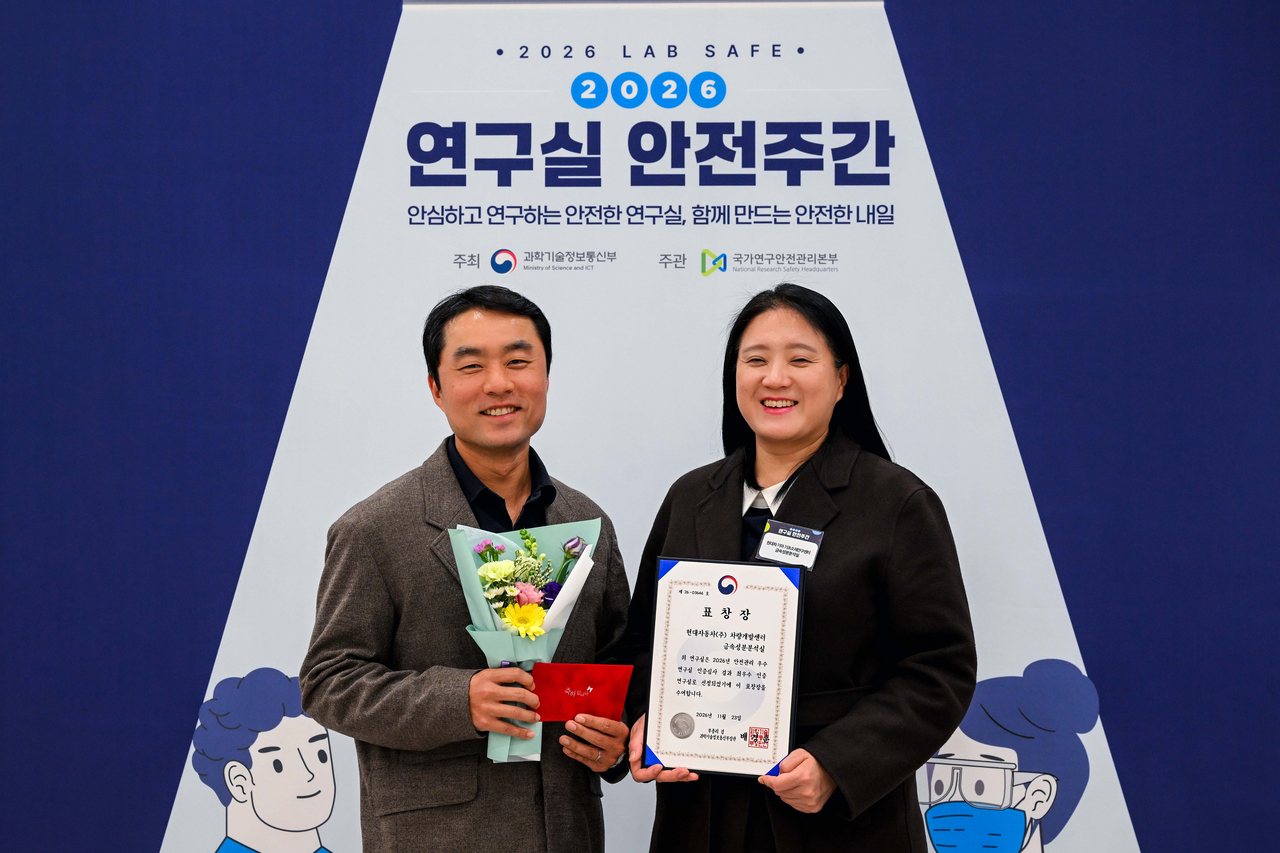
Hyundai Motor and Kia announced Tuesday that their metal composition analysis lab, part of the Basic Materials Research Center at the Namyang Research and Development Center, was named the top-rated laboratory in the Ministry of Science and ICT's 2026 Excellence in Laboratory Safety Management certification review, earning a commendation from the deputy prime minister and minister of science and ICT.
The Excellence in Laboratory Safety Management certification program is a system administered by the Ministry of Science and ICT to strengthen the autonomous safety management capabilities of domestic science and technology laboratories and to identify and promote standard safety management models. Laboratories are evaluated across three areas — safety environment systems, activity levels, and safety awareness — and the top 10 percent of certified labs are designated as top-rated.
The recognition carries particular significance amid growing public attention to safety management at industrial sites and research facilities, as it represents an official government certification acknowledging the strength of Hyundai Motor and Kia's laboratory safety management capabilities and each lab's specialized management systems.
The companies have now produced a top-rated laboratory for three consecutive years — the electrolyte membrane development lab at the Mabuk Research and Development Center in 2024, the commercial vehicle environmental wind tunnel lab at the Namyang center in 2025, and this year the metal composition analysis lab.
The metal composition analysis lab handles elemental analysis of metallic and inorganic materials used in vehicles. In addition to traditional metal materials such as steel sheet, it also conducts analysis of permanent magnets, rare earth elements, and battery component materials in line with the electrification trend.
The lab prevents improper mixing and reactions by storing the numerous chemicals it handles separately according to their properties. It has also reinforced on-site safety management by installing a chemical management kiosk that allows staff to look up chemical information and print warning labels, and by introducing ventilation equipment with strong resistance to acidic substances.
Hyundai Motor and Kia applied for certification for 15 laboratories this year — covering both new certifications and renewals — and obtained all 15. Each certification carries a two-year validity period, bringing the total number of currently valid certified safety management laboratories across the two companies to 25.
"This recognition as a top-rated safety management laboratory reflects an acknowledgment of the environment, safety systems, and safety awareness at our research sites," a Hyundai Motor and Kia official said. "Since safety at research sites is the starting point for building safe vehicles, we will continue to raise our safety management standards."
Meanwhile, Hyundai Motor and Kia recently signed an MOU with the Korean Agency for Technology and Standards, the Hyundai Motor and Kia Suppliers Association, and the K-Mobility Bridge Foundation on supporting technology regulation responses for the 2026 transition to future mobility, and held a greenhouse gas seminar for executives of high-emission parts suppliers. The companies have also been actively pursuing eco-friendly management, running a "virtuous-cycle greenhouse gas reduction partnership program" since last year to help suppliers cut their emissions.
likehyo85@heraldcorp.com





