'Bear hug' disclosure rule targeted for passage by year-end
Mandatory tender offer regime open to renegotiation with opposition
Panel asks FSS to scrutinize 'finfluencer' front-running
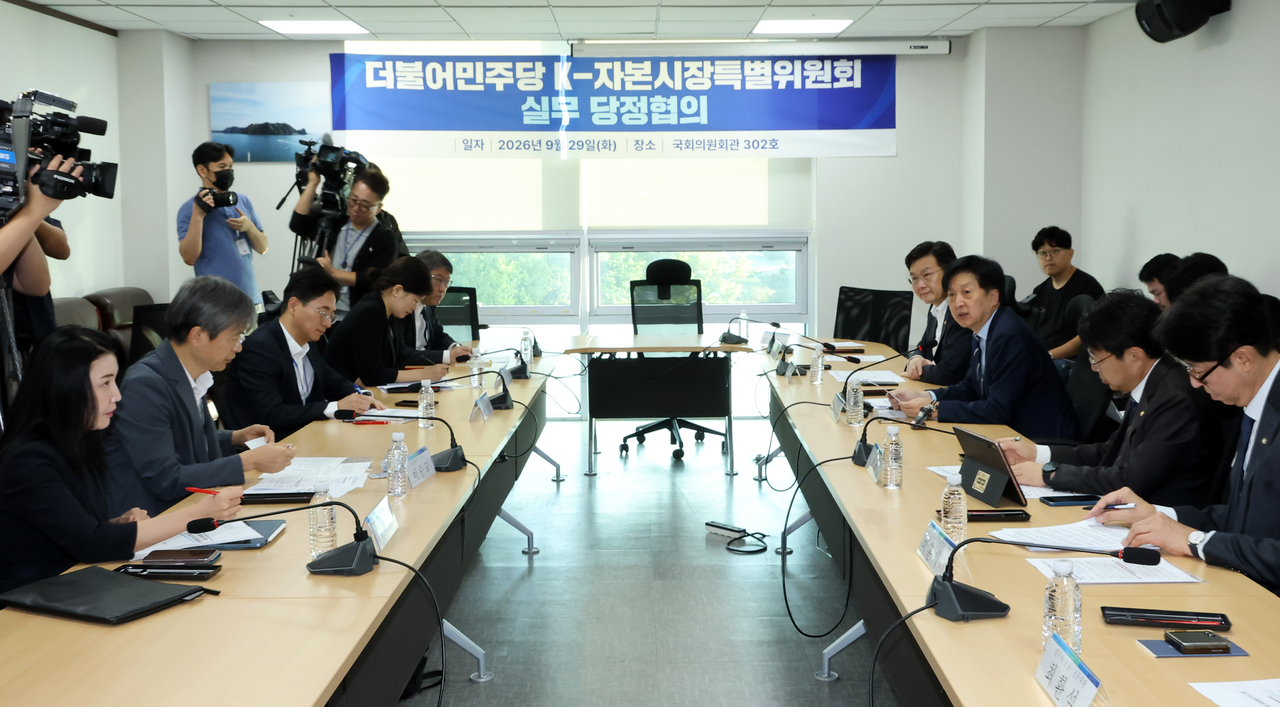
Amid continued volatility on the Kospi, the Democratic Party of Korea said it would reach a conclusion this month on the so-called share-price suppression prevention bill. The party also set a year-end target for passing a "bear hug" disclosure requirement and left open the possibility of renegotiating the mandatory tender offer regime, which has drawn pushback from retail shareholders.
The Democratic Party's K-Capital Market Special Committee held a closed-door meeting Tuesday at the National Assembly Members' Office Building to discuss measures to improve low price-to-book ratios. Committee Chairman Oh Ki-hyung told reporters after the meeting that the inheritance and gift tax amendment — the legal vehicle for the share-price suppression bill — "has no choice but to be resolved in the National Assembly's Finance and Economy Planning Committee this month," adding that the panel would "reach a conclusion in some form."
The share-price suppression prevention bill refers to a proposed amendment to the inheritance and gift tax law aimed at stopping major shareholders from artificially keeping share prices low to reduce their inheritance and gift tax burdens. It is one of the capital market modernization measures the Democratic Party has been pushing as a remedy for a structural cause of the so-called Korea discount. The panel has yet to bridge differences between a government proposal — which would raise the assessed value of shares by at least 30% for tax purposes and apply a 30% surcharge to undervalued companies — and a separate bill by Assembly member Lee Hun-gi that would set a floor on share valuations at a price-to-book ratio of 0.8.
On the bear hug regime, Oh said the party "hopes to get it through the National Assembly this year and is working to persuade the Political Affairs Committee." The Korean-style bear hug system refers to a proposed amendment to the Capital Markets Act that would require company boards to actively review acquisition proposals and mandate disclosure to ordinary shareholders.
On the mandatory tender offer regime, Oh said the party could not simply declare void what the ruling and opposition parties had already agreed on in the Political Affairs Committee, but added that "more communication between the parties is needed and the opposition needs to be persuaded." Committee member Kim Nam-geun said it did not appear that many within the People Power Party wanted to proceed with the bill as passed by the committee, and that "once the PPP sorts out its internal views, it seems we could follow the procedure of re-deliberating and submitting an agreed bill to the plenary session."
The mandatory tender offer regime is a proposed amendment to the Capital Markets Act that would require an acquirer of a listed company's management control to share the control premium not only with the largest shareholder but also with ordinary shareholders. It was designed to prevent cases like that of Namyang Dairy Products, where ordinary shareholders suffered losses after the controlling stake was sold and the share price collapsed.
Earlier, a "50%-plus-one-share" formula — under which an acquirer must purchase from ordinary shareholders enough shares to bring its total holding to 50% plus one share — was referred to the plenary session with bipartisan agreement. However, the bill has stalled amid calls, mainly from retail shareholders, to raise the mandatory purchase ratio to 100%.
Oh said market participants appeared to be demanding one of three alternatives: a 100% mandatory tender offer, a pro-rata approach split between 100% and 50%, or a 75% threshold modeled on Japan's system, adding that the committee was "keeping all options on the table." On concerns that a 100% mandatory tender offer could dampen mergers and acquisitions, Kim said ordinary shareholders would make their own judgments based on a company's growth prospects, and that "a 100% mandatory tender offer does not necessarily mean everyone will sell."
The committee also discussed measures to address unfair trading by so-called finfluencers — financial influencers — at Tuesday's meeting. Oh said the panel had discussed the need for ongoing scrutiny of finfluencers who engage in front-running, taking profits and then selling, and said the committee had "asked the Financial Supervisory Service to actively step up its monitoring."
addressh@heraldcorp.com