Districts with index above 50 shrink from 18 to 7
Seongdong falls from 50.14 to 29.22, steepest in Seoul
'Loan regulations a hurdle for new homebuyers'
Over the past year, Seocho-gu was the only one of Seoul's 25 districts to record an increase in its mortgage index — a measure of the average ratio of mortgage collateral registered against apartment sale prices. The number of districts with an index above 50 shrank from 18 to 7 over the same period. Analysts say the combination of rising home prices and tightening loan regulations has made cash reserves increasingly decisive for anyone looking to buy property in Seoul.
According to data from the Supreme Court's Registry Information Plaza, 24 of Seoul's 25 districts posted a year-on-year decline in their mortgage index as of October, with only Seocho-gu bucking the trend. The index is calculated as the average ratio of mortgage collateral to sale price across collective-building transactions in which both a sale and a mortgage registration occurred simultaneously. A falling index indicates lower reliance on borrowing.
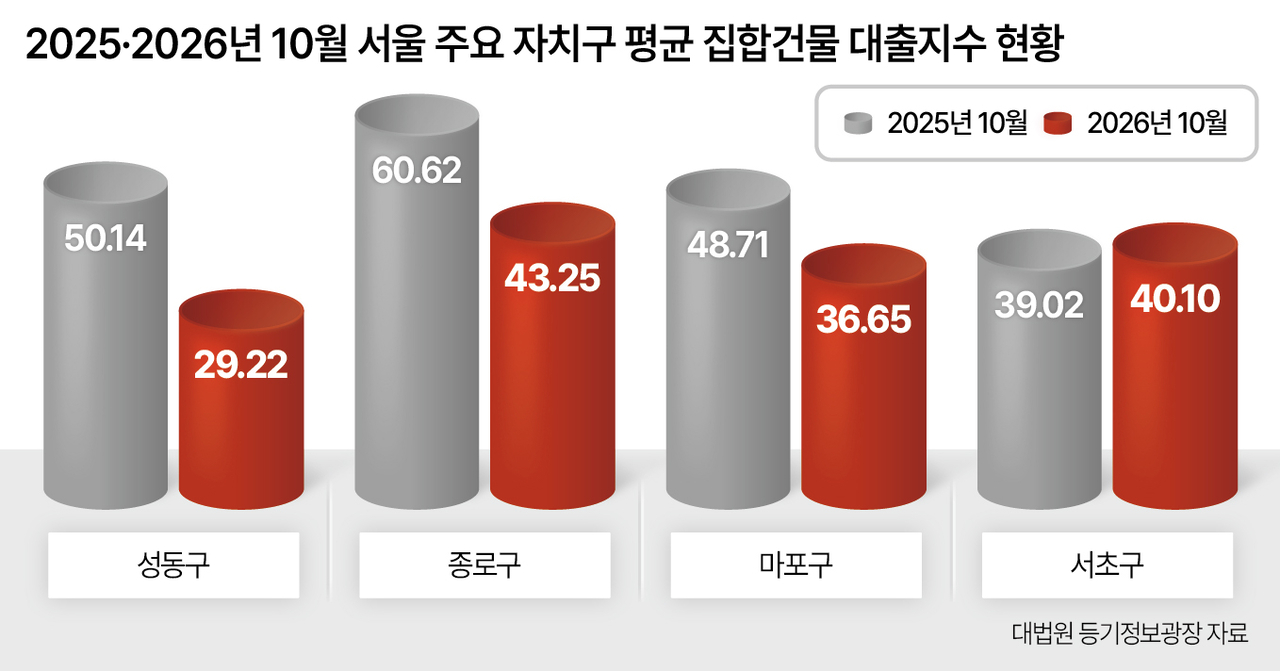
Seocho-gu was the only district in Seoul where the mortgage index rose, climbing from 39.02 in October last year to 40.10 in October this year, a gain of 1.08 points.
Elsewhere, the index fell sharply. Among the 18 districts that had posted an index above 50 in October last year, 11 dropped below that threshold by October this year — including Gwanak-gu (57.48 to 49.44), Dongdaemun-gu (54.26 to 43.70) and Seodaemun-gu (53.63 to 45.03).
Outer districts also saw declines. Geumcheon-gu fell 9.77 points, from 63.54 to 53.77. Dobong-gu dropped 6.82 points, from 59.05 to 52.23, and Nowon-gu fell 4.08 points, from 58.35 to 54.27. These areas, where home prices are relatively affordable, still maintained indexes above 50, but loan dependency fell across the board compared with a year earlier.
The broad-based decline across Seoul reflects rising home prices and tighter loan regulations working in tandem. Analysts say sustained price increases have dragged the index lower even as borrowing capacity has remained constrained.
Regulations that reduce mortgage limits for more expensive apartments are a key factor. The government capped mortgage loans for home purchases in the greater Seoul area and regulated zones at a maximum of 600 million won ($446,000) in June last year, then introduced a tiered limit structure in October based on property price. Under that framework, homes priced at 1.5 billion won or below qualify for loans of up to 600 million won; those priced above 1.5 billion won and up to 2.5 billion won are capped at 400 million won; and homes above 2.5 billion won are limited to 200 million won. The structure means that as home prices rise, the amount a buyer can borrow actually shrinks.

Seongdong-gu, part of the Han River belt, recorded the steepest decline of any district. Its average mortgage index tumbled from 50.14 in October last year to 29.22 in October this year, a drop of 20.92 points. After standing at 37.17 in June this year, the index fell to 36.42 in July, 34.48 in August and 32.29 in September before slipping below 30 last month.
Jongno-gu posted the second-largest decline, falling 17.37 points from 60.62 to 43.25, while Mapo-gu dropped 12.06 points from 48.71 to 36.65.
In Seongdong-gu, which saw the sharpest drop in the mortgage index, the share of apartment transactions above 1.5 billion won — the threshold at which mortgage limits tighten — also expanded. An analysis of Seongdong-gu apartment sale transactions reported to the Ministry of Land, Infrastructure and Transport's actual transaction price disclosure system showed that the proportion of deals above 1.5 billion won rose from 59.08 percent in October last year to 76.71 percent in October this year, an increase of 17.63 percentage points.
Cases where prices at the same complex crossed the 1.5 billion won threshold within a year were also confirmed. An 84-square-meter unit at Wangsimni Kumho Eoulim in Hawangsimni-dong, Seongdong-gu, sold for 1.29 billion won in October last year but changed hands for 1.7 billion won in October this year. A 59-square-meter unit at Wangsimni Punglim I-One similarly rose from the 1.12 billion to 1.28 billion won range during the same period to 1.55 billion won.
Experts said the divergence in index trends reflects differences in local home prices and applicable loan limits. Yoon Su-min, a real estate specialist at NH NongHyup Bank, said that in outer districts with high loan dependency, rising prices have pushed the index lower, while in the Han River belt, tightening loan regulations on top of price gains have produced an even steeper decline. "Those looking to buy a home for the first time may find themselves in a difficult position given the tightening trend in loan regulations," Yoon added.
Seo Jin-hyung, a professor in the real estate law department at Kwangwoon University, said Gangnam-area transactions are relatively few in number and include a fair share of unusual cases such as below-market deals between related parties. "Buying a home without cash has become in effect impossible, meaning only those who already have wealth have any opportunity," Seo said, adding that some loan regulations should be eased for those without homes and for owner-occupiers.
shy@heraldcorp.com