
An says exceptions needed for unavoidable non-residency under long-term holding deduction; inheritance tax deductions unchanged for 30 years burden middle class
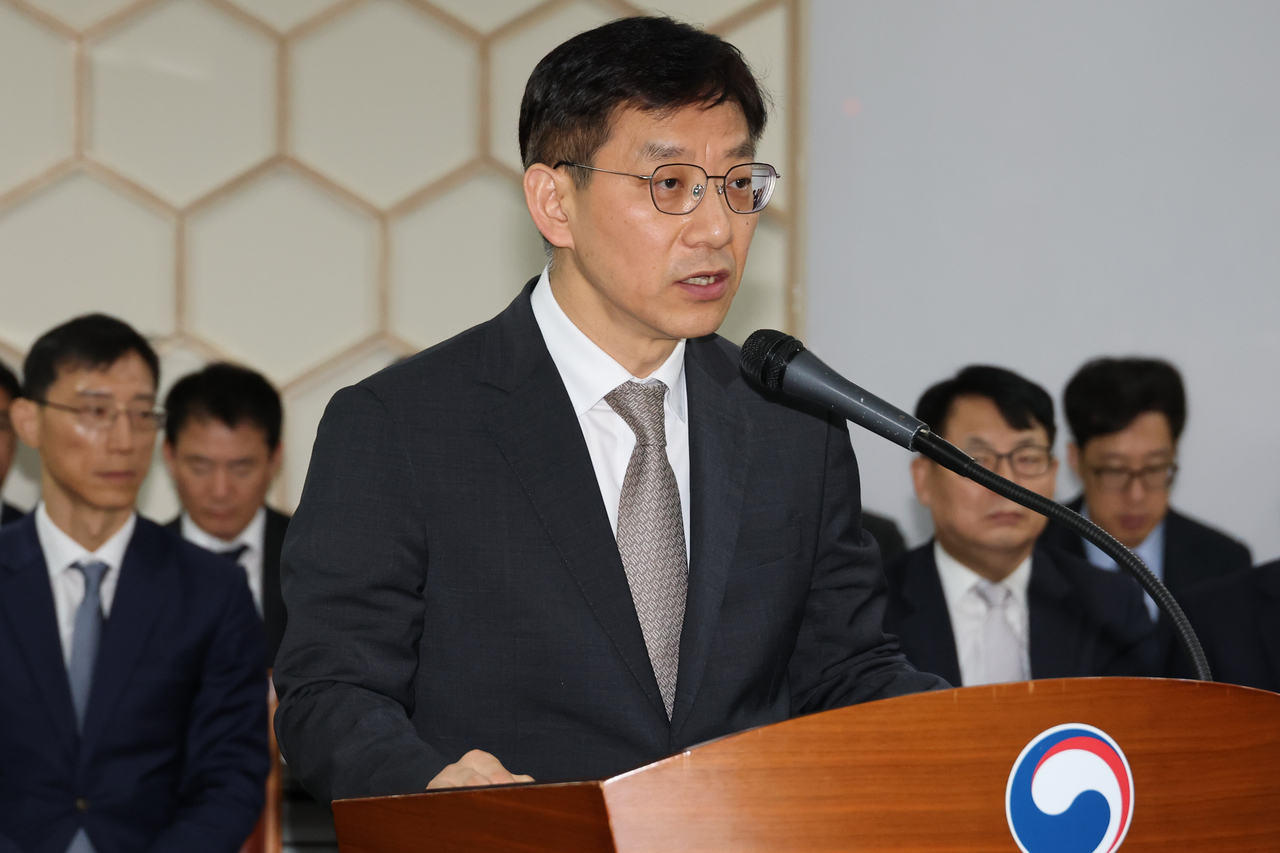
An Duk-su, the nominee for National Tax Service commissioner, said Tuesday that the NTS has never received instructions from the presidential office regarding unscheduled tax audits.
An made the remarks in written responses submitted to the National Assembly ahead of his confirmation hearing, addressing a question from Democratic Party of Korea lawmaker Yoon Hu-deok about allegations that tax audits had been ordered by the president. "Tax audits are conducted by the head of the relevant regional tax office or tax office director, and we have never received instructions from the presidential office in the course of those audits," An said.
He added that audit targets are selected fairly in accordance with the requirements set out under the Framework Act on National Taxes, and that the presidential office neither makes requests nor holds prior consultations in that process.
Asked by People Power Party lawmaker Bae Jun-young what he would do if the presidential office or a senior official demanded that a specific company be audited, An said: "Audits must be conducted fairly and by the law and principles, in service of their core purpose of encouraging honest tax filing. The neutrality of tax audits is an overriding value."
An also denied any connection between President Lee Jae-myung's mention of price gouging on sanitary products during a work briefing in December last year and the NTS's announcement one month later that it would launch an investigation into "profiteering tax evaders on daily necessities," including manufacturers and sellers of sanitary products.
"We continuously monitor for suspected tax evasion related to prices, and when suspicions are confirmed, a tax audit is conducted under the responsibility of the relevant regional tax office head or tax office director," he said. "Among those cases, we select briefing topics by comprehensively considering factors such as public interest and the impact on people's daily lives."
He acknowledged that the government's broader policy direction can be reflected in the overall operational approach of national tax administration, but said that "in any case, individual tax audits must be conducted fairly and in accordance with the law and principles."
When Bae asked whether price increases alone could make a company a target for audit, An said a company would not be selected for investigation simply because it raised its prices.
"Price-related tax audits are intended to correct tax evasion by businesses that have deliberately siphoned off profits gained by charging consumers higher prices — through means such as falsifying cost records or engaging in improper transactions with related parties," he said. "They are not aimed at achieving a direct price-stabilization effect."
Asked to disclose statistics on unscheduled tax audits last year, An said the NTS assessed 2.57 trillion won ($1.91 billion) in taxes across 1,827 cases involving corporate taxpayers, and 586.9 billion won across 1,496 cases involving individual business operators.
On the government's proposed tax reform to shift the long-term holding special deduction toward a residency-based system, An said he believes exceptions are needed for cases where taxpayers were unable to live in their homes due to unavoidable circumstances, as such situations could still result in a tax burden.
Asked how the NTS would verify claims of "unavoidable non-residency" in the context of differential basic deductions under the comprehensive real estate tax, An said the agency could consider confirming such cases through objective documentation such as school enrollment certificates, employment certificates and medical records.
An, who has experience in the tax policy division of the Ministry of Economy and Finance and the NTS's asset taxation bureau, was asked to identify the most pressing problem with the current inheritance tax system. He said that despite rising asset values over the past 30-plus years, deduction amounts under the inheritance tax have remained unchanged, placing a heavy burden on the middle class. He said he would gather feedback from the field and work closely with the Ministry of Economy and Finance to ease that burden.
On the question of shifting to an "inheritance acquisition tax" system — under which each heir is taxed individually on their own share — An said the approach has merit in that taxation corresponds to what each person actually receives. However, he cautioned that it also carries drawbacks, including the risk of inheritance tax avoidance through sham divisions of assets, reduced tax revenue, and increased administrative costs to track each heir's assets. He said the matter should be approached carefully with public consensus in mind.
Regarding the NTS's delinquency management unit, An acknowledged the point raised by PPP lawmaker Kim Sang-hoon that some of the taxes collected by the unit would have been collected anyway without it. "I agree that may be the case in some instances," he said, adding that the unit's purpose is not to directly collect delinquent taxes but to verify the actual status of delinquencies, update records and classify cases by type.
On the taxation of virtual asset income, An said the NTS has prepared a draft notice on how to calculate taxable income but that follow-up procedures have been put on hold pending discussions on a further deferral. He said the agency would use the deferral period to refine tax standards for new and complex transaction types and update related notices.
Nominated on Nov. 6, An is a career tax official who has held key posts across the NTS's audit and collection functions.
Born in 1971, An graduated from Yongin High School in Busan and studied economics at Korea University, entering public service through the 40th administrative examination. He has served in a range of NTS roles, including head of the capital transactions management division, real estate taxation division, taxpayer protection office and tax base information division under the audit bureau. He also gained hands-on experience in tax policy as head of the environment and energy taxation division at the Ministry of Economy and Finance.
After a posting at the Internal Revenue Service in the United States, An went on to serve as head of audit bureau No. 1 at the Busan Regional Tax Office and at the Central Regional Tax Office, before heading audit bureau No. 4 at the Seoul Regional Tax Office — a post known in business circles as the "grim reaper of the corporate world."
At NTS headquarters, An has held major positions including head of the asset taxation bureau, which oversees real estate taxation and inheritance and gift taxes; head of the collection and legal affairs bureau, responsible for pursuing and managing delinquent taxpayers; and head of the audit bureau. He currently serves as commissioner of the Seoul Regional Tax Office.
Since the Lee Jae-myung administration took office, An has led the audit bureau and pursued a policy of "considerate tax audits," introducing a scheduling-choice system that allows businesses and small merchants to select the timing of their regular tax audits within a three-month window.
He has also handled major audit cases involving tax evasion tied to crimes harming people's livelihoods, monopolistic practices in the food industry, and unfair trading in the stock market by share price manipulation rings.
An is widely regarded within the organization as a person of generous character who commands deep respect among colleagues.
oskymoon@heraldcorp.com





