Seoul Metropolitan Government draws up emergency transport plan ahead of Wednesday's strike
City bus service to add 3,519 extra runs during peak hours
Seoul will maintain full subway service on Lines 1 through 8 during the morning commute hours of 7 to 9 a.m. Wednesday, even if Seoul Metro workers go on strike, the Seoul Metropolitan Government said. The city has also drawn up plans to boost bus service as a contingency.
The city announced the emergency transport plan Tuesday in preparation for a potential strike by the Seoul Metro union.
If a strike begins, subway Lines 1 through 8 will operate at 100 percent of normal capacity during the morning rush from 7 to 9 a.m. During the evening rush from 6 to 8 p.m., Lines 2 and 5 through 8 will also run at full capacity, while Lines 1, 3 and 4 — including Korail-operated sections — will maintain at least 88 percent service. The city plans to keep the overall train operation rate at around 81 percent throughout the day. Line 9, whose workers are not participating in the strike, will run normally.
To minimize congestion during peak hours, three standby train sets will be kept on alert on Lines 2 and 4, ready for immediate deployment at the height of the rush to ease passenger crowding and ensure stable operations.
Bus capacity will also be expanded. If the strike begins, the city plans to extend peak-hour concentrated dispatch on 344 regular bus routes by one hour each during both the morning and evening commutes starting Wednesday morning, adding a total of 3,519 extra runs during rush hours.
Morning peak dispatch hours will be extended from the usual 7–9 a.m. to 6–9 a.m., while evening peak hours will stretch from 5–7 p.m. to 5–8 p.m.
Of the additional runs, 1,873 are scheduled for the morning commute and 1,646 for the evening. The total is 981 more runs than the emergency transport plan prepared for the Dec. 12 strike last year. However, the actual number of runs may vary depending on the circumstances of individual bus operators.
The city said it will also ensure safety management at subway stations. As subway service is designated an essential public service — meaning workers must maintain minimum operations even during a strike — the city plans to secure around 13,000 personnel, roughly 80 percent of normal staffing levels, drawn from non-striking workers and contractors to keep trains running.
In addition, 124 city employees will be deployed as station support staff at 31 major stations expected to see heavy passenger traffic.
The city is also preparing for the possibility of a prolonged strike. It has divided any strike period into two phases — Phase 1 covering the first seven days and Phase 2 from the eighth day onward — with separate emergency transport measures for each phase.
Even if the strike extends beyond eight days, the city said it will maintain a train operation rate of at least 90 percent during morning rush hours and at least 80 percent in the evening. It will also seek additional alternative transport options, including shuttle buses operated by district offices.
"We are mobilizing every available means of transport from before the strike begins in order to minimize inconvenience to citizens," said Yeo Jang-gwon, head of the Seoul Metropolitan Government's transportation bureau. "We hope labor and management will reach an agreement as soon as possible with citizens as the top priority, and we will do our utmost to restore normal subway operations."
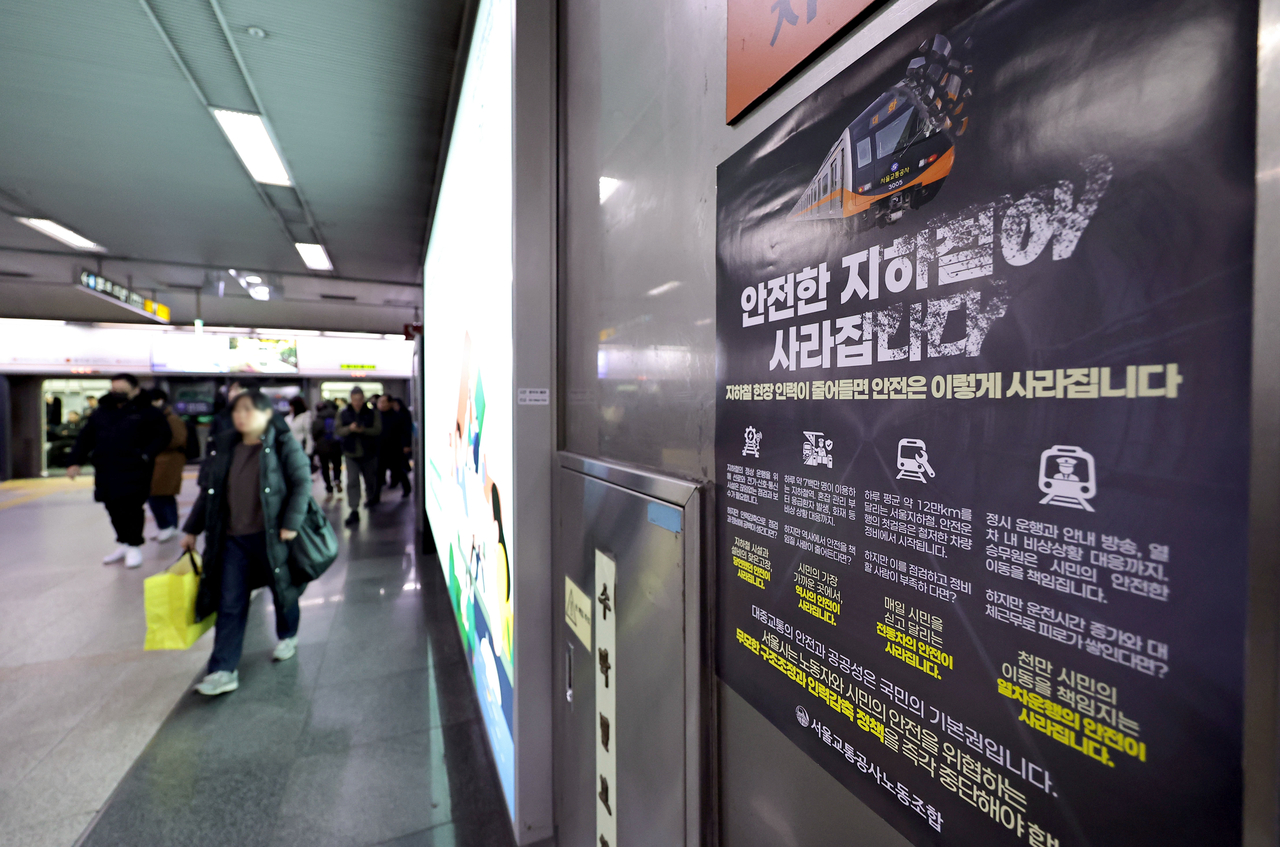
Meanwhile, Seoul Metro and its union have been in final negotiations since Tuesday morning. Staffing is the central issue in this year's talks. The union is demanding that management scrap its plan to cut 2,212 positions, arguing the shortage of on-site workers is creating gaps in safety operations, and is calling for the hiring of 1,313 additional safety personnel. The union is also seeking a 3.5 percent wage increase, a mandatory two-person system for safety duties, and government funding for public service obligations. Seoul City and Seoul Metro, for their part, have maintained that fiscal constraints and management efficiency improvements are necessary. The key variable in whether a deal can be reached is what staffing proposal the city puts forward that day.
cook@heraldcorp.com