Experts discuss paths forward on industry, administrative integration and energy
A panel of experts will gather to discuss the region's long-term development — covering semiconductor industry promotion, conflict resolution following administrative integration, energy supply and urban planning — in the wake of the launch of the Jeonnam-Gwangju Special Integrated City.
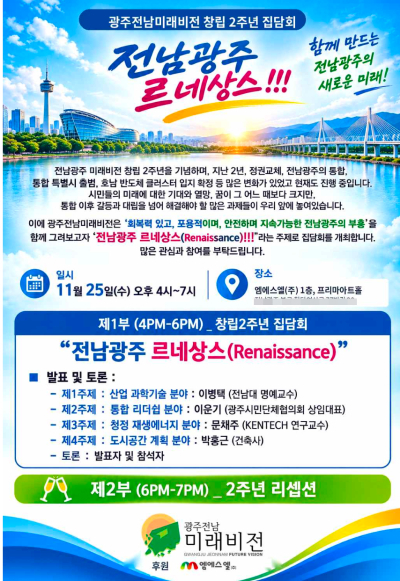
Gwangju-Jeonnam Future Vision will hold its 13th forum Wednesday at Prima Art Hall in Buk-gu, Gwangju, under the theme "South Jeolla-Gwangju Renaissance," marking the private think tank's second anniversary.
Founded in November 2024, Gwangju-Jeonnam Future Vision brings together universities, industry and civil society to propose policy on regional issues and industrial development. The forum will focus on four areas — industry, administrative integration, energy and urban development — as part of a medium- to long-term growth strategy.
Lee Byeong-taek, an emeritus professor at Chonnam National University, argued that the region should prioritize building up the semiconductor sector while simultaneously advancing emerging industries — including AI, mobility, energy, biotech and aerospace — alongside established pillars such as petrochemicals, shipbuilding, steel and automobiles. Lee also proposed tailored measures to attract businesses, expand participation by local firms and support industrial transition.
The forum will also take up institutional mechanisms to ease regional tensions following administrative integration. Lee Un-gi, standing representative of the Gwangju Civic Organizations Council, proposed establishing an independent social conflict mediation committee, concluding a balanced-development social compact, strengthening civil society solidarity and operating a permanent public deliberation forum.
Securing sufficient power for the semiconductor industry is another key concern. Moon Chae-ju, a professor at Korea Energy University of Technology, outlined a plan combining medium-voltage direct current transmission with short-term grid stabilization through LNG power generation and, over the longer term, a mix of energy sources including ESS and small modular reactors.
On urban planning, participants called for industrial complex development and residential environment design to be planned together. Park Hong-keun, an architect and head of a spatial welfare consultancy, proposed creating a coordinating function to align planning inside industrial complexes with broader metropolitan spatial plans, while also preparing to open a semiconductor city promotional center and build a permanent future exhibition hall starting next year.
sij@heraldcorp.com