Opening remarks at Toss Insight Future Finance Forum on Tuesday
AI to handle fund supply, risk assessment and transactions
Biased data, opaque criteria seen as discrimination risks
Institutional safeguards urged for AI-related financial incidents
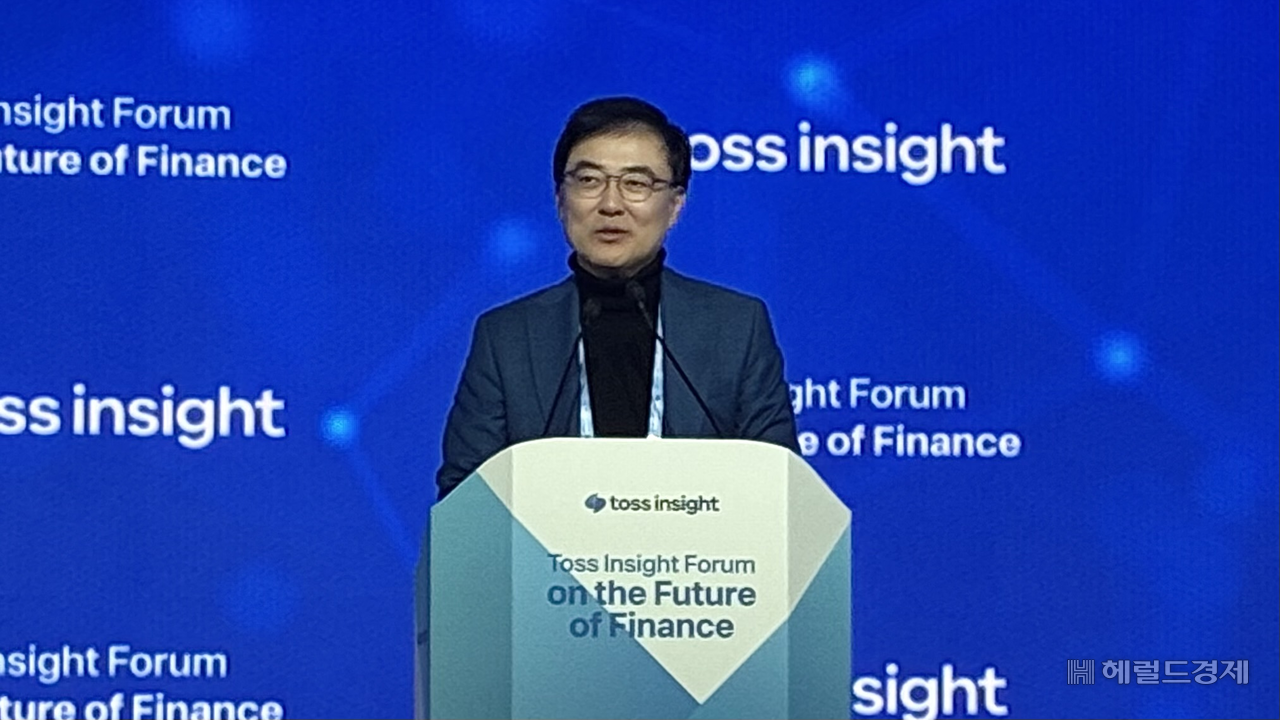
Son Byung-doo, CEO of Toss Insight, warned Tuesday that as AI takes on core financial decision-making roles — including loan screening and product recommendations — it could give rise to new forms of consumer discrimination. With AI agents poised to conduct financial transactions on behalf of customers, Son called for greater transparency in AI-driven judgments and clear accountability when incidents occur.
Speaking at the opening of the Toss Insight Future Finance Forum at the Westin Josun Seoul in Jung-gu, Son said AI "is entering the core judgment processes of finance — deciding who receives funding, how risk is assessed, and which products to recommend." He added that AI agents capable of comparing terms across multiple financial institutions and executing transactions directly on behalf of customers would emerge "before long."
Son pointed to the risks that arise when AI takes over both the judgment and execution of financial transactions. In AI-assisted loan screening, consumers could face unfair assessments if the underlying data is flawed or the evaluation criteria are biased.
"Flawed data can produce flawed conclusions," Son said. "If AI's decision-making criteria are opaque, they can amplify existing biases or create new forms of discrimination."
Son also said financial institutions need systems that can explain why AI recommended a particular product or rejected a loan application. "We must also examine data privacy, the explainability of AI judgments, who bears responsibility when an incident occurs, cybersecurity, and excessive dependence on specific models or infrastructure," he said.
On emerging payment instruments such as stablecoins, Son said safety must keep pace with technological convenience. "We need to institutionally design answers to questions like: Can the promised value always be redeemed? Are reserve assets secure? How do we prevent money laundering? And who is accountable when a crisis hits?" he said.
While new technologies are reshaping the competitive landscape of the financial industry, regulation struggles to keep up with the pace of technological change. Son urged financial authorities and the industry to work together to develop concrete measures for managing the risks that come with innovation.
"The market feels that regulation cannot keep up with the speed of technology, but policy authorities must also think about what risks an innovation, once permitted, may leave for consumers and the financial system," Son said. "Good regulation should not be a barrier standing opposite innovation — it should be the foundation that allows innovation to spread more widely and endure longer."
Toss Insight said it will focus on analyzing the potential and risks of emerging financial technologies and developing alternatives that can be applied in real financial settings and policy.
"Through research, we will verify both the possibilities and the risks of new technologies and present alternatives that are actionable in practice," Son said. "We will consistently hold forums to create a public space where the languages of research, the field and policy can meet."
snsd@heraldcorp.com