Agri-food sector's productivity would rise just 4.65% if AI adoption gap persists
ICT and finance sectors projected to gain 30.96% and 28.73%, respectively
Lack of know-how and skilled workers cited as key barriers; tailored support urged
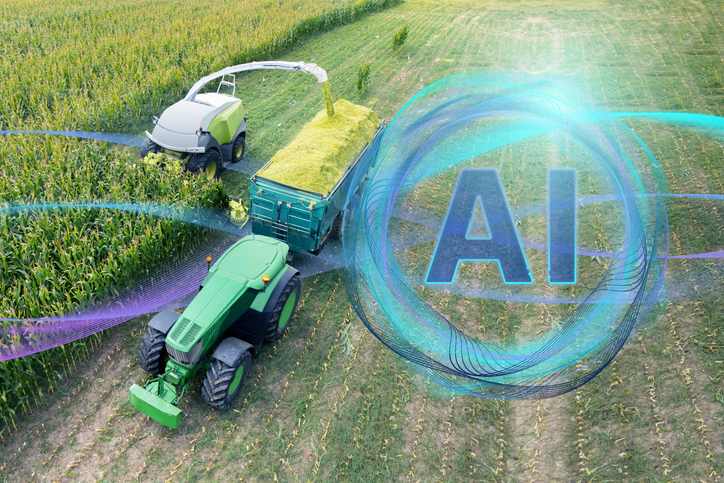
Even as AI spreads across industries, agriculture may not benefit nearly as much as other sectors, according to new research. If current disparities in AI adoption persist, productivity in the information and communications technology sector is projected to rise by about 31%, while the agri-food industry would see gains of less than 5%. The findings suggest that without broader deployment of AI in farming, the productivity gap between industries could widen further.
A report released Tuesday by the Korea Rural Economic Institute, titled "Analysis of AI Adoption and Its Impact on the Agri-food Industry," found that even if the overall AI adoption rate across all industries reaches an average of 40% over the next decade, productivity gains will vary sharply depending on how quickly each sector embraces the technology.
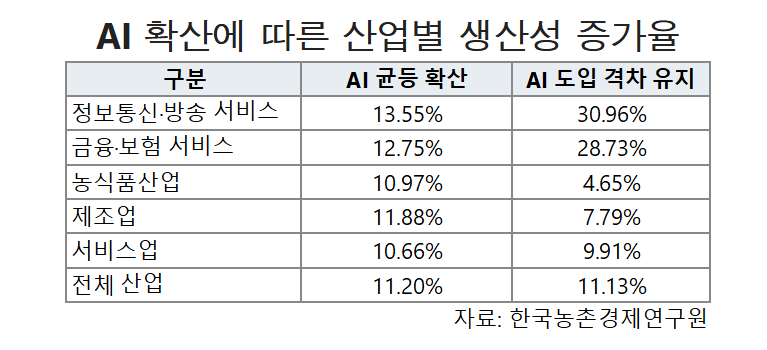
If the current adoption gap holds, productivity in the ICT and broadcasting services sector is estimated to rise 30.96%, and the finance and insurance sector by 28.73%. The agri-food industry, by contrast, would see a gain of just 4.65% — meaning the ICT and finance sectors would outpace agri-food by roughly 6.7 times and 6.2 times, respectively.
Agriculture's lag stems from its low level of AI adoption. The agri-food sector has relatively few companies using AI to begin with, and it also lacks the foundational infrastructure — skilled workers and data — needed to put the technology to use.
In 2024, the AI adoption rate in the agri-food industry stood at 4.2%, less than half the national average of 9.6% across all industries. A survey of food manufacturers found that 77.2% of respondents said they did not know how to apply AI, while 44.1% cited a shortage of skilled workers. Some 92.6% of businesses in the sector collected no data at all.
The picture could look very different if AI were deployed more evenly across agriculture. When researchers modeled a scenario in which all industries reach a 40% AI adoption rate, the agri-food sector's projected productivity gain rose to 10.97% — 6.32 percentage points higher than the 4.65% projected under the current adoption gap. The analysis indicates that even with the same workforce and facilities, the productivity benefit for the agri-food sector could more than double depending on how widely AI is adopted.
The report also found that grain and food-crop production — including rice and wheat — could be particularly vulnerable to the effects of uneven AI adoption. If labor and capital flow toward industries more aggressively embracing AI, the growth benefits for agriculture could shrink further.
When researchers factored in cross-industry movements of labor and capital, the real value-added growth rate for grain and food-crop production came in 3.08 percentage points below the productivity growth rate alone. This suggests that falling behind on AI adoption could hurt not just agricultural productivity but the sector's overall growth.
The real value-added growth rate for the agri-food industry as a whole was also lower under the persistent-gap scenario — 8.67%, compared with 10.95% if AI were adopted evenly. However, these figures reflect a modeled projection of AI diffusion over the next decade, not actual productivity gains.
Seong Jae-hun, a research fellow at the Korea Rural Economic Institute, said AI deployment tailored to the specific characteristics of agriculture and the food industry is needed. For farms, that means expanding AI tools that forecast weather, pest outbreaks and agricultural supply and demand; for food factories, it means automating processes such as product sorting and packaging.
Seong also said low-cost AI technology should be made available not only to large companies but also to small food businesses and grain and food-crop farms, with support provided for securing skilled workers and building data capacity.
adastra@heraldcorp.com