Researchers from South Korea, Japan, Canada and Taiwan participated in the 30th anniversary academic conference of the Korea Society of Natural Polymers.
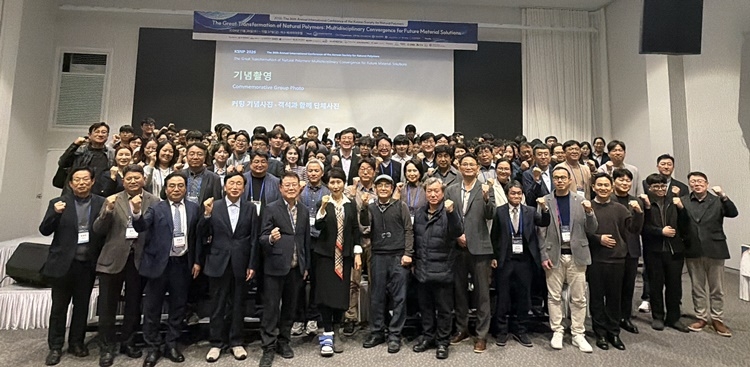
Leading global scholars in natural polymers convened in Yeosu, South Jeolla Province, to declare a convergence of green, blue, white and red biotech industries as a new paradigm for future materials in the AI era.
The Korea Society of Natural Polymers held its 36th Regular International Conference (KSNP 2026) at the Venice Hotel in Yeosu from Wednesday through Friday, marking the society's 30th anniversary.
Held under the theme "Great Transformation of Natural Polymers: Multidisciplinary Convergence for Future Material Solutions," the conference celebrated three decades of accumulated research and laid out a global vision for natural polymers converging with AI, food technology, pharmaceuticals and eco-friendly industries.
Researchers from five countries — South Korea, Canada, Japan, Taiwan and Hong Kong — participated over the three days, sharing 133 papers comprising 62 oral presentations and 71 poster presentations.
Keynote lectures featured Professor Woo-Do Baik of the University of Saskatchewan in Canada speaking on "AI-Driven Innovation in Food Processing: Opportunities and Challenges," and Professor Junichi Kadokawa of Kagoshima University in Japan presenting on "Synthesis of Polysaccharide-Grafted Functional Polymeric Materials by Chemoenzymatic Approach."
Professor Heung-Soo Shin of Hanyang University also drew significant attention with a keynote on "Engineering Living Tissues by Integrating Cell-Instructive Biomaterials and Cellular Building Blocks," as world-class scholars outlined key research directions bridging AI and biotech.
The academic sessions featured in-depth programs connecting cutting-edge technology with industry, including four core symposiums on green, blue, white and red biotech; an international session with researchers from Taiwan — National Chung Hsing University, Chang Gung University and Taipei Medical University — and Hong Kong — the University of Hong Kong; a special lecture on generative AI data analysis and vibe coding; and a joint industry-academia-research session involving the Korea Food Research Institute, Jeju National University and Sejong Food Tech Group.
The society was founded in 1996 as the Korea Chitin and Chitosan Research Society and has raised its international profile by successfully hosting the Asia-Pacific Chitin and Chitosan Symposium twice.
In 2025, it relaunched its academic journal as the Journal of Natural Polymers and changed its name, significantly expanding its research scope to cover natural polymers broadly.
On the second day of the conference, Thursday, a ceremony marking the 30th anniversary was held alongside a performance of Nanta, South Korea's signature non-verbal percussion show, fostering camaraderie among researchers from around the world.
Cheon Ji-yeon, president of the Korea Society of Natural Polymers and a professor at Suncheon National University, said the value of natural polymers grows even greater when they go beyond the excellence of the materials themselves to address real human challenges by meeting diverse fields and technologies such as AI. "I hope this international conference in Yeosu will serve as a springboard for a global leap into a new era of natural polymers, built on 30 years of deep research," Cheon said.
parkds@heraldcorp.com