Falling international prices expose market-distorting effect of maximum price regime; experts call for phased exit starting with gasoline
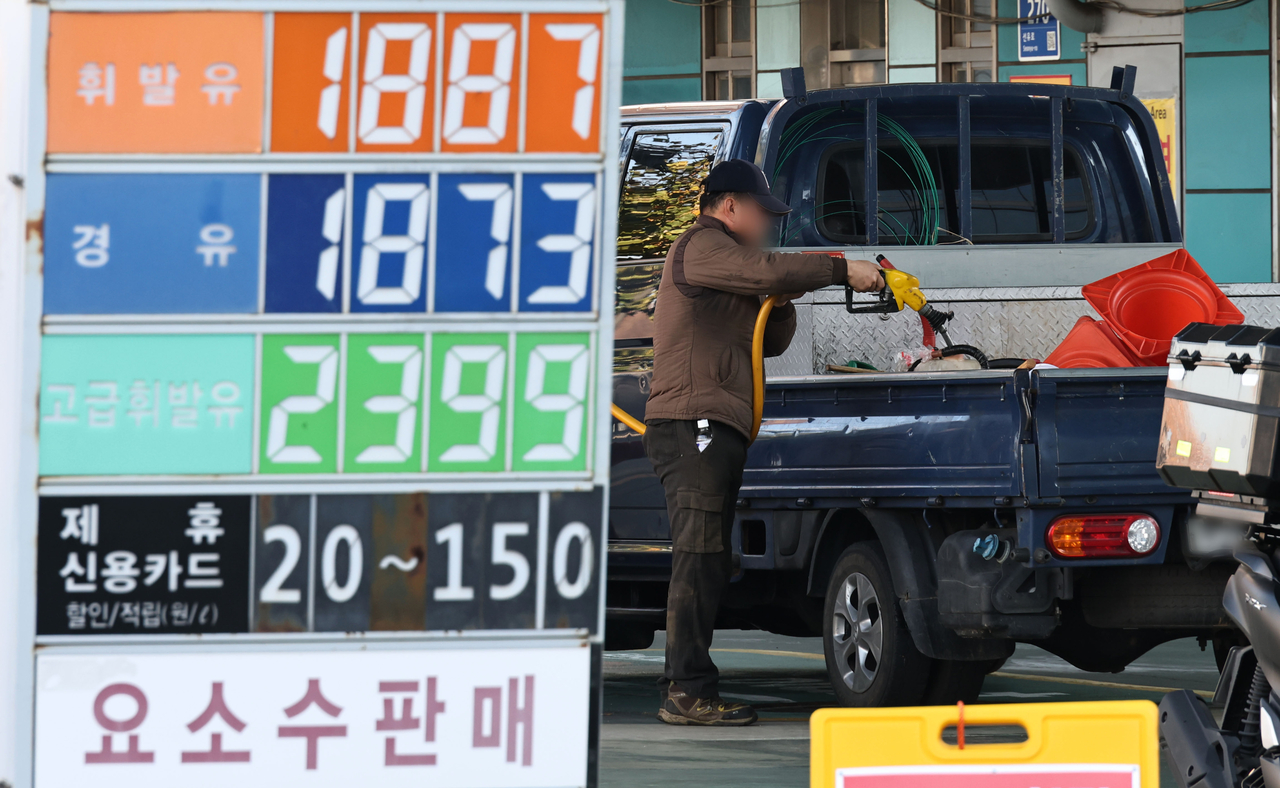
South Korean consumers paid roughly 100 won more per liter of gasoline last month because of the government's maximum price regime, according to an industry analysis.
While the price cap has helped stabilize domestic fuel costs, calls are growing for a phased exit strategy as falling international oil prices mean the regime now risks distorting the market and hurting consumers rather than protecting them.
A simulation released Sunday by the refining industry, based on the Singapore-benchmark MOPS price with refinery and gas station margins, taxes and fees applied, found that average gasoline prices at stations nationwide could be 30 to 100 won per liter lower than current levels if the maximum price regime did not exist.
Under a no-cap scenario, the pre-tax gasoline supply price for the second week of November was estimated at 959.74 won per liter — calculated by adding MOPS of 871.71 won to estimated refinery margins and other costs of 88.03 won, based on the average margin recorded in February before the Middle East war began.
Adding taxes of 793.97 won, other fees of 0.47 won, and estimated gas station margins and additional costs of 73.96 won, the projected nationwide average retail price came to 1,828.14 won per liter — 26.98 won below the actual average of 1,855.12 won recorded during that period.
The gap widens in the third week of November, when MOPS fell further to 808.14 won from the previous week. Without the price cap, the pre-tax supply price for that week was estimated to drop into the 800-won range at 896.17 won, with taxes also falling to an estimated 787.61 won.
Applying the same fees and gas station margins as the previous week, the industry estimated the nationwide average retail price would have come to 1,758.21 won — in the mid-1,700-won range — compared with the actual average of 1,855.40 won, a difference of 97.19 won.
MOPS has fallen in five of the six weeks since the first week of October, when it stood at 1,240.53 won.
Industry officials say the sustained decline in international prices has in effect removed the upward pressure on consumer prices that originally justified the cap, and are calling on the government to consider lifting it for gasoline first as part of a phased wind-down.
Minister of Trade, Industry and Resources Kim Jung-kwan acknowledged the issue in a recent broadcast appearance. "We are aware that the regime places a fiscal burden on the government and can distort the market," Kim said. "We plan to monitor trends in the Middle East and oil prices closely and work to resolve this in a timely manner."
Some warn that international oil product prices could rise again, but proposals have emerged suggesting that flexible adjustments to fuel taxes could cushion any price shock and minimize the impact on consumers.
Under current law, the transportation, energy and environment tax on gasoline can be adjusted within a range of plus or minus 30 percent of the base rate of 475 won per liter. With the current applied rate at 450 won, there is room for an additional reduction of up to 117.5 won per liter.
oskymoon@heraldcorp.com