
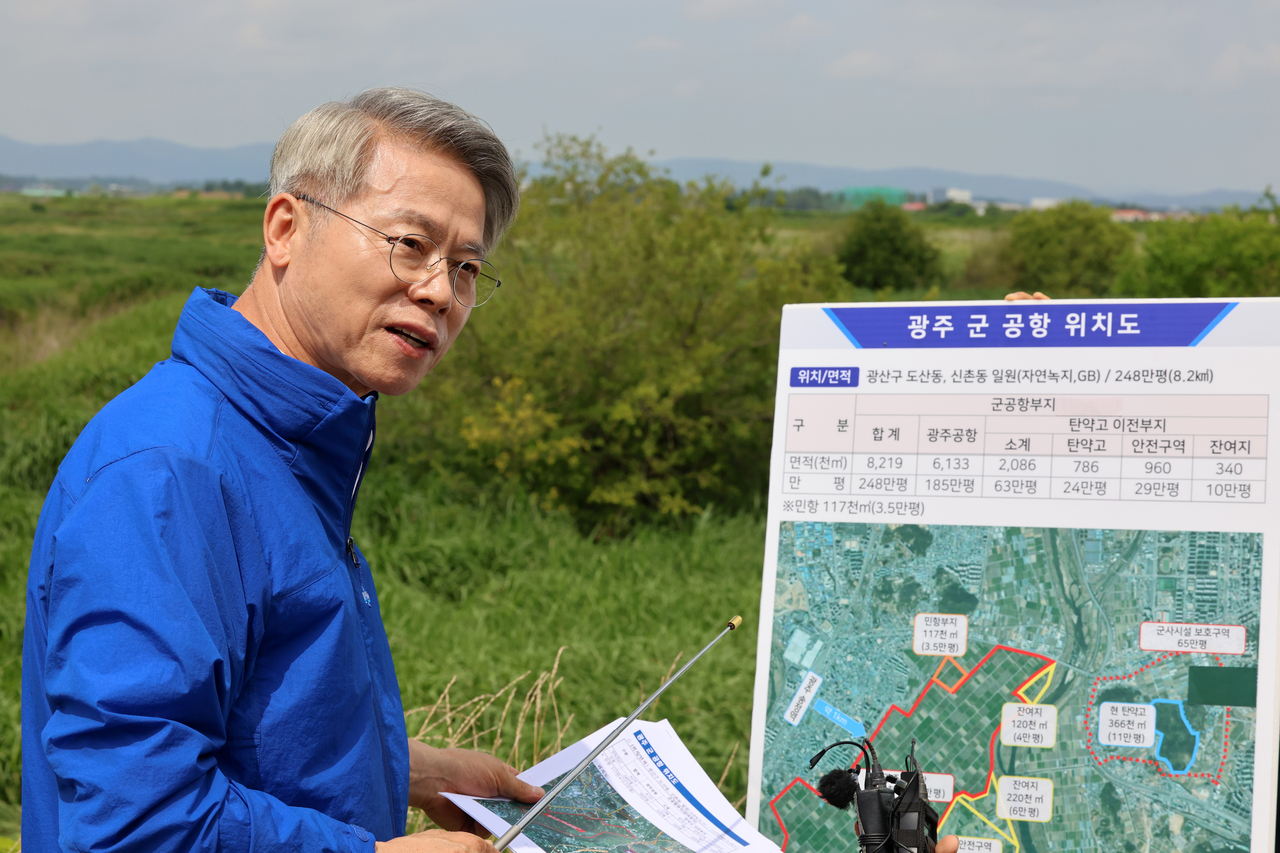
"We can build the semiconductor industrial complex even before the military airfield is fully relocated," Min Hyeong-bae, mayor of the South Jeolla-Gwangju integrated special city, said Tuesday.
Min visited the Gwangju military airfield site — confirmed as the location for the Honam-region semiconductor cluster — and said the site "requires almost no preliminary procedures, making it ideal for moving at speed." "Most of the land is state-owned and flat, which makes it perfect for building an industrial complex. There are almost no issues with community acceptance — land with these conditions is very hard to find," he said.
The government selected the Gwangju military airfield site for the Honam-region semiconductor cluster. Located about 1 kilometer from Gwangju Songjeong Station, the site encompasses the current airfield, a planned ammunition depot area and surrounding land, totaling approximately 2.48 million pyeong (1 pyeong equals 3.3 square meters), or 8.2 square kilometers.
Challenges remain, however.
Developing the industrial complex will require resolving the airfield relocation, military facility reorganization, US Forces Korea-related installations, and the handling of fuel storage facilities and pipelines.
To address these issues, the integrated special city plans to hold an inauguration ceremony for its semiconductor strategy committee Tuesday afternoon and formally launch an operational support system to oversee follow-up procedures including site preparation, power supply, water supply and permitting.
"One of the key issues related to the military airfield is the fuel storage facilities," Min said. "There had been concerns about environmental contamination given the long presence of fuel tanks, but our inspection found that the related cleanup work is nearly complete." He added that "a pipeline connected to facilities used by US forces remains in part of the site, and we also need to review how to handle that."
Min said that once the issue of Air Force training operations is resolved, work can begin regardless of whether the airfield has been relocated. "Now that the site has been decided, we must simultaneously begin securing transmission lines, power and water — that is what makes the speed-first approach work," he said.
On infrastructure requirements, Min said each semiconductor fab would need about 1 gigawatt of power, and that dual-line transmission should be considered to prevent outages. "Each fab needs about 60,000 tons of water, or 100,000 tons for stable operation. We believe connecting the pipeline would be sufficient to supply up to four fabs," he added.
He also said the essence of moving at speed is ensuring companies do not abandon projects midway. "The goal is to have the project firmly established within the terms of the president and the local government," he added.
Later Tuesday afternoon, Min visited the planned site of the Sinjangsong substation in Jangseong and Dongbok Dam in Hwasun to review plans for securing land, power and water for the semiconductor industrial complex.
The integrated special city said it would use the site inspections as an opportunity to establish a dedicated support system providing one-stop handling of permits, administrative assistance and public inquiries, concentrating its administrative resources on ensuring companies' fab construction proceeds according to their investment plans.
"The local government will support the historic decisions of the president and the central government at the highest level," Min said. "The special city will take direct responsibility for ensuring that permitting for the airfield site and the power and water projects proceed without delay."
sij@heraldcorp.com





