The Ulsan Urban Railway Line 1 tram project — the most pressing issue facing the city's ninth elected administration — has reached a crossroads, with officials weighing whether to halt or press ahead with construction.
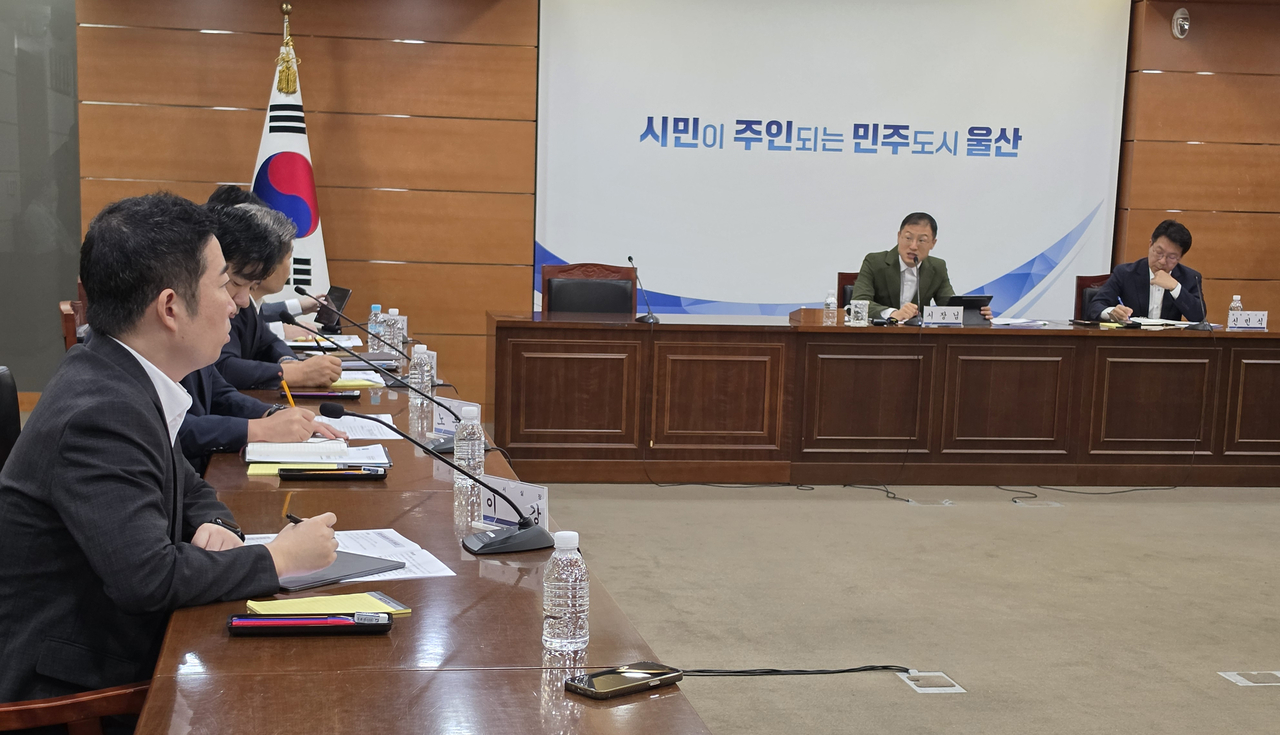
Mayor Kim Sang-uk convened an emergency meeting Monday morning at the situation room on the seventh floor of City Hall. He gathered Deputy Mayor for Economic Affairs Shin Min-sik, Chief Political Adviser Choe Hyeong-jun, Administrative Director Noh Dong-wan, Public Safety Director Park Sun-cheol, Economic and Industrial Director Jeong Ho-dong, Policy Planning Officer Kim Chang-hyeon, Transportation Director Kim Jong-hwa and Chief of Staff Lee Gang to discuss the project. The group agreed to finalize a decision on whether to proceed this week.
The meeting examined the legal and fiscal consequences of cancellation — including the return of national government subsidies and potential damages for sunk costs — as well as remedies for rising construction costs and projected operating deficits that would accompany continuation.
The project calls for building a 10.85-kilometer hydrogen-powered tram line with 15 stations between Taehwagang Station and Sinbok Intersection at a cost of 381.4 billion won ($260 million), with an opening target of 2029.
Ulsan began planning the line in April 2017, commissioning a study to establish an urban railway network. The city opted for a ground-level rail system accessible to mobility-impaired passengers and chose hydrogen fuel-cell trams that run without overhead wires, in keeping with the city's urban landscape.
Hanshin Construction was selected as the lead contractor for the consortium, and preliminary work — ground reinforcement and temporary facility installation — began April 21. Earlier, on March 5, the city signed a 63.4 billion won contract with Hyundai Rotem for the manufacture of the hydrogen tram sets, and production is now underway.
The city had planned to complete the detailed design and various impact assessments by October, obtain final project approval and move into full construction.
Those plans were thrown into doubt when Mayor Kim, shortly after taking office, signaled a review of the tram project, citing worsening traffic during construction and projected operating deficits afterward, and proposing bus rapid transit as an alternative. The stance quickly became a flashpoint in the local community.
Kim introduced an ordinance bill at the Ulsan City Council to launch a public deliberation process on the review, but the council rejected it July 16, making a formal citizen consultation process difficult to pursue.
The city also explored the possibility of terminating the contract with Hyundai Rotem and halting the project, but confirmed that was not feasible. Hanshin Construction has also indicated it will not accept a contract termination.
Following his talks with Hyundai Rotem on Friday, Kim signaled for the first time through social media that he was leaning toward resuming the project. "If the mayor has no legal authority to stop the tram project, then we must supplement it to minimize inconvenience to residents and make it genuinely beneficial," he wrote.
Before starting work Monday, Kim also hinted on his YouTube channel at pursuing a second tram line. "If the tram were extended from Songjeong-dong or Maegok-dong in Buk-gu to the main gate of Hyundai Motor Company, workers would use it heavily," he said. "Investing in areas with insufficient infrastructure is the balanced-development approach that raises the overall quality of life for all residents."
Ulsan Urban Railway Line 2 is a planned 13.55-kilometer line between Buk-Ulsan Station and Yaeum Intersection in Nam-gu, targeting a 2032 opening.
At Monday's meeting, Kim pointed out to senior directors that contracts had been signed before environmental impact assessments and feasibility reviews were completed. Even so, he set Friday as the deadline for a final decision on whether to proceed with the tram project, drawing close attention from across the city.
cityblue@heraldcorp.com