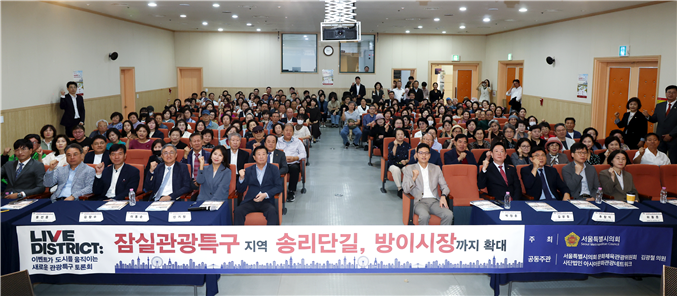
![South Gyeongsang Province Governor Park Wan-su presides over an expanded senior staff meeting at the provincial government conference room on Monday. [South Gyeongsang Province]](https://wimg.heraldcorp.com/news/cms/2026/08/10/news-p.v1.20260810.35ff3303a9e94e3eb8b95cc83cd1d396_P1.jpg)
South Gyeongsang Province Governor Park Wan-su said Monday that the government's discussions on consolidating and relocating public institutions must align with the principles of regional-led growth and balanced national development. At an expanded senior staff meeting, he flagged the growing burden on local finances from central government policy projects and called for preemptive action on a range of livelihood issues — including reform of provincial agencies, cooperation with Busan on metropolitan affairs, and responses to drought, drinking water shortages and rising interest rates.
Presiding over the meeting at the South Gyeongsang provincial government conference room, Park said recent discussions on adjusting the functions of the Korea Land and Housing Corp. (LH), consolidating power generation public enterprises and port authorities, and merging the Army, Navy and Air Force academies must give sufficient weight to each region's historical identity and the goal of balanced national development.
"Policy must be pursued in a way that harmonizes with the government's own agenda of regional-led growth and the second round of public institution relocations," he said. He added that the proposed consolidation of the Naval Academy and its potential relocation to another region warranted reconsideration.
Park noted that Jinhae has long served as a core base for the Republic of Korea Navy, and said the region had already suffered considerable loss with the earlier relocations of the Army University and the Naval Operations Command. The province's historical identity and the voices of its residents must be fully reflected in any decision, he said, and asked relevant departments to actively present the province's position to the government in coordination with political circles.
On the strain that central government policy places on local finances, Park said that as the local cost burden from centrally decided projects keeps growing, local governments will inevitably have less room to manage their finances in ways suited to regional conditions. He directed officials to boldly restructure low-performing, duplicative or wasteful projects during next year's budget process, and to weigh both the effectiveness and the local cost burden of government grant competitions before committing to them strategically.
Park also urged faster progress on internal reform and restructuring of provincial agencies. He named the Gyeongnam Technopark, the Gyeongnam Development Corp. and the Busan-Jinhae Free Economic Zone Authority, directing each to examine key problems and report back promptly with reform plans aligned with the province's administrative direction.
On cooperation with Busan, Park called on officials to conduct thorough working-level consultations on shared priorities — including securing national budget allocations for next year and coordinating metropolitan administration — so that he and the Busan mayor can meet to reach a final agreement.
On livelihood issues, Park directed officials to prioritize drinking water supply for island communities and areas not connected to the public water network, and to deploy all available resources — including firefighting vehicles, fire department equipment and, if necessary, military assets — to prevent agricultural losses from spreading across rice paddies, upland crops, orchards and livestock operations. He said drinking water safety must be the top priority, taking into account both water quality and residents' concerns, and asked that on-site welfare checks for low-income and vulnerable groups during the heat wave continue without interruption.
On the financial burden on households and businesses from the benchmark interest rate increase, Park asked departments covering the economy, welfare and industry to jointly develop support measures, with a focus on vulnerable groups and small and medium-sized enterprises.
Park urged officials to actively convey the province's position on government policy while responding proactively to the hardships that residents and businesses are feeling from the drought and rising financial costs.
ook967@heraldcorp.com