19 key items to be supplied at 1.6 times normal levels
103 billion won earmarked for agricultural discounts
Policy loans for low-income groups quadrupled from last year
Fuel subsidies extended, catastrophic medical cost support expanded
![Attention has turned to Chuseok staple prices as a record heat wave continues about a month before the holiday. Shown is a fruit display at a hypermarket in Seoul. [Yonhap]](https://wimg.heraldcorp.com/news/cms/2026/09/01/rcv.YNA.20260813.PYH2026081316010001300_P1.jpg)
The government plans to release a record 183,000 tons of 19 key Chuseok staples — including napa cabbage, radish, apples and beef — ahead of the holiday. It will also commit a record 103 billion won ($75 million) to discount support for agricultural, livestock and fishery products, cutting consumer prices by up to 50 percent. Small and medium-sized enterprises and small business owners will receive 43.4 trillion won in holiday financing, while policy loans for low-income households, vulnerable groups and youth will more than quadruple from last year.
The government announced the measures Tuesday at a Cabinet meeting under the banner of a "Chuseok livelihood stabilization package." The plan focuses on easing household budget pressure from accumulated price increases while helping small business owners and vulnerable groups struggling with high interest rates and elevated energy costs.
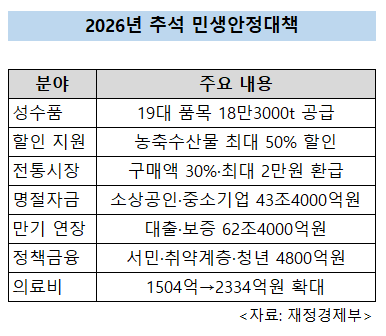
In the three weeks before Chuseok — from Thursday through Sept. 23 — the government will release 183,000 tons of 19 key staples, equivalent to 1.6 times normal supply levels and the largest volume on record.
Agricultural products will be released at 2.5 times the normal volume, totaling 49,000 tons. For vegetables such as napa cabbage, radish, garlic, onions and zucchini, the government will draw on stockpiles and contract-farmed supplies to release 18,000 tons. Apples and pears will be supplied through concentrated releases of National Agricultural Cooperative Federation contract volumes, with 32,000 tons available — more than three times the usual amount.
Livestock slaughter and shipment volumes will expand to 111,000 tons, 1.3 times the normal level, comprising 22,530 tons of beef, 67,000 tons of pork and 16,500 tons of chicken. Eggs, which have seen recent price instability, will be supplied at 4,914 tons — 2.4 times the normal volume — with fresh eggs imported weekly until Chuseok.
Forest products such as chestnuts and jujubes will be supplied at 2,480 tons, nine times the normal level. For seafood — including pollock, mackerel, squid, hairtail, yellow croaker and dried anchovies — the government will release 20,000 tons from its stockpiles to traditional markets and hypermarkets at prices up to 40 percent below market rates.
The government will commit 103 billion won to discount support for agricultural, livestock and fishery products, up 13 billion won from last year. Of that total, 59 billion won is earmarked for agricultural and livestock products and 44 billion won for seafood.
At both online and offline retailers, agricultural and livestock products such as apples, pears and beef will be discounted by up to 40 percent through a combination of government and retailer contributions. Key seafood items including pollock, mackerel and dried seaweed will be sold at up to 50 percent off. Discount limits are set at 20,000 won per person per week at each retailer.
At traditional markets, shoppers who make purchases of agricultural, livestock and fishery products from Sept. 16 through Sept. 20 will receive about 30 percent of their spending back in Onuri gift vouchers. The number of markets participating in the agricultural and fishery product cashback events has been expanded from 200 each last year to 300 this year. Customers spending at least 34,000 won will receive 10,000 won back, while those spending 67,000 won or more can receive up to 20,000 won.
Gift sets featuring fruit, Hanwoo beef and ritual offerings will be discounted by up to 50 percent, and seafood gift sets by up to 53 percent. In partnership with the food industry, more than 4,700 processed food items — including ramyun, tofu and bread — will be offered at discounts of up to 64 percent. An AI-based "smart shopping app" that gives consumers real-time prices and discount information for agricultural and livestock products at nearby stores will launch as a pilot in five regions in September.
The government rolled out the large-scale price stabilization measures because, while the pace of inflation has eased somewhat, accumulated price increases continue to weigh on household finances. Consumer price inflation rose to 3.1 percent in May and 3.2 percent in June before easing to 2.8 percent in July. The government expects August inflation to be pushed up by about 0.6 percentage points due to a base effect from last year's telecommunications fee discounts.
Small business owners and SMEs will receive a record 43.4 trillion won in new loans and guarantees. Loans and guarantees worth 62.4 trillion won maturing around Chuseok will have their terms extended by one year for borrowers in good standing. An additional 2.5 trillion won in conversion guarantees — which extend repayment periods for small business owners using guarantee-backed loans from regional credit guarantee foundations by up to five years — will be made available through the end of the year.
Value-added tax early refund filings will be paid out three days after submission, ahead of the statutory nine-day deadline.
The government will also encourage early payment of public procurement contract fees and subcontracting payments before Chuseok. Businesses with fewer than 30 full-time employees will be allowed to defer employment and industrial accident insurance premium payments for October through December, while small business owners will be permitted to pay electricity bills in installments over up to six months and gas bills over four months.
Policy loans for low-income households, vulnerable groups and youth will expand more than fourfold, from 114.5 billion won last year to 480 billion won this year. Over September and October, the government will supply 400 billion won through the Haetsal Loan special guarantee program, 50 billion won through Haetsal Loan Youth and 30 billion won through an illegal private lending prevention loan.
Interest rates on loans to employers and workers for settling unpaid wages will be cut by 0.5 to 1.0 percentage points through the end of October. The processing period for government advance payments — under which the state pays overdue wages on behalf of employers — will be shortened from 14 days to seven.
To ease the burden of high fuel costs, fuel-linked subsidies applied to diesel and compressed natural gas for freight and passenger vehicles and coastal cargo ships, as well as tax-exempt fuel for farmers and fishermen, will be extended through the end of the year. The budget for catastrophic medical expense support for low-income households facing excessive medical bills will be expanded by 83 billion won, from 150.4 billion won to 233.4 billion won.
fact0514@heraldcorp.com