Hecto unveils blueprint for global remittance service using CPN
Affiliate structure separates VASP and foreign-exchange licenses
Virtual asset transfer registration in the works ahead of December law revision
Ministry of Finance and Economy cites legislative gap in foreign exchange law
![[Provided by Hecto Financial]](https://wimg.heraldcorp.com/news/cms/2026/09/01/news-p.v1.20260901.39b24d60e5d84b81b2f951c250320605_P1.png)
Integrated fintech firm Hecto has drawn attention with a blueprint for receiving dollar stablecoins from Circle and settling them in won domestically — raising questions about whether such a business model can take root.
The global stablecoin remittance structure Hecto envisions divides responsibilities among its affiliates Hecto Wallet One and Hecto Financial, along with partner Circle. When an overseas customer sends USDC, Ohai Wallet — the custodial wallet operated by Hecto Wallet One, a registered virtual asset service provider (VASP) — receives it, verifies customer information, confirms the source of funds and conducts anti-money laundering screening.
The process uses Chainalysis Reactor, an on-chain data analytics firm, along with its Know Your Transaction service to verify counterparties and trace fund flows. Deposits from unauthorized exchanges or unidentified wallets are restricted or returned, and any suspicious transactions are flagged for suspicious transaction reporting.
The USDC is then converted to dollars through Circle's global payment infrastructure, the Circle Payments Network (CPN), with Circle transferring the funds to Hecto Financial's foreign-currency account. Hecto Financial then exchanges the dollars into won and settles the amount with domestic merchants. Hecto Financial joined CPN as an official partner in February and has since been conducting proof-of-concept testing.
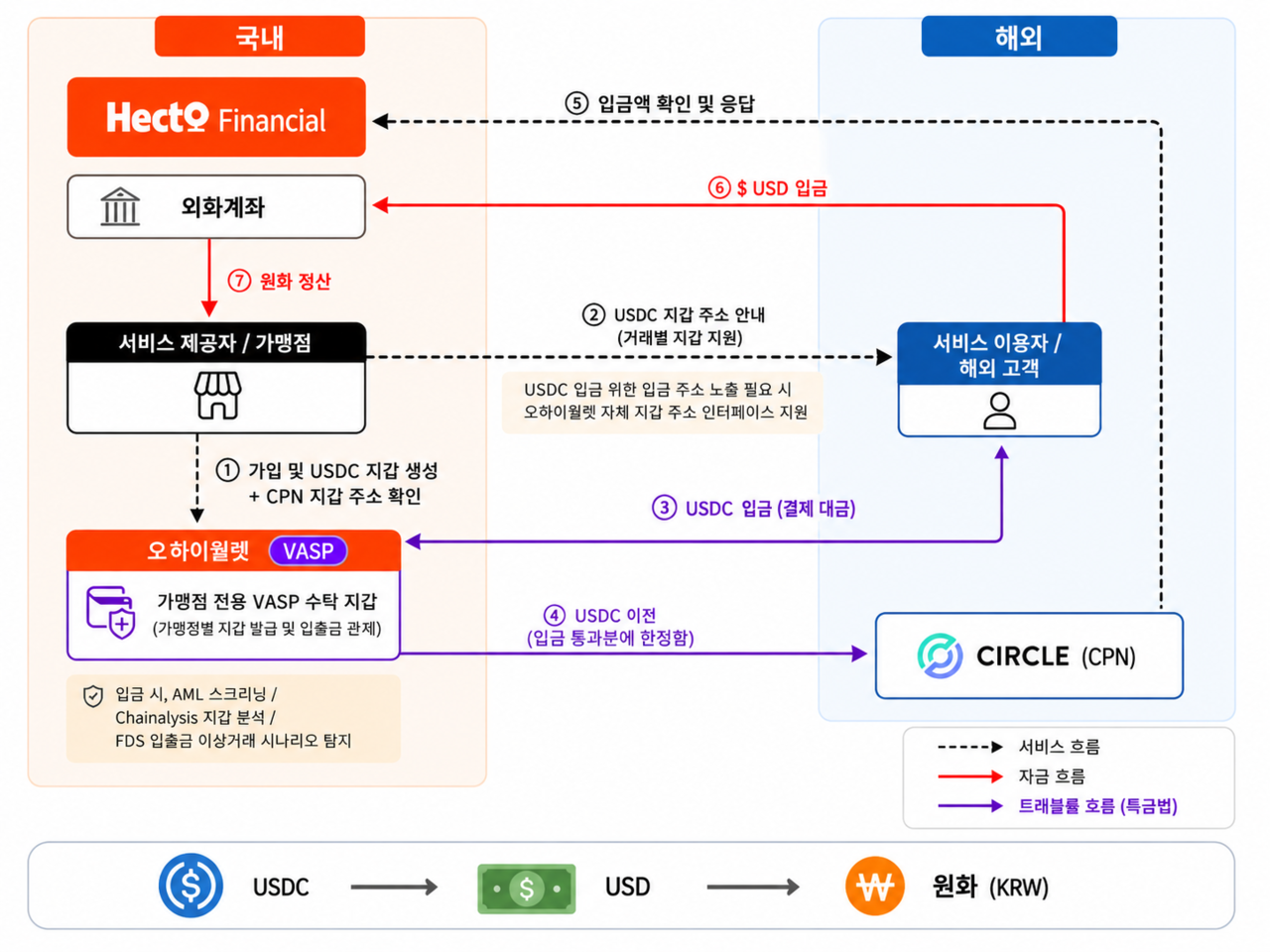
The central issue is that a single service would link activities requiring separate licenses — stablecoin receipt, off-ramping to fiat currency, foreign exchange remittance and domestic settlement. Hecto Wallet One has completed its VASP registration but does not hold a foreign exchange license. Hecto Financial, by contrast, holds registrations for specialized foreign exchange business and small-sum overseas remittance — making it unclear under current regulations whether this division of roles is permissible, and requiring further review.
An official at the Ministry of Finance and Economy said there is a legislative gap in the relevant provisions of the Foreign Exchange Transactions Act. "Structures that repeatedly convert between dollars and digital assets involve ambiguous areas in the current process," the official said.
The official added that while Hecto Wallet One is a VASP, it does not hold a foreign exchange license — that sits with Hecto Financial. "We also need to examine whether foreign exchange operations can be conducted in this setup, and whether off-ramping stablecoins into dollars is permissible," the official said.
The official further said that even when off-ramping is done through Circle, foreign exchange is ultimately involved in the structure. "This can only be resolved once legislation in the second phase addresses how stablecoins will be regulated under foreign exchange law," the official said.
The Foreign Exchange Transactions Act revised earlier this year also falls short of directly governing this type of stablecoin remittance and settlement model. The amendment focuses on tracking cross-border capital flows by requiring reporting of digital asset transactions when they cross national borders.
Hecto Wallet One plans to pursue registration as a virtual asset transfer service provider in time for the revised law's implementation in December. However, observers note that with the legal status of stablecoins and their treatment in foreign exchange transactions still undefined, the business model could intersect with multiple laws beyond the Foreign Exchange Transactions Act — including the Electronic Financial Transactions Act.
Hecto is currently in discussions with financial institutions to identify operational constraints and the permissible scope of its business, including minimizing slippage during fund receipt.
Meanwhile, Hecto highlighted its remittance business at a global payments seminar held Wednesday at the JW Marriott Hotel in Seocho-gu, Seoul. Ryu Chun, deputy chief of Hecto Wallet One, said that while receiving stablecoins is straightforward, the actual settlement process requires verifying the source of funds, the purpose of payment and how taxes should be handled. "The area where we can commercialize first is inbound remittance — receiving stablecoins from overseas," Ryu said.
Ryu added that the service could later expand from stablecoin custody and transfer into merchant stablecoin settlement, and ultimately develop into real-time payments. "In the first stage of inbound remittance, it is important to establish a framework for sales reporting and foreign exchange reporting," he said.

kyoung@heraldcorp.com